We run the mine against the numbers we sign for
Production, equipment, safety, environment, staffing and cost, managed as one operation. Payment can be a fixed fee, a share of the gain, or a mix, depending on where the risk sits.
Eight cooperation models
| Model | How it works |
|---|---|
| KPI turnkey operation | Output, technical indicators and cost control are guaranteed against agreed KPIs. |
| Profit sharing | Revenue is shared on the basis of output, recovery and cost efficiency. |
| Tailored model | A flexible agreement built around the specific project. |
| Labour services | Management and key technical staff are supplied to the owner's organisation. |
| Fixed cost contract | Operation is contracted for a fixed fee. |
| Cost plus profit sharing | Base cost is reimbursed and incremental profit is shared. |
| Product sharing | Mineral products are allocated in agreed proportions. |
| Equity participation | Xinhai takes a stake, typically in expansion projects. |
Six capabilities the contract rests on
- Qualification framework covering design, construction and operation
- Experienced project managers on site
- Technology driven operation supported by test work and design
- Internal coordination instead of multi-supplier friction
- Standardised safety framework embedded in daily production
- Steady delivery from construction into high value operation
Operating references
Each figure below is the outcome reported for that project in the Xinhai contract mining and operation brochure.
2 Mt/a spodumene plant, recovery lifted from 59.5% to 69%
EPC+M+OGuinea3,000 t/d gold mine and plant, overall recovery around 93% at 1.2 g/t feed
EPC+M+OMongolia3,500 t/d iron plant, concentrate at or above 65% Fe, yield around 31%
EPC+O4,000 t/d molybdenum mine, fully mechanised development fleet
C+M+O0.5 Mt/a wollastonite mining contract, dilution held below 5%
O, fixed cost500 t/d gold project, mining and processing optimised, local team trained
EPC+OWhat we manage
- Production. Reaching design output and grade, then optimising the process.
- Equipment. Maintenance regimes, fault diagnosis and availability.
- Safety. A standardised framework built into daily production rather than audited afterwards.
- Environment. Green mine practice and tailings facility management.
- People. Building and training the local team.
- Cost. Cost control and economic analysis against the operating model.
Common questions
Which cooperation models are available?
Does Xinhai operate mines it did not build?
What is managed under an operation contract?
EPC, EPCM, EPC+O, C+M+O, O: what each boundary actually transfers
The letters are not a price menu. They are a map of who carries which risk.
Ask three suppliers for "an operating contract" and you will get three different scopes back. The gap is not service level. It is the point where engineering responsibility stops and somebody else's starts, and that point decides who pays when the ore stops behaving.
| Scope | Who owns the flowsheet | Who runs the operation | Where the boundary has been drawn |
|---|---|---|---|
| EPCM | Contractor designs and manages; owner signs the purchase orders | Owner | Offered at group level |
| EPC | Contractor, up to handover | Owner, after handover | Italy fluorite |
| EPC+O | Contractor, and it keeps living with the design | Contractor | Mongolia iron; Zimbabwe gold |
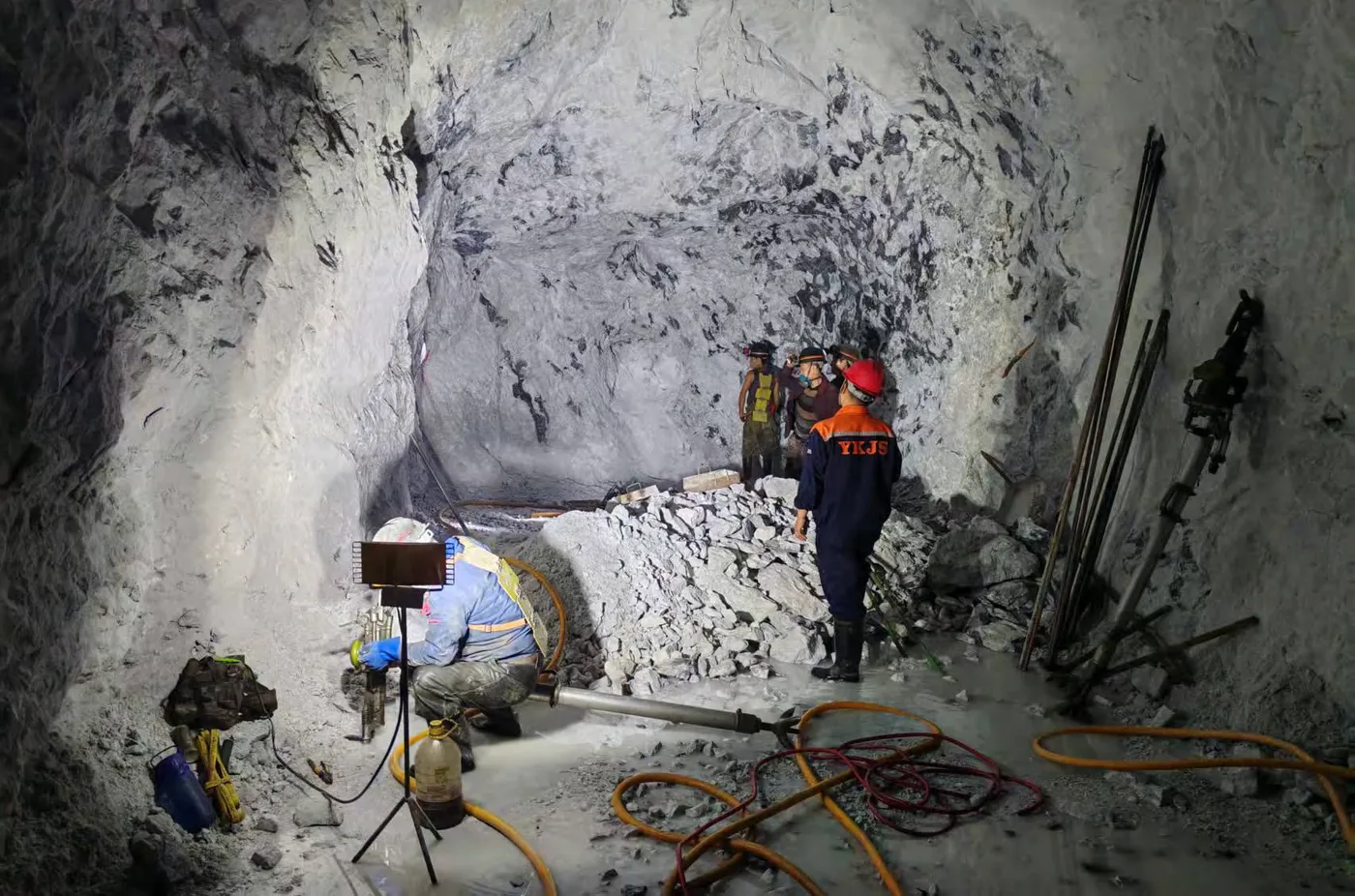
| C+M+O | Outside the contract | Contractor: mine development works — declines, ventilation shafts, the underground infrastructure that opens the next level — plus the production itself. No concentrator in scope | Hebei molybdenum |
| O only | Outside the contract | Contractor: production mining only. Development works sit outside the contract. No concentrator in scope | Jiangxi wollastonite |
| EPC+M+O | Contractor, whole life | Contractor | Guinea gold; Zimbabwe spodumene |
Read the third column before the fourth. The C in C+M+O is mine construction: driving the declines and ventilation shafts that open ground ahead of the mining faces, which is why the Hebei molybdenum contract runs a fully mechanised development line — drilling, mucking, support and ventilation — while the Jiangxi wollastonite contract is production mining under a fixed-cost fee and nothing else. Both are mine-side contracts with no concentrator in scope, and a supplier who blurs that distinction in a tender is telling you something about how the rest of the scope will be drawn.
EPCM is an agency relationship, not a wrapped price
The first two rows differ by more than one letter. Under EPC the contractor holds the supply and construction packages itself and prices the interfaces between them into a single number. Under EPCM the owner holds those packages directly and the contractor manages them as agent, so the owner keeps the interface risk, the variations and the claims. Neither structure is safer in the abstract. EPCM keeps you in control of procurement and leaves you exposed to every gap between packages. EPC hands the gaps to one party, which then prices them. The mistake is asking for EPCM pricing and EPC certainty in the same tender, because no bidder can give you both and the ones who say yes have simply not priced the gaps yet.
The split that quietly costs money
Separate the design from the operation and every recovery shortfall becomes a commercial argument instead of an engineering one. The flowsheet was signed by one party. The shift log is written by another. Neither can change the grind size without the other's consent, so nobody does, and the plant runs at whatever the weakest interface allows.
That's the honest case for bundling, and it is also the honest case against it. If your team already knows the orebody better than any outsider will in the first year, buy turnkey delivery or design and keep the operation. Bundling is worth paying for when the ore is unfamiliar, when the ramp-up curve matters more than the day rate, or when the same party needs the authority to change a reagent scheme and the exposure to be wrong about it.
What to have ready before you ask anyone to price an operating contract
Seven inputs decide whether you get a real number or a placeholder.
Most enquiries arrive with a location, a mineral and a target tonnage. That is enough for a conversation and not enough for a number. Here is what actually moves a proposal from indicative to bankable, and who has to produce each piece.
1. A resource and reserve statement under a recognised code
JORC and the CIM Definition Standards, the latter incorporated into NI 43-101, define a reserve as the economically mineable part of a measured or indicated resource, including diluting materials and allowances for losses, established by pre-feasibility or feasibility study through the Modifying Factors: mining, processing, metallurgical, infrastructure, economic, marketing, legal, environmental, social and governmental. Read that list again. Several of those factors are things an operating contractor influences directly, which is why the reserve statement, not the exploration press release, is the document a contract gets priced against. It comes from your Competent or Qualified Person. Not from us.
2. Samples that represent the mill feed, not the highest-grade intersection
CIM leading practice asks that metallurgical samples be judged against spatial distribution, lithology and alteration, mining phase, grade distribution across every payable and penalty species, and mineralogical domain, with emphasis on the parts of the deposit that drive project economics. Size distribution, storage time, storage conditions and transport can all change what a metallurgical sample tells you, and CIM asks that the effect be appraised before a sample is accepted for test work. A drum of core that has sat in a yard through two wet seasons can flotation-test like a different orebody. Ship fresh material, and ship it from the zones you will mine in years one and two.
3. The rest of the package
- Assay suite. Payable elements plus the penalty ones. Arsenic, fluorine, chlorine, magnesium, organic carbon and clay content can each redirect a flowsheet, and each is easy to leave off an assay request.
- Baseline data, if the plant already runs. Mass balance, availability and downtime causes by equipment class, reagent consumption, blend history. Without a measured baseline there is nothing to write a KPI against.
- Site envelope. Grid capacity or generation plan, raw water source and seasonal reliability, altitude and ambient temperature range, rainfall season length, road weight limits and port distance, camp and local labour law.
- Tailings. Remaining capacity, deposition method, permit status. TSF capacity is a hard constraint on any expansion and it is usually the last item checked.
- Authority. Who signs off a flowsheet change, who holds the permits, whether an offtake or lender covenant restricts what the operator may alter.
Xinhai reports roughly 200 test programmes a year across more than 70 ore types, run through a CNAS-accredited laboratory and a pilot-scale facility, and its design institute integrates 17 disciplines. That capacity only helps if the sample on the bench resembles what the mill will eat. Start at test work and research before you start at price.
The clauses that decide whether an operating contract works
Scope letters set the boundary. These paragraphs decide what happens when reality crosses it.
Once the boundary is agreed, the argument moves into the contract text. The clauses below are the ones that get tested, usually inside the first year and usually under time pressure. Written before mobilisation they cost nothing. Written after an incident they cost the relationship.
Definitions that should not be left to custom
- The baseline. Name the reference period, the data source and the person who reconciles it. A KPI without a stated baseline is an opinion with a number attached to it.
- The feed envelope. An operator can be held to a recovery at a stated feed grade, hardness and mineralogy. It cannot be held to that recovery once the feed leaves the envelope. Write the envelope down, and write down what happens to the KPI when feed sits outside it for a defined number of shifts.
- Availability against utilisation. Two different numbers, routinely swapped in tenders. Fix the formula, the scheduled-maintenance carve-out, and the log or meter the figure is read from.
- Consumables and power. Reagents, grinding media, liners, fuel and electricity move a cost per tonne further than most fee negotiations do. Say who buys each of them, who carries price escalation, and who funds the spares float.
- Change control. Which flowsheet changes the operator may make alone, which need the owner's signature, and how long the owner has to answer. An approval clause with no clock on it is a veto.
- Stop-work authority. The party running the shift has to be able to stop the shift. That one is not tradeable in either direction, and it belongs in the same paragraph as the production KPI so that the two are always read together.
The exit belongs in the scope
Every operating contract ends, and the handback is the clause drafted last and read first. Settle up front what returning the operation in working order means: trained crews with a documented competency record, standard operating procedures kept current rather than filed, environmental monitoring and compliance records, maintenance and calibration history, a spare parts register that matches what is actually on the shelf, and the process data in a format the owner's own system can open. Then settle who owns the improvements. A reagent scheme, a blending rule or a control narrative developed during the term is worth more than the wear parts, and it is the item most often left unassigned.
Those clauses only bite once you know which of the management lines listed further up this page actually cross the boundary, and they do not all cross at the same moment. Safety crosses on day one, because stop-work authority follows whoever is running the shift and cannot be held by a party that is not on site. Of the figures reported on this page, only production and equipment are reported against a measured operating record, which is why they are the easiest two to name in a KPI clause without further drafting. A KPI written against training, safety or environmental performance works just as well. It just needs the clause to name the reference record it is read from, and the party who reconciles it — the competency record and the environmental monitoring records the handback clause above already asks for are exactly that kind of record. Environmental management and cost control are managed day to day by the operator in an operation contract, as the list further up this page sets out, while the owner keeps the permits, the tailings facility licence and the capital budget — so what the text has to define is which decisions the operator may take inside that envelope, not who owns the line.
One distinction to keep straight while you draft. At group level Xinhai contracts under EPC, EPCM, subcontracting, joint venture, performance-based operation and maintenance, collaborative management and customised strategic cooperation; those describe how a whole project is delivered. For a mine or plant operation specifically, the eight models at the top of this page are the ones that get priced. Ask for the second list when the scope is operation, and the first when it is delivery.
When a contract operation is the wrong answer
And the four judgement errors that put owners in the wrong contract.
Contract operation isn't the right route for every mine. The disqualifiers are worth publishing, because spotting one early saves you a mobilisation you cannot unwind.
- The resource confidence is not there yet. No reserve, no defensible tonnage and grade basis, no contract worth signing. Fund the drilling and the study first.
- The problem is mineralogy, not management. When recovery falls because the ore changed, an oxidised zone, more clay, finer liberation, no operating team can KPI its way back. What fixes it is a variability test programme and a flowsheet change. An operator hired to fix a metallurgical problem will simply be the party that fails at it.
- You want the capability but not the handover. Then what you want is the labour-services model listed on this page, not an operating contract: staff move to you, control does not move to us.
- Short remaining life. Mobilisation, training and a standardised safety framework take time to pay back. Against a thin remaining reserve, that arithmetic does not close.
- Governance forbids it. Joint venture terms, lender covenants or a state partner may make operational control non-transferable, whatever the commercial logic says.
Four judgement errors worth checking for
Writing KPIs against nameplate instead of a measured baseline. Look at what the reported Zimbabwe spodumene figures are actually measured against. Recovery moving from 59.5% to 69% is a before-and-after against the plant's own record; equipment utilisation at 95.7% and concentrate grade at or above 5.5% are both plant-measured figures rather than design values. Mill throughput, reported at 7.6% above design capacity, is the one measured against the nameplate figure rather than against a baseline — which makes it a fair acceptance test at handover and a poor operating KPI afterwards, because the design number does not move when the feed does. If a proposed KPI cannot be computed from a named operating record against a stated reference period, it will be litigated instead of measured.
Pricing tonnes when you sell metal. Dilution sits inside the reserve definition for a reason. A fixed-fee mining contract with no dilution ceiling pays for movement, not for grade, and the mill discovers the consequence downstream.
Comparing bids that are not the same scope. A cost per tonne only compares across bidders once you have normalised who buys the reagents, who carries the power bill, who funds the spares float and who owns availability risk during ramp-up.
Reading the reserve statement as a production plan. It is an economic classification made at a point in time, by the judgement of the Competent or Qualified Person(s) on the Modifying Factors. Grade control, blending and stockpile policy decide what the mill actually receives, and those are operating decisions, revisited weekly.
Uncertain which of these applies to you? The fastest way through is to put the flowsheet, the last twelve months of operating data and the reserve basis in front of a process engineer. Our project record shows the scope shapes we have run, and technical strength shows what sits behind the operations team. If it turns out you do not need a contract operator, we'd rather say so at the enquiry stage.
Sources
External references for the industry context on this page. Project figures come from our own project brochures.
JORC Code, 2012 Edition (Joint Ore Reserves Committee, AusIMM / AIG / MCA)Clause 29 defines an Ore Reserve as the economically mineable part of a Measured and/or Indicated Mineral Resource that includes diluting materials and allowances for losses, defined by studies at Pre-Feasibility or Feasibility level that apply the Modifying Factors; Clause 9 requires a Public Report to be based on and fairly reflect documentation prepared by a Competent Person.
CIM Definition Standards for Mineral Resources and Mineral Reserves (Canadian Institute of Mining, Metallurgy and Petroleum, 10 May 2014)Defines Modifying Factors as considerations used to convert Mineral Resources to Mineral Reserves, including mining, processing, metallurgical, infrastructure, economic, marketing, legal, environmental, social and governmental factors, and requires estimates to be prepared by or under the direction of a Qualified Person as defined in NI 43-101.
CIM Leading Practice Guidelines for Mineral Processing (CIM Council, November 2022)Lists the criteria for sample description and representativity as spatial distribution, rock type distribution (lithology, alteration, geotechnical characteristics), mining phase, grade distribution of all economic mineral species considering credits and penalties, and mineralogical domains; states samples should emphasise the parts of the deposit critical to project economics, and that size distribution, storage time, conditions and transportation affect metallurgical sample quality.
Tell us the mine and the target, and we will propose a model.