
Three institutes and five centres
The research structure is what makes a single contract across test work, design, manufacturing, construction and operation possible in the first place.
The three institutes
Mine research institute
Ore characterisation and process innovation across more than 70 ore types, with a CNAS accredited laboratory and an industrial test plant, running roughly 200 test programmes a year.
Mine design institute
Geology, mining, processing, civil, electrical, automation and steel structures across 17 disciplines and 11 departments, with more than 300 specialists averaging over 20 years of experience and more than 300 delivered projects.
Intelligent equipment institute
A 110,000 m2 production area with more than 200 patents in large intelligent mining equipment, capable of supplying the complete main and auxiliary equipment set for plants up to 50,000 t/d.
The five research centres
Pilot plant research centre
Bench to semi-industrial testing across crushing, grinding, flotation, gravity, magnetic separation and dewatering. Designated a provincial key laboratory and a municipal key laboratory.
Underground backfill test centre
Classification, dewatering, mixing and batching technology, rheology testing, thickening optimisation, backfill system design and automated one-touch backfill.
Physical and chemical inspection centre
Non-destructive testing by radiographic, ultrasonic, penetrant, magnetic particle and visual methods, with ISO 9712 certified personnel.
Wear resistant rubber centre
Wet process wear resistant rubber technology for pump liners, impellers, cyclones and mill liners, developed in house.
Automation research centre
Mine automation and digitalisation, including 5G, AI and IoT applications, digital twins and data analysis, from planning through EPC implementation.
Manufacturing bases
Advanced materials, mining equipment and modular prefabrication bases, integrated with 5G and industrial IoT infrastructure.
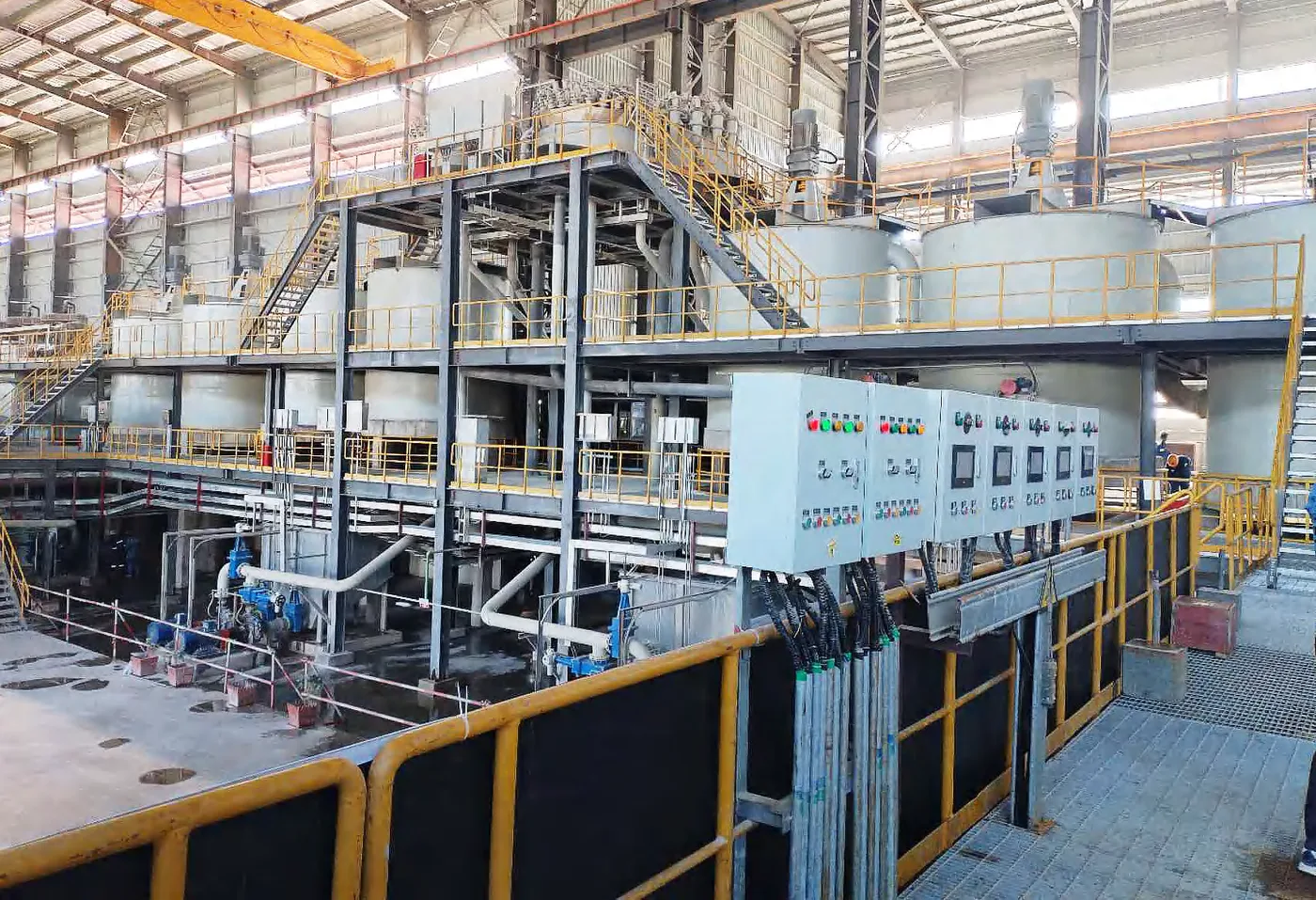
ManufacturingWhat this means on a project
- Test engineers, designers and commissioning engineers in one organisation
- Wear parts and pump liners developed against our own duty data
- Instrumentation and control developed with the process, not retrofitted
- Non-destructive testing on fabricated equipment before it ships
How to check a claim like this one
Every contractor's about page says in-house. Here is what separates a structure from a sentence.
Ask for the scope, not the certificate. Laboratory accreditation only covers the activities defined in that laboratory's scope of accreditation, so a certificate number tells you far less than the schedule sitting behind it. Check that the method and the parameter range you actually care about are listed. Then check it in the accreditation body's own directory rather than in a PDF somebody emailed you. Ours is accredited to ISO/IEC 17025 through CNAS. Ask us for the scope the same way you would ask anyone else.
Four questions worth putting to any EPCM contractor
- Which methods are your NDT people certified for? ISO 9712 certification is issued per method and per level, not as a blanket ticket: the standard covers personnel in one or more of ten named methods, and three levels of qualification sit inside each of them. Radiographic and ultrasonic are separate qualifications. Ask which one covers the welds on your structural and pressure items.
- Whose jurisdiction is the licence in? Chinese design and construction qualifications are Chinese. They describe what a company is licensed to do inside China. They don't make anybody the engineer of record in your country, and a bid that implies otherwise deserves a second read. What we hold, and who issued each one, is listed on qualifications.
- Which product certifications travel with the equipment? CE for the European market, CSA W47.1 and CWB for Canadian fabrication. Match them to the destination before you compare prices. Equipment manufacturing sets out what ships with an order.
- Who signs the number your financing depends on? Not us. Under the JORC Code, public reporting of Mineral Resources and Ore Reserves has to rest on documentation prepared by a Competent Person, who must belong to a recognised professional organisation and hold at least five years of experience in that style of mineralisation. NI 43-101 sets an equivalent bar in Canada under a different title, the Qualified Person, and there the regulator adds a second condition: in some circumstances that person must also be independent of the company and the property. Name the code your filing runs under before you go looking for the individual. Our test work feeds that person. It doesn't replace them.
When you shouldn't buy the whole structure
Integration is a genuine advantage on some projects and dead weight on others.
Start with the awkward case. Our design institute prepares studies to JORC, NI 43-101 and VALMIN reporting format, and that part is real. Reporting-format compliance and author independence are two different tests, though, and buyers routinely collapse them into one. JORC sets no independence requirement on the Competent Person at all; NI 43-101 requires an independent Qualified Person only in defined circumstances. So ask your counsel or your lender which of the two conditions your filing actually turns on. If it is format, the institute can carry the document. If an independent author is the binding condition, the code compliance we can deliver does not satisfy it, because a contractor who will later bid the construction package is not independent of the document that justifies building it. Commission the study elsewhere and use us for the test work underneath it. Cleaner file, fewer arguments later.
Three more cases where the vertical stack isn't the thing you need:
- A plant that already runs, badly. Don't open with a design contract. Open with a sampling and testing programme against the ore you are feeding today. The answer is often reagents or classification, not new steel.
- One unit misbehaving. A cyclone cluster or a pump duty is a parts conversation. It doesn't need an EPC wrapper around it.
- A jurisdiction with a statutory engineer of record. Where local law requires a locally licensed designer to seal drawings, an integrated group gives you engineering capacity and a local firm still carries the seal. Budget for both, and say so in the tender.
Where the structure earns its keep is narrower and clearer: greenfield projects, ore nobody has run at scale before, and owners who would rather not arbitrate between a laboratory, a design house, a fabricator and an operator. That's the case where full lifecycle design and turnkey delivery under one contract stop being a sales line.
Which room answers which question
A capability list is only useful once you can map it to the decision it settles, and to what you have to hand over first.
| Decision | What settles it | Where it comes from | What you need to supply |
|---|---|---|---|
| Crusher and mill sizing | Comminution test work on composites that represent the mine plan, not just the intervals that assayed well | Mine research institute, then the industrial test plant | Core or bulk sample split by ore domain and by weathering horizon, with the mine plan those composites are meant to stand for |
| Reagent scheme and saleable concentrate grade | Bench flotation first, then locked cycle or continuous pilot runs | Pilot plant research centre | Sample mass at the tens to hundreds of kilograms scale, stored against oxidation, plus your target concentrate specification and the penalty elements your offtaker prices |
| Thickener, filter and tailings sizing | Settling and rheology behaviour of the real slurry, read against a deposition method you have already chosen | Pilot plant research centre and underground backfill test centre | Site water chemistry and make-up water source, the disposal route you intend to permit, and whether backfill is inside the scope |
| Liner and wear part selection | Duty data: slurry density, abrasiveness, tonnage through each unit | Wear resistant rubber centre | Abrasion data on the ore and, on a brownfield plant, the change-out records your maintenance team already keeps |
| Control philosophy | Whether the circuit runs on setpoints or on operator judgement, decided before the P&IDs freeze, because it sets the instrument count | Automation research centre | Shift manning, who is allowed to move a setpoint, and what your site network and power supply can carry |
Where sampling goes wrong
One high grade interval goes off for testing, the flowsheet gets built around it, and the plant then performs on paper and never on the ore the mine actually delivers. Grade variability belongs in the sample set. So does hardness variability, and clay content, and whatever the weathered zone does. It is cheap to fix while you are still drilling. It is brutally expensive to fix once the mill is on its foundation.
Where the fabrication ceiling sits
Worth knowing before a layout freezes. In-house fabrication runs to ball mills of 7 m diameter, flotation cells to 320 m3, leaching tanks to 20 m x 20 m and thickeners to 100 m diameter, with single project scale supported to 50,000 t/d. If your circuit calls for a unit above those sizes, either the design splits the duty across more lines or another supplier makes that item. Both are workable. Both change the general layout, so raise it early, and raise it earliest on a modular plant, where module envelopes and road transport limits bite before anything else does.
Sources
External references for the industry context on this page. Project figures come from our own project brochures.
ILAC - Frequently Asked QuestionsAccredited laboratories and inspection bodies undertake testing and inspection activities as defined in their scope of accreditation, which is why the scope matters more than the certificate.
ILAC - Accredited Conformity Assessment Bodies and the ILAC MRA Signatory SearchBuyers can verify a laboratory through the accreditation body's own directory via the ILAC MRA Signatory Search, and signatories accept the results of each other's accredited laboratories.
ICNDT Guide to Qualification and Certification of Personnel for NDTISO 9712 covers qualification and certification of NDT personnel in one or more of ten NDT methods, and three levels of qualification are defined (Levels 1, 2 and 3), so a certificate is specific to a method and a level rather than general.
JORC - Competent PersonsPublic Reporting of Mineral Resources and Ore Reserves must be based on documentation prepared by a Competent Person who is a member of a recognised professional organisation with a minimum of five years of relevant experience in the style of mineralisation concerned.
British Columbia Securities Commission - MiningUnder NI 43-101 disclosure must be based on information provided by a qualified person, and in some circumstances the qualified person must be independent of the company and the property, which is a condition separate from preparing a report in the required format.
Send us the ore, the tonnage target and the site conditions. We reply with a scoped proposal.