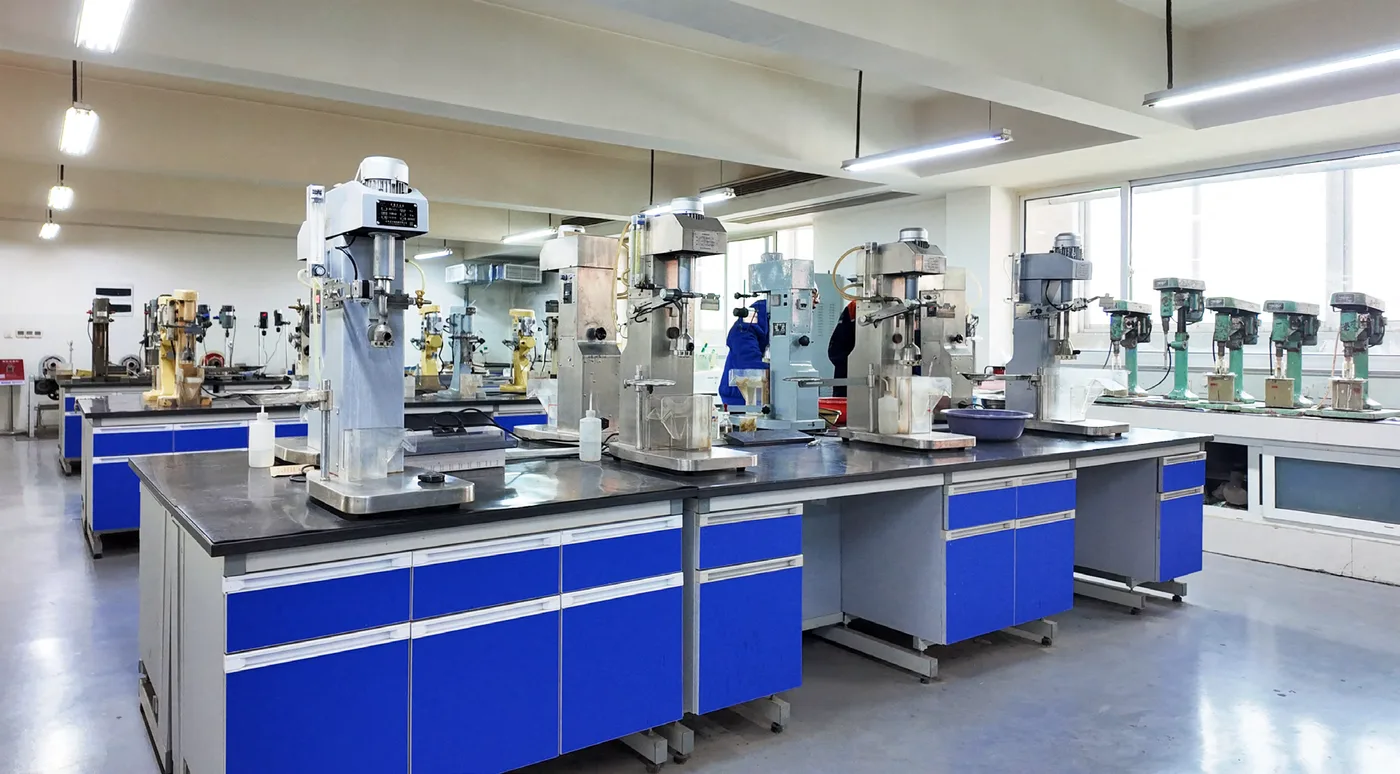
Test work decides the plant, so it comes first
Every Xinhai flowsheet starts in the laboratory. Analysis, bench tests, pilot runs and site commissioning are handled by one team, which is why the plant behaves like the test report said it would.
Four stages, one report chain
Analysis
Sampling, sample preparation, detection and analysis, data consolidation and reporting. Element, spectral and phase analysis identify what the orebody actually contains and in what mineral form.
Bench test work
Exploratory tests, verification tests and flowsheet tests. Sample preparation, scheme design, separation testing, product evaluation, flowsheet selection, report.
Pilot trials
Semi-continuous industrial trials in the pilot centre confirm the bench result at scale, including gravity, washing, flotation, chemical, magnetic and electrostatic circuits.
Commissioning
Commissioning engineers work with installation, electrical and automation teams on site until the plant reaches design output and grade.
Test methods and the parameters that matter
| Test | Suited to | Key parameters |
|---|---|---|
| Flotation | Base metals, rare metals, ferrous metals, industrial minerals | Grind size, pulp density, pH, reagent regime |
| Magnetic separation | Magnetite, hematite, manganese ore, quartz purification | Field intensity, feed size, throughput |
| Gravity separation | Gold, tungsten, tin, zircon and titanium | Feed rate, size range, medium density |
| Roasting and magnetic separation | Refractory iron ores | Roasting atmosphere, temperature, time |
| Electrostatic separation | Zircon, rutile, ilmenite | Feed size, throughput |
Inside the laboratory and pilot centre
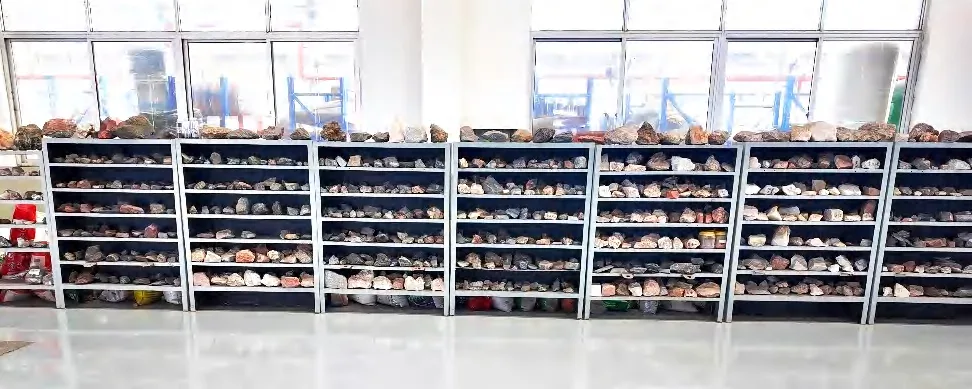
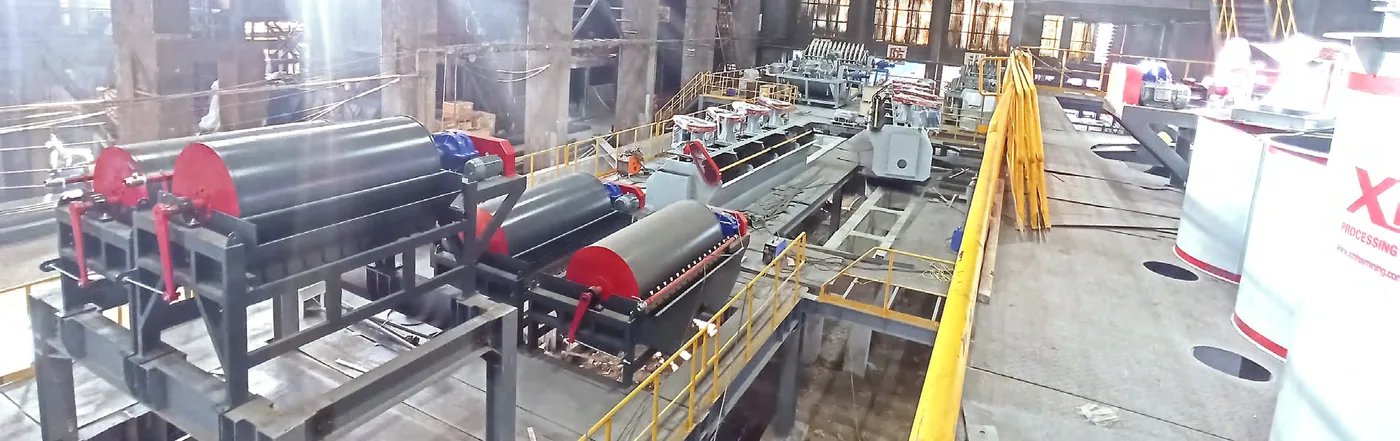
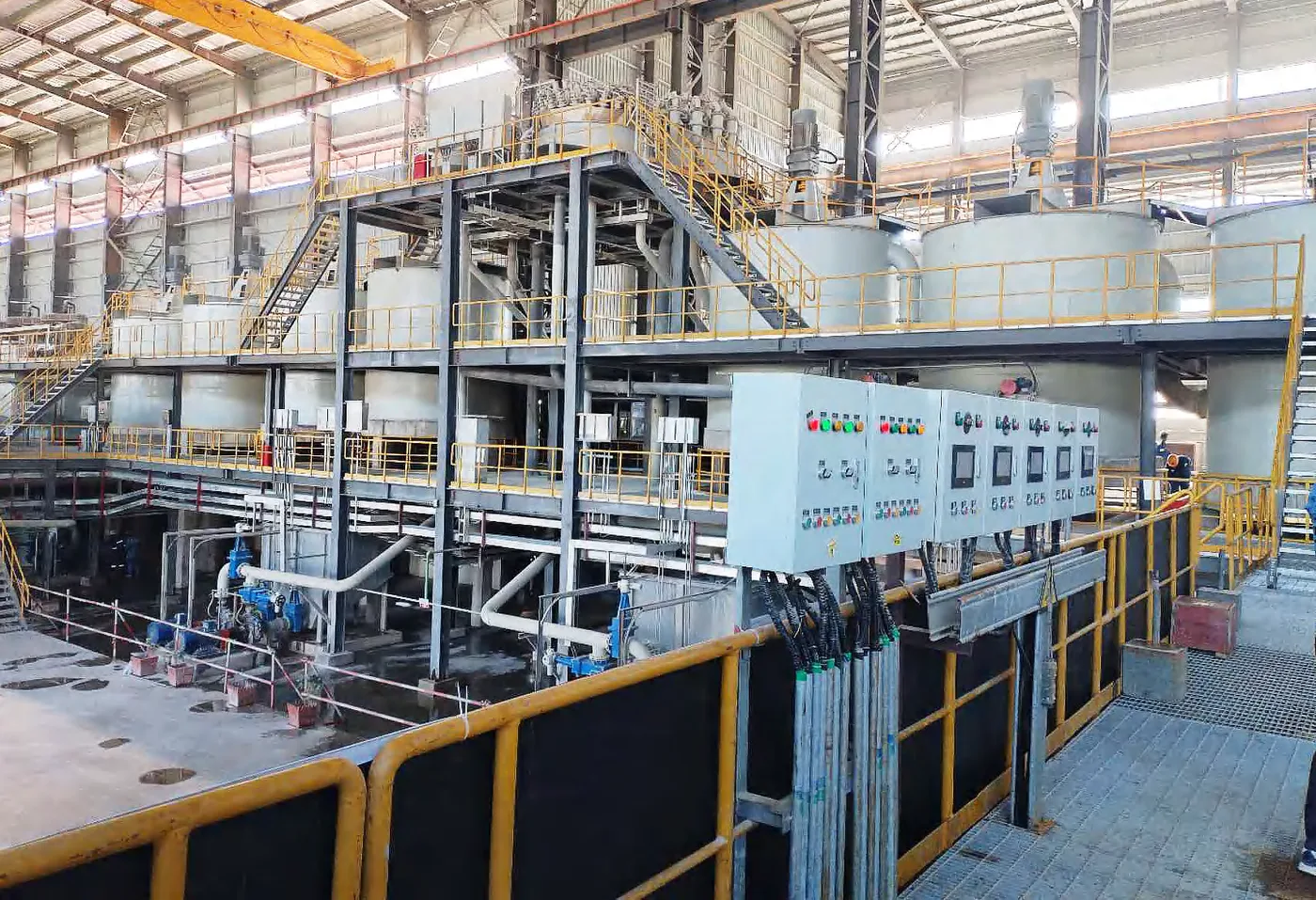
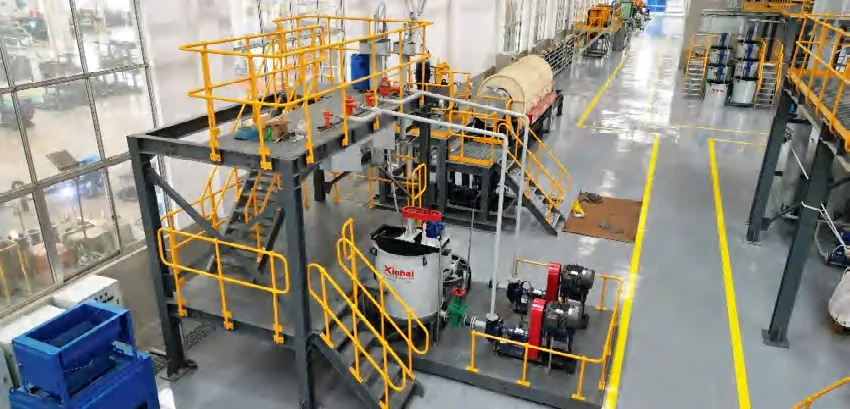
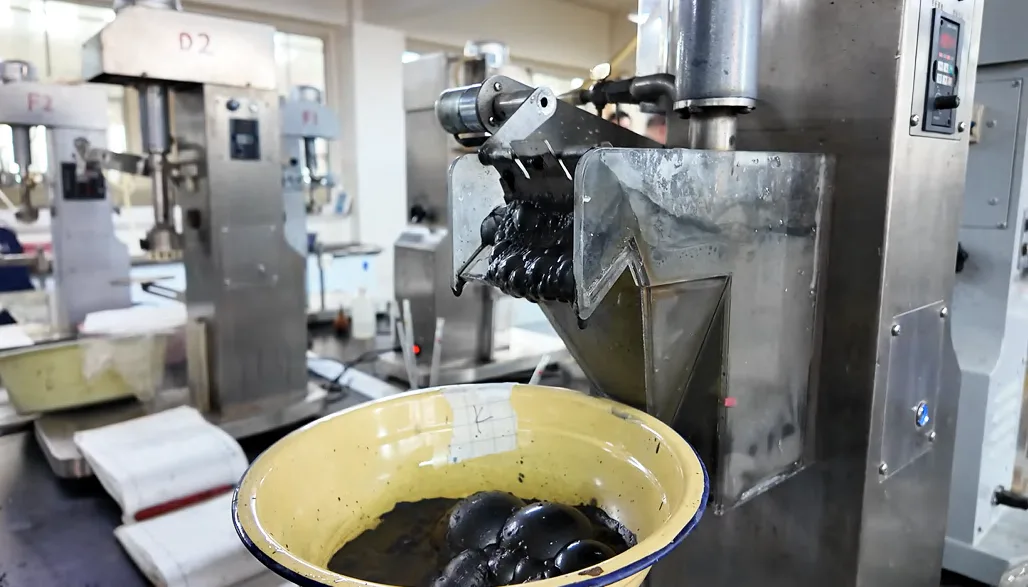
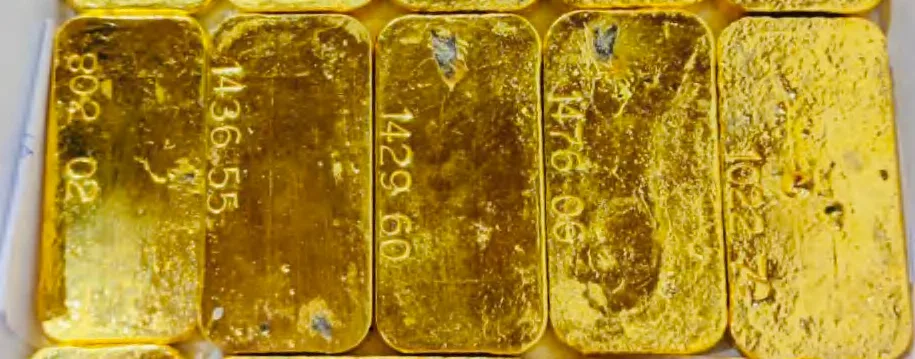
Reference test programmes
The results below are the ones reported in the Xinhai research and test service brochure. They describe those specific ore samples and cannot be extrapolated to another deposit.
Kazakhstan, 1.5 Mt/a copper flotation
Closed circuit conditions at a grind of 50% passing 200 mesh, one rougher, two scavenger and three cleaner stages. Copper concentrate at 3.50% yield, 16.23% Cu grade and 66.23% recovery.
Pakistan, phosphate extended continuous test
Direct flotation with two rougher and two scavenger and two cleaner stages, acid conditioning, then three stage reverse flotation. Phosphate concentrate at 62.10% yield, 22.43% P2O5 and 56.10% recovery.
Canada, integrated recovery from tailings
Lithium, rubidium and caesium recovered from tailings assaying 0.46% Cs2O, 1.2% Li2O and 0.5% Rb2O. The recommended route was spodumene flotation, then mica flotation, then pollucite flotation, producing a lithium concentrate at 3.83% Li2O and 57.92% recovery alongside mica, caesium, feldspar and quartz products.
Zimbabwe, 2 Mt/a spodumene dense medium separation
Petalite did not respond to flotation, so dense medium separation was tested with tetrabromoethane heavy liquid in the laboratory and ferrosilicon medium at pilot scale. The recommended flowsheet was crushing and screening, DMS to recover petalite, grinding and classification, gravity recovery of tantalum and niobium, desliming, mica flotation and spodumene flotation.
Common questions
What can the Xinhai laboratory analyse?
How far can testing go before construction?
Which separation methods are covered?
Who uses the test results afterwards?
Before you ask for a quote: what the programme needs from you
The scope we can write back depends almost entirely on what arrives with the sample.
Most enquiries arrive as one line: can you test my ore? Yes. But the scope, the duration and the cost of that programme move a long way depending on what turns up with the sample. Here is what actually changes the answer.
The sample itself
A single high-grade specimen is the most common thing we receive and the least useful. It tells you what the deposit does on its best day. Sample requirements also scale with the test you want: bench flotation and magnetic separation run off modest charges, comminution and coarse-ore separation tests need physically larger pieces, and a semi-continuous pilot campaign needs bulk material measured in tonnes rather than kilograms. Ask us for the mass before you ship, not after.
CIM's practice guidelines for mineral processing state the representativeness test plainly. Samples should span the geological, mineralogical and metallurgical domains, follow the mining sequence, and include material approaching cut-off grade alongside the higher-grade areas, so that a relationship between feed grade, recovery and cost can actually be drawn. Send the average and the marginal. Not the showpiece.
What should travel with it
- Head assays if you already hold them, and the name of the laboratory that produced them.
- Drill logs, domain boundaries and any mineralogy you have. Liberation size and mineral association drive more flowsheet decisions than head grade does.
- The penalty elements you already suspect: arsenic, fluorine, chlorine, magnesia, organic carbon, whichever one your offtaker will price against.
- Export paperwork. Ore samples cross borders as regulated goods, and permitting is often the longest single item in a test programme's calendar. That item sits on your side of the line, not ours.
And what you want at the other end
A test programme without a target is a science project. Tell us the concentrate specification your buyer will accept, the tonnage you are studying, and the constraints the site imposes: water source and quality, power, altitude, ambient temperature, haul distance to port. Water deserves more attention than it usually gets. A reagent regime tuned on clean laboratory water can behave differently on recycled or saline process water, and the plant drinks the second kind for its entire life.
How much testing is enough, and where the judgement slips
More tests on the same composite is not the same thing as more confidence.
When bench work is enough
Not every project needs a pilot campaign. A well-understood ore type on a conventional, widely deployed flowsheet can often be settled with exploratory and verification bench work plus closed-circuit tests. The JORC Code frames the same question from the reviewer's side when it asks whether the proposed metallurgical process is well-tested technology or novel in nature.
Pilot work earns its cost when one of four things is true. The separation leans on a physical property that scales badly out of a beaker, which is why the dense medium programme summarised above went to pilot scale at all. The flowsheet chains several unit operations whose recycle streams interact. The orebody is variable enough that no single composite can stand in for it. Or the route is genuinely unusual for that mineral, as it often is on lithium and industrial mineral projects.
There is also a scale-up gap that no amount of bench repetition will close. Bench cells hold litres. Production flotation cells are ordered in cubic metres, to 320 m3 per cell within Xinhai's own manufacturing range. Residence time, froth transport and cell hydrodynamics do not survive that jump on paper alone. Checking them is what the semi-continuous line is for.
The composite tells you the average, and the plant never runs the average
A fourth locked-cycle test on the same composite buys precision, not confidence. Confidence comes from variability samples, separate charges drawn from separate domains and separate parts of the mining schedule, because year one of that schedule is not the life-of-mine mean. CIM recommends precisely this once a process route has been chosen and the study reaches prefeasibility or feasibility level.
Borrowing a flowsheet from a similar deposit is legitimate, and CIM says so, at the conceptual stage. Carrying that borrowed assumption forward into design is where it quietly turns into a liability.
Four failures worth naming
- Testing after the equipment is shortlisted. The order is test, then flowsheet, then equipment. Run backwards, the report stops being evidence and becomes a justification. Design belongs downstream of the report.
- Leaving the tailings end untested. Thickening, filtration and water recovery set plant footprint, water balance and your permitting posture. They are part of the flowsheet, not a package to price later.
- Testing on water you will never use. Fresh laboratory water, recycled plant water and saline make-up are three different chemistries. Fix a reagent scheme against the wrong one and you will be re-tuning it during commissioning.
- Meeting the deleterious elements at the offtake term sheet. Both JORC and NI 43-101 ask what allowance was made for them. Discovering the answer late usually means reopening the cleaning circuit.
Who the report has to satisfy, and how your contract changes that
A programme scoped only to pick equipment can leave your technical report short.
If the project is being financed
Test work is a disclosure item, not only an engineering input. Under Canada's Form 43-101F1, Item 13 requires a technical report to discuss the nature and extent of the testing and analytical procedures, the basis for any assumptions or predictions regarding recovery estimates, the degree to which the test samples are representative of the deposit as a whole, and any processing factors or deleterious elements that could significantly affect economic extraction. The JORC Code asks for the same set in Table 1 Section 4, and counts metallurgical factors among the Modifying Factors used to convert a Mineral Resource into an Ore Reserve.
Read that list against your draft test scope before you commission it. A programme designed purely to select a flowsheet will answer the first two points well and can leave the last two thin, and that gap tends to surface at the worst possible moment, with a Competent Person or Qualified Person waiting to sign.
One boundary worth stating out loud: that person is your appointment, not ours. Xinhai runs the laboratory, the pilot centre and the design work, and reports what the samples did. The credential a reviewer will look for on the analytical side is the laboratory's ISO/IEC 17025 recognition under CNAS, described on our technical strength page. Sign-off on your public disclosure stays with you.
What the delivery model changes
The same report gets read differently depending on how you intend to contract the build.
| Model | Who holds the interfaces | What the test data has to carry |
|---|---|---|
| EPC turnkey | Contractor holds engineering, supply and construction | A tightly defined feed specification, because the acceptance criteria are written against it |
| EPCM | You hold the packages; the manager holds coordination and schedule | Enough detail to tender each package, since several vendors will read the same report |
| EPC plus operation | Contractor stays through production | Variability data, because whoever operates the plant lives with the ore that is not the composite |
| Operation of an existing plant | Plant already built; the scope is running it | Current feed and current performance, since the baseline is measured rather than predicted |
What we will not do is quote you a recovery figure before the test report exists. Ask what your ore will do and the honest reply is a test scope, a duration and a deliverables list, not a percentage. If you already know which build model you want, EPC turnkey and contract mining and operation set out what shifts on the delivery side, and an enquiry is enough to start the scoping conversation.
Sources
External references for the industry context on this page. Project figures come from our own project brochures.
JORC Code, 2012 Edition (Joint Ore Reserves Committee, AusIMM / AIG / MCA)Table 1 Section 4 lists metallurgical factors or assumptions, including whether the process is well-tested technology or novel in nature, the representativeness of test work, allowances for deleterious elements and the existence of bulk or pilot scale test work; metallurgical is named among the Modifying Factors converting Mineral Resources to Ore Reserves.
Form 43-101F1 Technical Report (Canadian Securities Administrators, published by the BCSC)Item 13 requires a technical report to discuss the nature and extent of testing, the basis for recovery assumptions, the degree to which test samples represent the deposit as a whole, and any processing factors or deleterious elements affecting potential economic extraction.
CIM Practice Guidelines for Mineral Processing (CIM Mineral Resource and Mineral Reserve Committee, 2022)Section 2.1.4 sets out sample representativity criteria across geological, mineralogical and metallurgical domains, including cut-off grade material and the feed grade to recovery correlation; section 2.1.5 recommends variability samples at prefeasibility and feasibility level and limits similar-deposit analogues to early conceptual work.
Send an ore sample brief and we will scope the test programme.