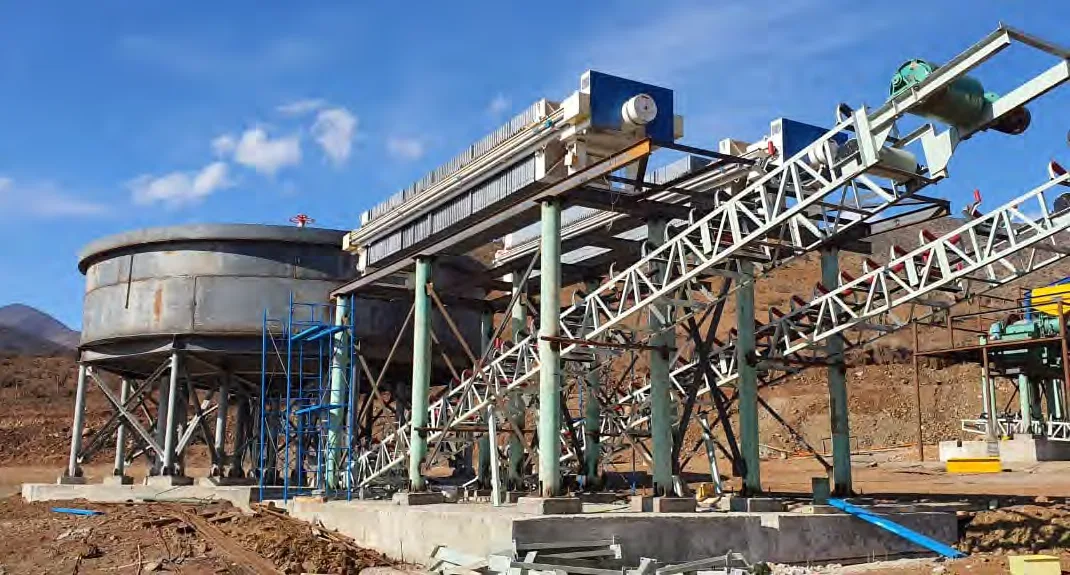
Guinea: a 3,000 t/d gold operation held at around 93% recovery
Turnkey mining and processing under one contract, with Xinhai supplying management and key technical staff to run it.
Project at a glance
| Item | Detail |
|---|---|
| Location | Guinea |
| Capacity | 3,000 t/d gold mine and processing plant |
| Scope | EPC+M+O, delivered with labour services |
| Feed grade | 1.2 g/t |
| Overall recovery | Stable at around 93% |
| Related capacity range | Gold plants in Guinea reported from 3,000 to 15,000 t/d |
What the project involved
This is the case where the integrated model is easiest to see. Xinhai carried the engineering, the equipment supply, the construction and then the operation, providing management and key technical personnel on site.
At 1.2 g/t, the margin between a plant that works and one that does not is thin, and it is decided in the leaching and adsorption circuit. The reported result is an overall recovery held stable at around 93%, which is a function of grind size control, leach residence time and carbon management rather than of any single piece of equipment.
Cross-process coordination is what the operation contract actually buys: mining supplies the plant with feed of a known character, and the plant is tuned for it, instead of each side optimising separately.
What a gold plant quote needs from your samples
A gold plant gets quoted off data you supply. Thin data buys you a thin number.
Here's the awkward bit of any enquiry. You want a capital number and a schedule. What decides both is a body of test data that may not exist yet. So the honest first answer to “what would a plant like this cost” is a list of what we need from you.
Why gold punishes a single composite
Gold is harder on sampling than most ores, for two reasons that are specific to it. Coarse gold turns the sub-sampling and splitting step into a source of error in its own right — JORC's sampling criteria single it out as a case with inherent sampling problems — and oxide, transition and fresh material from the same deposit can behave differently in cyanide, in reagent demand and in grind requirement. Send separate charges for each weathering horizon and each ore domain rather than a blend that averages them away; what a representative programme needs in general is set out under test work and research.
The assay and test suite
- Head assay by fire assay, plus silver, copper, arsenic, sulphide sulphur and organic carbon. Those last four decide whether cyanidation behaves at all.
- Gravity-recoverable gold. Coarse gold changes the flowsheet and it also changes how your samples have to be split.
- Bottle-roll or diagnostic leach at more than one grind size — with reagent consumption logged, not just recovery. Consumption is what shows up in your operating cost.
- Oxygen demand and lime demand measured through the leach, not assumed from it. Both size the aeration and reagent plant, and both are cheap to record alongside a bottle roll.
- Carbon behaviour on your own leach solution: adsorption isotherm and loading kinetics. Carbon inventory, elution frequency and regeneration duty come off those curves, and they set the size of the adsorption train and the acid wash and kiln that sit behind it.
- Comminution indices measured on the same material, so the mill and the leach aren't sized off two different orebodies.
- Settling and rheology. Thickener diameter, filtration and tailings deposition all come out of this and nowhere else.
The site constraint that gets left out
The heaviest single lift your access route allows, the port handling limit, and the road weight limits between port and plant. That set decides how much of the plant is welded in a workshop and how much is welded in your yard. Leach tanks to 20 m diameter and mills to 7 m diameter sit inside Xinhai's own fabrication range, described under equipment manufacturing, but whether a given vessel travels whole or in plate is settled by your road, not by the workshop. Decide the fabrication split while the layout is still on paper: it moves site welding hours, crane and rigging requirements and the construction sequence, and none of the three is cheap to change once steel is ordered.
Xinhai reports roughly 200 test programmes a year across more than 70 ore types, run in a CNAS-accredited laboratory, and the same house feeds the design. The discipline coverage that handover reaches into sits on full lifecycle mine design.
Where cyanidation stops working, and what replaces it
Free-milling ore suits this route. Change the ore and the arithmetic changes with it.
A route built on leaching and adsorption earns its recovery only where the ore liberates at a grind you can afford and dissolves cleanly in cyanide. A great deal of gold ore does not behave like that. Grade never tells you which camp you're in. Test work does.
| How the ore behaves | What direct cyanidation does | Where to look instead |
|---|---|---|
| Free-milling | Dissolves at a reachable grind | CIP or CIL, sized on residence time and carbon inventory |
| Coarse gravity gold | Dissolves slowly; gold builds up in the circulating load | Gravity recovery ahead of the leach, with intensive cyanidation of that concentrate |
| Gold locked in sulphides | Cyanide can't reach the gold, however fine you grind | Oxidation first — roasting, pressure oxidation or bio-oxidation — then leach |
| Carbonaceous, preg-robbing | Gold dissolves, then the ore adsorbs it back out of solution | CIL rather than CIP, blanking agents, oxidation, or a flotation product route |
| High cyanide-consuming copper or other cyanicides | Recovery can look acceptable; reagent consumption does not | Cyanide recovery and destruction economics, weighed before the flowsheet is fixed |
| Low grade over very large tonnage, competent ground | Leaching is fine; milling every tonne is the problem | Heap leaching, proven on column tests rather than bottle rolls |
Notice what the comparison is not. It isn't recovery against recovery. A route that pulls less gold can beat one that pulls more, once oxidation capital, reagent consumption and the cost of grinding every tonne are in the same sum — and at low head grade that is an outcome worth testing for rather than assuming away. Judge candidate routes on net revenue per tonne treated against the capital and operating cost each one carries.
Our test scope covers cyanide leaching and adsorption, bio-oxidation, heap leaching, and acid leaching and hydrometallurgy. That matters for one reason only: the comparison can be run on your ore instead of argued from experience. Route selection for gold is set out on gold solutions.
Four things owners get wrong about a 3,000 t/d gold operation
Each one is cheap to settle before contract and expensive to discover after.
Four errors are worth naming. None of them are exotic, and every one of them is decided long before the first foundation is poured.
Watching the mean instead of the spread
A thin margin at this grade is real. What breaks plants at 1.2 g/t, though, is not the mean — it's the spread. A deposit averaging that figure with tight metallurgical behaviour is an easier plant to run than a higher-grade one whose recovery swings by domain, because the second one forces you to design for a case you cannot predict. Ask what the variability looks like, domain by domain, not what the average is. The reporting codes already put that question in writing, which means the material often exists before anyone thinks to ask a plant designer for it. In the JORC Code, Table 1 Section 1 “Sampling Techniques and Data” covers sample preparation, sub-sampling quality control and the quality of assay data, and its criteria apply to every later section; Section 4, on Ore Reserves, lists among its criteria the nature, amount and representativeness of the metallurgical test work, the metallurgical domaining applied and the recovery factors that go with it — to be addressed on an “if not, why not” basis. Canada's Form 43-101F1 asks for the same ground at Item 13: where metallurgical testing has been carried out, a technical report discusses the nature and extent of it, the basis for any assumptions or predictions regarding recovery estimates, and the degree to which the test samples are representative of the deposit as a whole. Ask for whatever a project already holds under those headings before you ask anyone for a capital number.
Treating nameplate as production
A 3,000 t/d design figure is a design figure. Annual tonnes are that number multiplied by availability and by utilisation, and the gap between the two lives in crusher downtime, wet-season feed handling, power interruption and spares lead time. Size the surge capacity and the spares holding against that gap, not against a perfect year.
Buying the flowsheet and forgetting the reagent chain
Cyanide is not a line item. It's a supply chain with its own storage, handling, training, emergency response and decommissioning obligations, all of which an international code already spells out, and on a remote site with a wet season it's also a stockholding decision. Lime, grinding media and fuel behave the same way. On a site like that, a washed-out road can cost more production days than any single equipment failure, and the fix is inventory policy rather than engineering.
Assuming an operating team appears
Recruitment and training run longer than the construction tail, and they are the part of the programme that rarely appears on the bar chart. Decide the staffing model before you fix a commissioning date, because that decision sets three things you cannot retrofit late. The training plan, and how far ahead of first feed it has to start if operators are to learn the circuit on the circuit rather than on the ore. The recruitment runway for whichever roles are scarce near site — control-room operators, leach and reagent supervisors, maintenance planners — each with its own visa, medical and induction lead time. And the spares holding, which a crew still learning the plant consumes faster than a settled one, so a first-year list built off steady-state consumption will be short in exactly the months you can least afford it. The cooperation models available for the staffing side are on contract mining and operation.
Sources
External references for the industry context on this page. Project figures come from our own project brochures.
JORC Code, 2012 Edition (Joint Ore Reserves Committee, AusIMM / AIG / MCA)Table 1 Section 1 'Sampling Techniques and Data' covers sub-sampling and sample preparation quality control and the quality of assay data, and states that its criteria apply to all succeeding sections; the sampling guidance names coarse gold as a case with inherent sampling problems. Table 1 Section 4 lists, among the criteria for Ore Reserves, the nature, amount and representativeness of metallurgical test work, the metallurgical domaining applied and the corresponding recovery factors. Clause 18 defines the 'if not, why not' basis on which Table 1 items are addressed.
Form 43-101F1 Technical Report (Canadian Securities Administrators, published by the BCSC)Item 13, Mineral Processing and Metallurgical Testing: where such testing has been carried out, the report must discuss the nature and extent of the testing and analytical procedures, the basis for any assumptions or predictions regarding recovery estimates, and the degree to which the test samples are representative of the mineral deposit as a whole.
CIM Leading Practice Guidelines for Mineral ProcessingCIM's guidance on the mineral processing input to Mineral Resource and Reserve estimation and to technical reporting, supporting the section on what test work and sample coverage an owner should have in hand.
The International Cyanide Management CodeThe Code's mining principles cover transport, unloading, storage and mixing facilities, worker health and safety, emergency response and decommissioning, supporting the point that cyanide is a supply chain with its own obligations.
Send us the ore, the tonnage target and the site conditions. We reply with a scoped proposal.