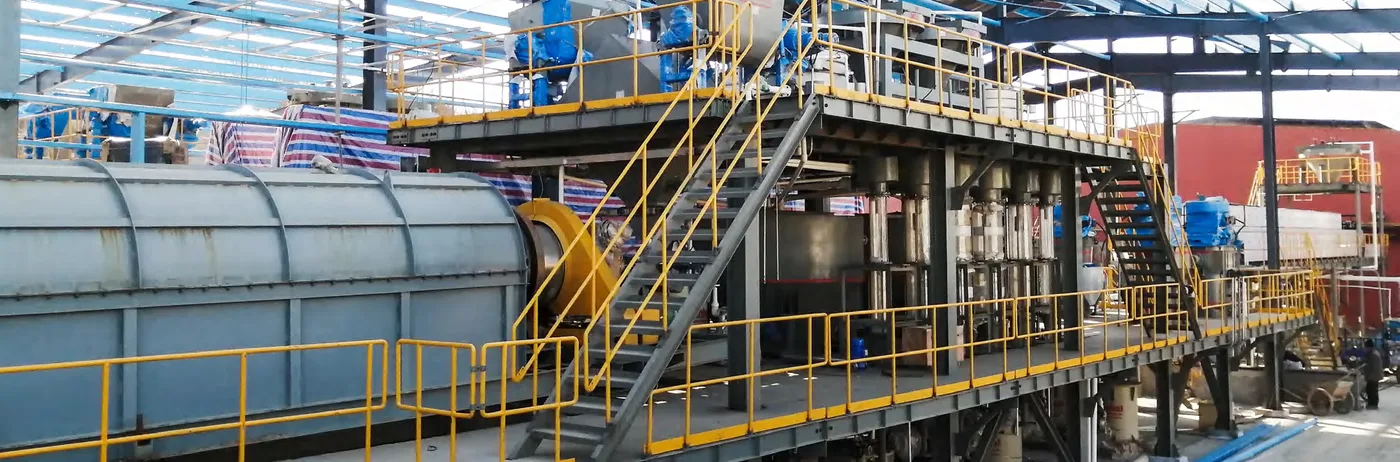
Italy: 1,200 t/d fluorite, delivered CE certified
The first full-scale Xinhai EPC project in Europe, executed against European conformity requirements from design through equipment supply.
Project at a glance
| Item | Detail |
|---|---|
| Location | Italy |
| Capacity | 1,200 t/d fluorite processing plant |
| Scope | EPC |
| Significance | First full-scale Xinhai EPC project in Europe |
| Compliance | CE certification applied throughout the project |
What the project involved
Fluorite flotation is demanding in itself: calcite and barite behave similarly enough that separation depends on depressant control and repeated cleaning. Doing it in Europe added a second constraint that has nothing to do with metallurgy.
CE marking governs the design basis, the technical documentation and the conformity of the supplied equipment. On this project that requirement ran through the whole scope rather than being handled as a certificate at the end, which is the practical difference between exporting equipment and delivering a plant into the European market.
Xinhai holds CE certification for products placed on the European market, alongside ISO 9001, ISO 14001 and ISO 45001 management system certification. The Italian project is where that documentation was put to work.
Why it mattered
A European first
This was the first full-scale EPC project Xinhai delivered in Europe, which is why it is cited in the company brochures rather than treated as one plant among many.
Conformity as scope
CE certification applied throughout the project, so conformity work sat inside the engineering scope rather than at the end of it.
A difficult separation
Fluorite has to be separated from calcite and barite, which behave similarly in flotation. The answer is staged cleaning under tight reagent control.
What CE marking asks of a plant, and what it never tells you
Conformity is a paper trail with legal weight. Someone has to own it before the first foundation bolt goes in.
Buyers hear "CE certified" and picture a sticker. It's closer to a file cabinet. Under the EU machinery regime the manufacturer designs against the essential health and safety requirements, compiles the technical documentation, runs the conformity assessment, draws up the EU declaration of conformity, affixes the marking, and supplies instructions a working crew can actually follow. Regulation (EU) 2023/1230 replaces Directive 2006/42/EC and applies from 20 January 2027; until that date, machinery placed on the EU market is still governed by 2006/42/EC, so a plant being built this year and a plant being designed for handover in 2027 are not answering to the same text. Its scope reaches partly completed machinery too, so a package that only becomes a working circuit after site assembly is still inside the regime rather than outside it. What changes there is the obligation set, not the coverage: partly completed machinery is supplied with a declaration of incorporation and assembly instructions rather than a CE mark and an EU declaration of conformity. That is the regime a plant now being planned for Europe has to be designed against. It says nothing about which rules governed any plant already standing there; a date in a regulation is not a date in a project history.
Ask who signs
On a concentrator that question is anything but rhetorical. Conveyors, cells, pumps, thickener drives, the control system: each has its own supplier, and the assembly still has to hold together as one conforming whole. Settle that boundary in the contract, early. It drives engineering hours, drawing formats, spare-part documentation and the language every manual on site has to be written in — and none of that is free to retrofit once fabrication has started.
What the mark will not tell you
Nothing about metallurgy. A perfectly conforming flotation cell can still be the wrong cell for your ore. Conformity answers safety and documentation questions; recovery and concentrate grade are answered by test work, and no certificate substitutes for that. The qualifications page sets out which certificates Xinhai publishes and how to ask for a certificate number and check it against the register yourself, and equipment manufacturing sets out which base builds what and the eight inputs that decide the machine list.
The fluorite data that decides the proposal
A grade threshold is shorthand. The specification your buyer signs is longer than one number.
Start with the product, not the plant. The USGS Minerals Yearbook describes acid-grade fluorspar as a flotation concentrate typically above 97% CaF2, sold mainly into hydrogen fluoride manufacture, and calls material at 97% or lower metallurgical grade, used mainly as a steelmaking flux. The same line is drawn in trade classification: USGS Mineral Commodity Summaries 2025 lists acid grade above 97% CaF2 and metallurgical grade at 97% or less as two separate tariff headings. The Minerals Yearbook also records cement-industry fluorspar products at typically 40% to 50% CaF2, and flux metspar that may run as low as 60%. Those are not one plant at three settings.
The threshold is only the headline. USGS is explicit that although CaF2 content has served for decades as a practical way to separate the grades, consumer specifications — allowable impurities, moisture content and particle size — can be equally important in deciding what a concentrate can be sold as. So the number to send us is not 97%. It is the specification sheet your off-taker signs, impurity limits included, because that document works backwards into the cleaning stage count, the reagent scheme and the entire back end of the plant.
Fluorite-specific data to send with the enquiry
- A head assay across the gangue, not only CaF2. Calcite, barite, silica, sulphides, phosphorus. Fatty-acid collectors do not tell fluorite apart from calcite and barite on their own, so the depressant scheme gets chosen against carbonate and sulphate content rather than against fluorite grade. Two ores at the same CaF2 head assay can need different reagents.
- Mineralogy, and specifically the intergrowth. How finely fluorite is locked with calcite and quartz sets the liberation size, and liberation size sets grinding power for the life of the plant. Under-grinding this ore costs you less in lost units than in calcite riding into the concentrate inside composite particles, which extra cleaning stages cannot remove.
- Water, analysed rather than assumed. Source, hardness, and whether process water returns to the head of the circuit. Recycled water brings residual collector and depressant back with it, and dissolved calcium and magnesium shift how a fatty-acid circuit behaves — neither effect shows up in bench work run on clean tap water.
- Impurity limits with penalties attached. Arsenic content carries commercial consequences beyond the assay: USGS records China's Ministry of Finance eliminating a 3% import tax on low-arsenic fluorspar. Ask your buyer which elements carry penalties, and at what level, before the flowsheet is fixed.
The generic items — a representative composite instead of a hand-picked specimen, the resource statement and its stage, site constraints in writing — are the same on every project and are set out in full on the EPC page. Send those alongside. The list above is the part of a fluorite enquiry that no other ore type asks for. Test work settles which reagent scheme and how many cleaning stages your ore actually needs, and fluorite solutions shows the route that comes out of it.
Three ways a fluorite project gets mispriced
All three are cheap to check now and expensive to discover during commissioning.
Pricing acid grade off ore that only reaches metallurgical grade
The premium is real and it is published. USGS puts the average unit value of US fluorspar imports for 2024, its estimated year, at $470 per metric ton for acid grade against $400 for metallurgical grade, cost, insurance and freight. Read the rest of that series before you bank the spread: in 2022 the same table shows $387 against $206, so the gap has closed rather than widened. Whether your ore reaches the higher grade at all is a laboratory question, and it belongs before the capital plan hardens, not after the cells are ordered. Cleaning capacity built for a concentrate the ore cannot feed is money parked in steel.
Costing the flotation circuit and forgetting the form the product ships in
The two grades leave a plant as different physical objects. USGS records metallurgical-grade fluorspar shipped routinely as lump or gravel, the gravel passing a 75-millimetre sieve with not more than 10% by weight passing 9.5 millimetres, while acid grade moves as damp filtercake carrying 7% to 10% moisture to keep it handleable and hold the dust down, then gets dried again before it meets sulphuric acid. Crushing and screening to a size envelope on one route; filtration, moisture control and dust management on the other. A flowsheet drawn as far as the last cleaner cell has costed neither.
Assuming the cleaner circuit runs at ambient
Reaching acid grade is a multi-stage cleaning job under close reagent control, and on many fluorite ores it is run warm. If your test work settles on a warm route, heat becomes an operating line with a capital tail behind it: a heat source, exchangers, insulation, and a winter case for a site where launders can freeze. An estimate copied from a circuit that runs cold carries none of those.
Delivery model sits underneath all three. The Italian plant was contracted as EPC, one counterparty carrying engineering, procurement and construction; the EPC page compares that against EPCM and operation-inclusive routes. Where access is hard or heavy civil works are difficult to justify at this kind of tonnage, modular delivery shifts fabrication away from the site and has to be costed on its own construction scope, not as a discount applied to a conventional estimate.
Sources
External references for the industry context on this page. Project figures come from our own project brochures.
USGS, Mineral Commodity Summaries 2025: FluorsparThe tariff table lists metallurgical grade as 97% or less CaF2 (HTS 2529.21.0000) and acid grade as more than 97% CaF2 (HTS 2529.22.0000); anhydrous hydrogen fluoride production was by far the leading use for acid-grade fluorspar; the salient statistics table gives average unit values of US imports, cost, insurance and freight, of $470 per metric ton for acid grade and $400 for metallurgical grade in estimated 2024, against $387 and $206 in 2022; and China's Ministry of Finance eliminated a 3% import tax on low-arsenic fluorspar.
USGS, Minerals Yearbook 2021: FluorsparAcid-grade fluorspar is a flotation concentrate typically above 97% CaF2 used primarily in hydrogen fluoride manufacture, and material at 97% or lower is commonly metallurgical grade, used primarily as a steelmaking flux; cement-industry fluorspar products are typically 40% to 50% CaF2 while flux metspar may be as low as 60%; consumer specifications such as allowable impurities, moisture content and particle sizes can be equally important as the CaF2 threshold in determining marketable use; metallurgical grade ships as lump or gravel passing a 75-millimetre sieve with not more than 10% by weight passing 9.5 millimetres, and acid grade ships as damp filtercake containing 7% to 10% moisture to facilitate handling and reduce dust, dried before treatment with sulphuric acid.
EU-OSHA, Regulation (EU) 2023/1230 on machineryThe regulation replaces Directive 2006/42/EC and applies from 20 January 2027, so Directive 2006/42/EC remains the applicable regime for machinery placed on the EU market until that date; the regulation also applies to partly completed machinery, and requires manufacturers to design against the essential health and safety requirements, draw up the technical documentation, carry out the conformity assessment, draw up the EU declaration of conformity, affix the CE marking and supply instructions for use.
Send us the ore, the tonnage target and the site conditions. We reply with a scoped proposal.