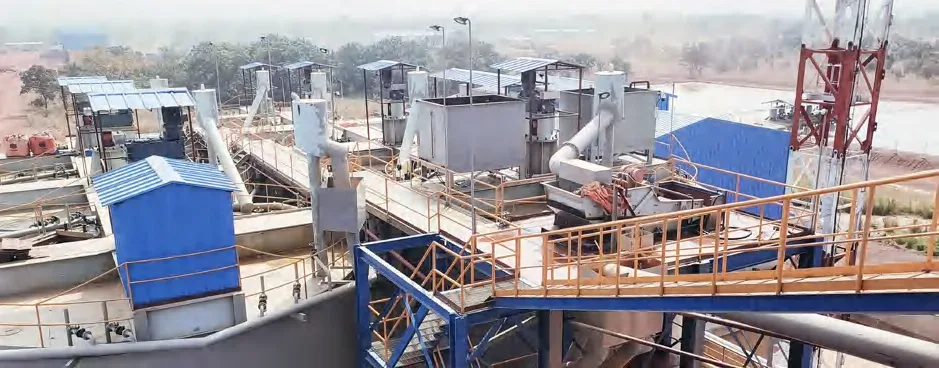
Mongolia: 3,500 t/d iron, concentrate at or above 65% Fe
Built and then operated by Xinhai, with process engineering feeding directly into the revenue and cost models the owner used for planning.
Project at a glance
| Item | Detail |
|---|---|
| Location | Mongolia |
| Capacity | 3,500 t/d iron mining and processing operation |
| Scope | EPC+O |
| Iron concentrate | Grade at or above 65% Fe |
| Yield | Around 31% |
| Secondary concentrate | Grade 50 - 60% |
What the project involved
The plant produces a primary iron concentrate at or above 65% Fe with a yield around 31%, plus a secondary concentrate in the 50 to 60% range. Two products rather than one is a deliberate choice: it recovers iron that a single high grade product would send to tailings, and it gives the owner a second revenue stream to trade against grade.
Full process engineering guided the development of the mining area, and the operation was supported with revenue modelling at different concentrate grades so that the profitability threshold was explicit. Operating cost structure analysis fed the same planning work.
That is the part of an EPC+O contract owners tend to underestimate. The engineering does not stop at commissioning, because the grade and yield trade-off has to be re-optimised as the orebody changes.
How to read a 65% Fe concentrate at 31% yield
Two numbers off a project sheet. Here is what they constrain, what they leave open, and which one your bank will ask about.
Yield is the number buyers skim past. It shouldn't be. Grade decides what a tonne of concentrate is worth; yield decides how many tonnes you get out of ore you already paid to drill, blast, haul and grind. A plant is fed in ore tonnes and paid in concentrate tonnes. The gap between those two units is where the operating margin lives.
Some arithmetic bounds the discussion before anyone opens a flowsheet. Mass pull multiplied by concentrate grade can never exceed head grade multiplied by recovery. Quote any two of those four and the other two are already fenced in. So when a supplier offers you a grade target and no yield to go with it, you have been handed half a result. Ask for the other half.
A grade figure is not a product specification
Iron concentrate is sold against a specification, and Fe percentage is only the headline line item. Silica, alumina, phosphorus, sulphur, moisture and size distribution decide whether a smelter takes your material at reference price, at a discount, or not at all. JORC makes the same point from the reporting side: for minerals defined by a specification, its Table 1 checklist asks whether the reserve estimate was based on mineralogy appropriate to meet that specification. A grade quoted without its impurity suite is a marketing number.
Where the grade lands also decides who your customers are. The USGS quotes the world reference price on fines of 62% iron content, CFR Tianjin. Blast furnace grade pellets generally sit at 65% Fe or lower, while Midrex puts the preferred feed for a direct reduction plant at 67% Fe or better. Same mineral, three different buyers, three different conversations about the same plant.
Why a second product exists at all
A single high grade cut is the tidiest thing to sell and the easiest way to throw iron away. Splitting the recovery across a primary and a secondary concentrate keeps middling units in the revenue column instead of the tailings dam, at the price of a product that sits below the 62% reference and gets paid accordingly. Whether that trade is worth making is a marketing question at least as much as a metallurgical one, and it wants your offtaker in the room. Test work tells you which splits your ore can produce. Only the market tells you which one is worth producing.
Where this project is the wrong benchmark for yours
A case study only helps if the ore behaves the same way. Four checks that decide whether it does.
Magnetic susceptibility, not the word "iron"
Magnetite answers to low intensity magnetic separation and concentrates at low cost per tonne. Hematite, goethite and martitised ores don't. They route to high intensity or high gradient separation, gravity, reverse flotation, or magnetising roasting, and each of those rewrites the capital cost and the power bill. Two deposits with the same Fe head grade can need entirely different plants. Our iron process routes page sets out where each split leads.
Penalty elements you inherited from geology
Phosphorus in oolitic ores. Alumina in lateritic and clay-rich material. Alkalis, and titanium in vanadium-bearing magnetite. What matters is deportment rather than assay: an impurity sitting in its own mineral can be rejected, one substituted into the iron lattice cannot. That distinction comes out of mineralogy and diagnostic test work, never out of a head assay, and it's a common reason a benchmark grade refuses to travel.
Site constraints that write the flowsheet before metallurgy does
Water availability can force dry pre-concentration or heavy recirculation. Freezing conditions change thickening, filtration, pipework routing and how much of the plant has to sit indoors. Grid capacity, or the lack of it, decides whether high intensity separation is affordable to run. And for a landlocked deposit, inland freight is paid per tonne of product on your own account, which pushes the economic concentrate grade above what metallurgy alone would pick. Low unit value, high bulk: logistics gets a vote on the flowsheet.
Scale, in both directions
Xinhai reports single project capability up to 50,000 t/d, so scaling up is an engineering exercise rather than a wall. Scaling down is the harder case. At small tonnages, or on a remote site with a short build window and a thin local labour pool, a stick-built concentrator can cost more per tonne than the ore will carry, and a modular plant starts to make sense. Where reserves are still being proven, the honest answer is often to stage the plant rather than design it once at full size. That call belongs in full lifecycle design, not on an equipment list.
Five ways owners misread a plant reference
Each of these has cost somebody a study cycle.
- Treating resource tonnes as concentrate tonnes. The USGS publishes iron ore reserves twice over, once as crude ore and once as contained iron. For China the two columns read roughly 17,000 and 3,000 million tonnes. Your lender cares about the second column, and about the yield that connects it to the first.
- Reading a laboratory weight recovery as a plant yield. Davis tube and bench separations run on prepared, dilution-free material at a fixed grind. A plant runs on whatever the trucks deliver. The lab figure is a ceiling. Closing the distance between ceiling and reality is what continuous and pilot scale work is for, and JORC asks the question directly: how representative was the test work, and did any bulk or pilot scale programme exist at all?
- Building the business case on design throughput. A t/d rating becomes annual tonnes only after availability and utilisation are assumed. Those are maintenance strategy and contract terms, not physics. Xinhai reports equipment utilisation of 95.7% on its Zimbabwe lithium operation; whatever figure you adopt for your own case, write it down and make the operating party sign against it.
- Assuming yield travels with the flowsheet. It doesn't. Yield belongs to your orebody first and the circuit second. Copy a circuit, inherit a different number.
- Comparing capital cost per tonne across different battery limits. One quote includes the tailings facility, the power line, the access road, the water supply and the camp. The next one stops at the plant fence. Until you have listed what sits inside each number, you are not comparing prices, you are comparing scopes. Our project record states the delivery scope alongside every case for exactly this reason.
Sources
External references for the industry context on this page. Project figures come from our own project brochures.
USGS, Mineral Commodity Summaries 2026 - Iron OreThe world reference price is quoted for fines of 62% iron content, CFR Tianjin Port, China, and reserves are tabulated separately as crude ore and as contained iron content (China: about 17,000 and 3,000 million tonnes).
JORC Code 2012, Australasian Code for Reporting of Exploration Results, Mineral Resources and Ore ReservesTable 1 Section 4 asks, for minerals defined by a specification, whether the reserve estimate was based on appropriate mineralogy to meet that specification, and asks about the representativeness of metallurgical test work and any bulk or pilot scale programme.
Midrex Technologies, DR-Grade Iron Ore Pellets: A Supply OverviewPreferred direct reduction plant feed carries 67% Fe or greater, against blast furnace grade pellets typically at 65% Fe or lower.
Send us the ore, the tonnage target and the site conditions. We reply with a scoped proposal.