What Are the Ores of Copper? Sulphide and Oxide Minerals
Copper never leaves the ground as wire.
Say a mine owner asks, 'What are the ores of copper?' The answer is a short list of sulphide and oxide minerals. That list decides the flowsheet. Copper processing starts with knowing which mineral you have, not just the copper grade.
The copper ore minerals that matter in a processing plant
What do most copper mines actually recover? One of eight minerals. Four are sulphides. Four are oxides or carbonates. Native copper is the odd one out.
| Mineral | Formula | Type | Plant behaviour |
|---|---|---|---|
| Chalcopyrite | CuFeS2 | Sulphide | Floats readily with xanthate collectors; the workhorse copper sulphide. |
| Bornite | Cu5FeS4 | Sulphide | Floats well; purple-brown tarnish in hand specimen. |
| Chalcocite | Cu2S | Sulphide | High copper content; fast floating, often in enriched zones. |
| Covellite | CuS | Sulphide | Floats well; indigo-blue colour. |
| Malachite | Cu2CO3(OH)2 | Carbonate oxide | Needs sulphidisation or leaching; green. |
| Azurite | Cu3(CO3)2(OH)2 | Carbonate oxide | Similar to malachite; blue. |
| Cuprite | Cu2O | Oxide | Leaches in acid; can float after sulphidisation. |
| Chrysocolla | CuSiO3·2H2O (approx.) | Silicate oxide | Harder to recover; often poor flotation response. |
| Native copper | Cu | Native metal | Dense, malleable; can be recovered by gravity or leaching. |
Chalcopyrite? It's the workhorse. It floats without drama. Simple. Bornite and chalcocite are enriched cousins. You often find them in the same deposit. Covellite is less common. It still floats well. What about oxides? Malachite and azurite are carbonates. They respond to sulphidisation. Cuprite is a simple oxide. Chrysocolla? A hydrated copper silicate. It gives every metallurgist a headache. Native copper, when it appears, is metallic. You can recover it by gravity or acid leaching.
Need a public reference? The US Geological Survey's Mineral Commodity Summaries for copper covers these mineral groups and supply context. USGS copper commodity summary
What copper ore looks like in hand specimen
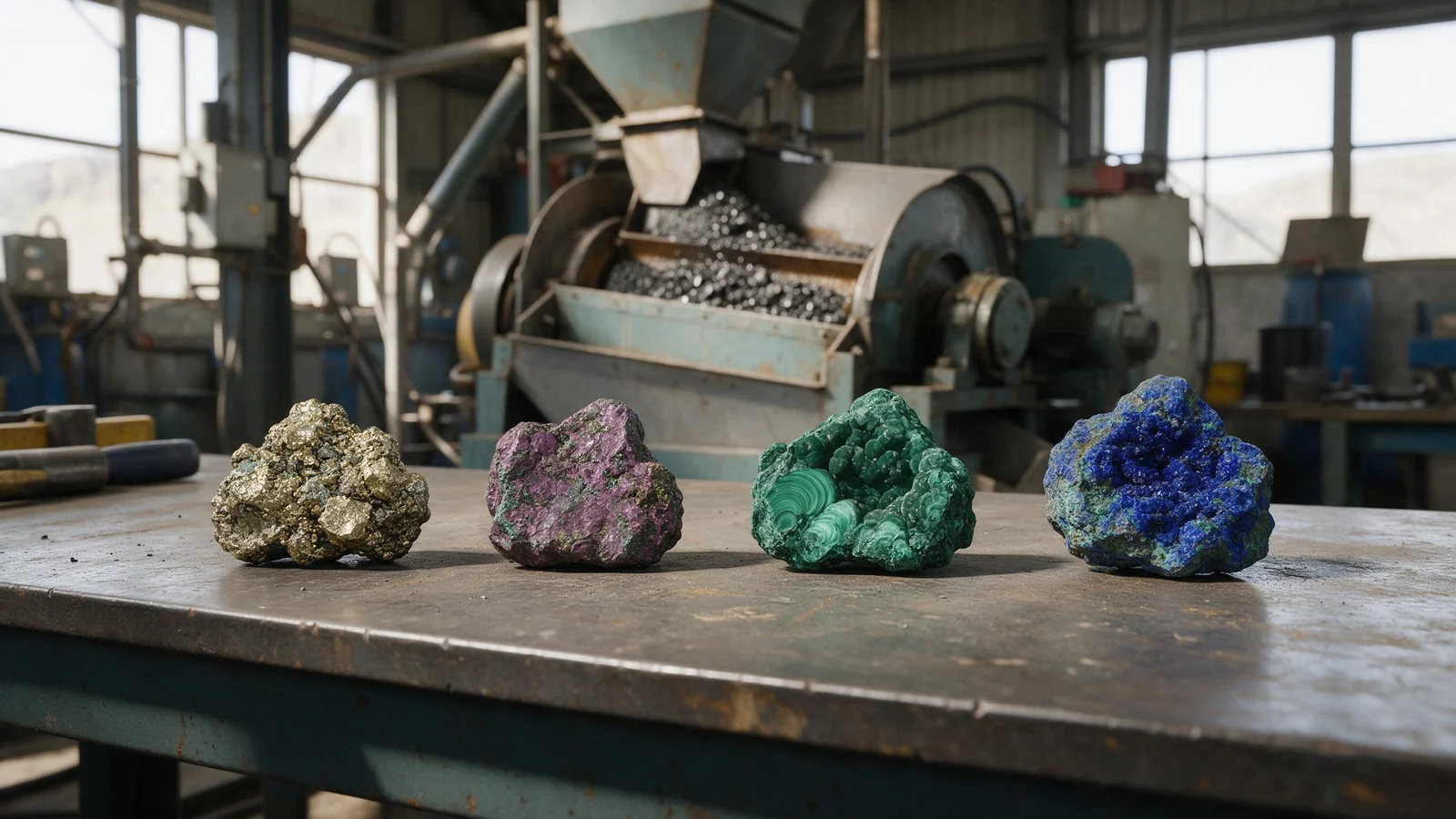
Colour gets you most of the way. But tarnish lies. Chalcopyrite starts brass-yellow. Tarnish turns it iridescent purple and blue. Bornite looks brown on a fresh surface. Give it days. It turns peacock purple. Chalcocite is lead-grey. Soft enough to cut with a knife. Covellite? Unmistakably indigo-blue. Malachite is bright green. Azurite is deep blue. Cuprite is dark red. Almost black. Chrysocolla is a soft blue-green crust. It looks like old chewing gum.
Streak is more reliable. Use it. Chalcopyrite gives a greenish-black streak. Bornite gives a grey-black streak. Malachite gives a light green streak. Hardness differs too. Sulphides are mostly soft. Chrysocolla is very soft. Quartz gangue scratches everything. But visual ID alone won't design a plant. A green hand specimen might be malachite. Or it might be copper-stained clay. Get a polished section and a mineral liberation analysis first. Then spend money on flotation cells.
Sulphide vs oxide copper: why the ratio decides the flowsheet
Many ranking pages skip this question. Don't. Sulphide minerals float with a thiol collector. That's the starting point. Oxide and carbonate minerals generally don't float. Not unless you add a sulphidising agent like sodium hydrosulphide or sodium sulphide. So the oxide-to-sulphide ratio changes the whole route. Big time.
Say the copper is 95 per cent chalcopyrite, 5 per cent malachite. A conventional flotation plant works. You'll lose a little oxide copper to tailings. Usually acceptable. Half oxide, half sulphide? That's mixed ore territory. Then you need testwork. Separate circuits or a combined sulphidisation-flotation circuit? Testwork decides. The hinge point isn't a fixed number. Not at all. It depends on acid-soluble copper, carbonate content, clay content. And whether the owner wants concentrate or cathode.
Gangue matters too. Never forget that. Carbonate minerals consume acid. That hurts heap leaching. Clays swell. They blind flotation froths. A high clay mixed ore can force a simpler route. Even if the copper mineralogy looks easy. You'll see this pattern again and again. Mineralogy sets the menu. Gangue picks the dish.
How sulphide copper ores behave in flotation
Chalcopyrite and bornite float fast. Xanthate collector, pH around 10 to 11. Done. The main villain? Pyrite. Iron sulphide dilutes concentrate grade. So we depress it with lime. Too little lime? Pyrite floats. Too much? You lose copper recovery. Collector choice matters too. Xanthates are strong. And cheap. Dithiophosphates? More selective against pyrite. Thionocarbamates offer better selectivity for complex ores. But they cost more. You don't pick a collector from a catalogue. No way. You pick it from a locked-cycle test.
Slimes? Second problem. Clay and talc gangue crowd the bubble surfaces. They carry fine copper minerals to tailings. The fix? Usually a dispersant or a pre-flotation stage. Standard practice. Not a special trick. The US EPA technical resource document on copper describes the same beneficiation logic. EPA copper beneficiation document
Xinhai reports a 1,500 t/d Pakistan copper ore with 0.80% Cu feed reaching 20.78% Cu concentrate and 90.05% recovery.
How oxide and mixed copper ores are treated
Malachite and azurite? They can be floated after sulphidisation. Add sodium sulphide. The surface sulphidises. A xanthate collector does the rest. Reagent dosage is delicate. Very delicate. Too little sulphide? Recovery stays low. Too much? The sulphide depresses the mineral you're trying to float. Chrysocolla? Worse. It's a hydrated silicate. It often loses copper to acid leaching. But it floats poorly, even after sulphidisation.
For acid-soluble copper, heap leaching followed by solvent extraction and electrowinning is a proven alternative. Stack the ore on a pad. Acid solution percolates through. Pregnant solution goes to SX-EW. It's not a universal fix. Don't think that. It needs acid-soluble copper, low carbonate, decent permeability. And enough flat ground for a pad. A bottle roll test tells you acid consumption and leach kinetics. Before you commit.
Xinhai reports a Nigeria oxide copper ore at about 74% recovery, and a Bolivia ore with 71.92% oxidation rate at 81.45% copper recovery.
What to test before you choose a copper processing route
Don't start with a flowsheet. Start with a sample. Get a representative sample first. Ask your lab for a copper phase analysis. It splits total copper into sulphide, oxide and native copper fractions. That one report? It often answers more than a dozen flotation tests.
Then test grindability and liberation size. Both. A fine-grained ore needs finer grinding. That costs more. Useful copper locked in a 10 micron host? A standard regrind circuit won't cut it. Acid consumption matters for any leach candidate. Always. High carbonate content? Kills heap leach economics. Clay content affects flotation and leaching. Measure it early. Batch flotation tests and bottle roll leach tests. Two workhorses. They decide between flotation and leaching. You can read what a typical mineral testing laboratory should give you.
Mixed ore? Run both tests. Compare copper recovery, reagent cost per tonne of copper. And what product you can sell. The answer? Rarely obvious from the head grade.
From ore type to a small-scale copper plant
Small copper deposits? Usually a plant of 200 to 2,000 tonnes per day. A flotation plant in the 500 to 1,500 t/d range is common. Nothing exotic. EPC timeline? Typically 12 to 18 months, design through commissioning. Permits and power need to be ready. Industry-typical figures. Not project promises.
Xinhai reports 2,500+ mines served and 600+ EPC+M+O projects, according to the company's published figures. If you're looking at a small oxide or mixed deposit, the route is usually tested before it's built. See the small-scale copper processing plant solution page, and the copper extraction process guide.
Frequently asked questions
What are the main copper ores?
Main copper ores? Sulphide minerals like chalcopyrite, bornite, chalcocite, covellite. And oxide or carbonate minerals: malachite, azurite, cuprite, chrysocolla. Native copper shows up in some deposits too.
What stone is copper found in?
Where is copper found? In a range of host rocks. Sulphide minerals often sit in igneous or metamorphic rocks. Oxide minerals form in the weathered zone above them. The copper-bearing minerals aren't a single stone. They occur as veins, disseminations, or sedimentary layers within the host rock.
How to extract copper from ore?
Sulphide ores? Crush, grind, float. Get a copper concentrate. Then smelt and electrorefine. Oxide ores? Heap leach with acid. Then solvent extraction and electrowinning. Mixed ores need testwork. One route, a combination, or separate treatment? Testwork decides.
What is the most common copper ore?
Chalcopyrite? Generally the most common primary copper sulphide in economic deposits. Most large sulphide copper mines treat ore where chalcopyrite is the principal copper mineral. That's the reality.