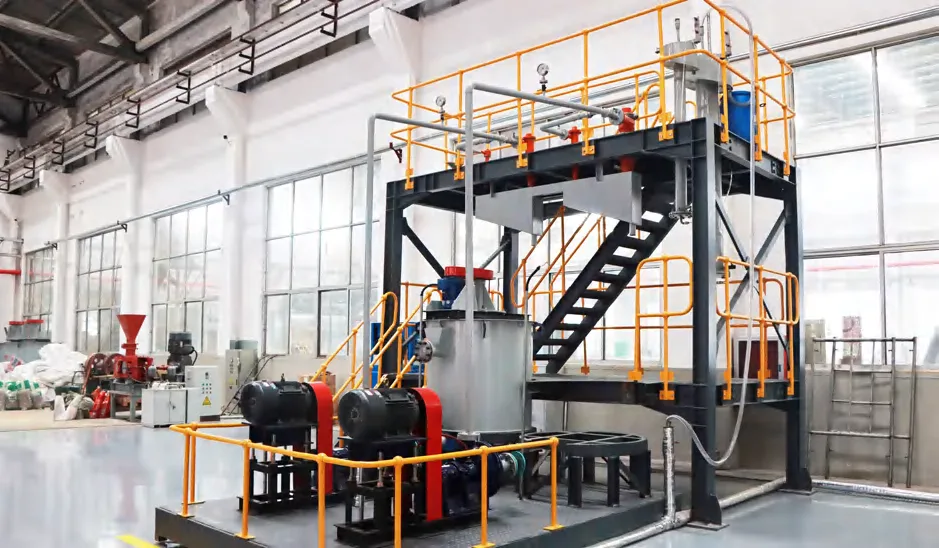
Inside a Mineral Testing Laboratory
Mineral testing is the foundation of concentrator design—skip it and you'll build a plant on guesswork.
If you're planning a concentrator, the mineral testing laboratory is where the flowsheet gets decided, not just checked. A mineral testing laboratory runs ore through the same unit operations you'll install later—crushing, grinding, gravity separation, flotation, leaching—but at a scale small enough to measure and change variables. Xinhai reports more than 600 EPC+M+O projects, and nearly every one of those plants began with bench-scale or pilot-scale ore testing before a single foundation drawing was issued. This article walks through what to expect when you send material to a lab.
Before you commit to a lab programme, understand the sequence. First comes sample characterisation: mass, moisture, and particle size. Then sample preparation: crushing, splitting, pulverising. Then the analytical phase: element assays and mineral identification. Then performance tests: grindability and bench separations. Finally, if the project justifies it, pilot runs. Each stage adds cost but also removes risk.
What a mineral testing laboratory actually does
A mineral testing laboratory is a controlled facility that measures how a specific ore responds to physical and chemical separation. It combines sample preparation, elemental assays, mineralogical identification, grindability work, and small-scale process tests. You don't get a single number; you get an evidence base. The standard output is a mass balance and a recommended process route, supported by test data rather than precedent or supplier preference.
USGS Mineral Commodity Summaries show how widely ore grades and recoveries vary across deposits, which is why testwork is non-negotiable. A USGS Mineral Commodity Summaries entry on gold, for instance, reports global production from many deposit types, each requiring a different process route. The World Gold Council likewise tracks mine production by deposit type and notes that recovery routes depend on ore mineralogy, not grade alone. That variability means no two orebodies test alike.
Sample preparation and what the owner must send
Start with the sample itself. The lab needs material that represents the orebody, not a hand-picked high-grade piece. For most programmes you'll send split drill core, reverse-circulation chips, or bulk material from a pit. The owner should also provide geological context: lithology, alteration, grade distribution, oxidation state, and any known problem minerals. Xinhai's mineral processing test service performs around 200 studies per year across more than 70 ore types, according to the company's published figures. That intake experience means the lab knows how to handle difficult samples without losing representativeness.
Sample mass scales with the test suite. Bench-scale flotation can start from tens of kilograms, while a full programme including piloting may need several hundred kilograms to a few tonnes. If you're testing a high-grade gold ore with coarse nugget gold, you'll need more mass because nuggets are statistically scarce. Always split samples using a riffle splitter or rotary divider, not a shovel, to avoid bias.
The standard preparation sequence is: dry, crush to minus 2 mm, split a representative sub-sample, pulverise to minus 75 µm, and then split for assay and test charges. This repeated splitting is what keeps the test results traceable to the original drill core.
Moisture matters too: wet samples may need drying before crushing, but high-temperature drying can alter some minerals. Tell the lab if the ore contains clay, sulfides, or soluble salts before they dry it.
Elemental and mineralogical analysis
Before any separation test, the lab establishes what is actually in the ore. Fire assay or aqua regia digestion gives gold, silver, and base-metal grades. X-ray fluorescence and inductively coupled plasma methods cover the broader element suite. Then mineralogy identifies the host minerals and the gangue. It's not enough to know the ore contains 1.2 g/t gold; you need to know whether the gold is free, locked in sulfides, or associated with carbonaceous matter. A mineral testing laboratory uses optical microscopy, XRD, SEM, and sometimes automated mineralogy to map the deportment.
If the ore contains significant graphite or talc, that changes flotation chemistry. If it contains reactive sulfides, that changes tailings management. The data from this stage also feeds the mine plan: a mineralogical report can show whether high-grade zones will behave differently from low-grade zones. Xinhai's design institute integrates geology, mining, and mineral processing across 17 professional disciplines, so mineralogical findings flow directly into process choices.
Assay turnaround varies from a few days for simple fire assay to weeks for full mineralogy. Plan the test programme to allow for analytical lead time before bench tests start.
Grindability and comminution testing
Comminution often consumes more than half of plant energy. That's why grindability testing happens early. Standard tests include Bond ball mill work index, SAG mill comminution, and abrasion index. The results feed mill sizing and power calculations. A mineral testing laboratory will usually run at least the Bond ball mill test because it produces a work index in kilowatt-hours per tonne, which is a direct input to process design.
Ore variability matters too: you might test composites from different zones instead of one blended sample. If the work index varies widely across the orebody, the mill must handle the hard end, not the average. Xinhai reports equipment manufacturing capacity for ball mills up to φ7 m in diameter and flotation cells up to 320 m³, so grindability data directly influences which standard machine fits. A softer ore may allow a smaller mill at the same throughput, while a harder ore may require a pebble crusher or a larger SAG mill.
For SAG mill designs, labs may also run a JK drop weight or SMC test to model impact breakage. These results feed simulation packages that predict throughput and product size distribution.
Gravity, flotation, and leach bench tests
Once the ore is characterised, the lab runs separations. Gravity tests use spirals, shaking tables, and centrifugal concentrators to see whether dense minerals can be recovered without reagents. Flotation bench tests vary collectors, frothers, pH, and grind size across dozens of conditions. Leach tests—cyanide, acid, or alkaline depending on the metal—measure extraction over time. For gold ores, CIL and CIP testwork can reach 99% recovery on suitable ores, but that figure applies only after test confirmation; it's not a design promise. The lab reports grades, recoveries, reagent dosages, and tailings characteristics.
You'll use these numbers to choose between a gold CIL plant and a flotation-concentrate route. Bench data also supports a preliminary economic assessment. If flotation recovery is too low, the project may not be viable. Don't scale a bench result directly to production—pilot work exists for that reason.
Each bench test should start with a flowsheet sketch and a list of variables. Without that, you'll end up with data that looks good but doesn't scale.
Pilot-scale testwork
Bench tests are quick, but they don't answer every question. Recirculating loads, froth handling, filtration, and reagent stability behave differently when you run continuously. Pilot plants do that. A pilot circuit runs continuously for days or weeks, producing enough concentrate or tailings for downstream testing. It confirms the mass balance, produces larger samples for thickening and filtration tests, and gives operators confidence in throughput.
Xinhai operates an industrial-scale pilot base as part of its mineral processing research. The exact floor area isn't published as a single figure because of documentation differences, but the base supports continuous runs for gold, copper, lithium, and other flowsheets. Pilot data locks down the equipment list and the control philosophy before detailed engineering begins. This is where you move from "the ore responds to flotation" to "this specific circuit, with these pumps and tanks, will meet the recovery target."
Pilot runs are also where you test water chemistry, reagent mixing, and operator response. A pilot plant can reveal a pump that plugs or a screen that blinds—problems that are cheap to fix before construction but expensive afterward.
Checklist before you ship a sample
You can avoid the most common delays by following a simple sequence. First, split the sample with a riffle splitter or rotary divider, not a shovel. Second, note the full moisture state and any clay, sulfides, or soluble salts before drying. Third, provide geological context such as lithology, alteration, grade distribution, oxidation state, and known problem minerals. Fourth, match sample mass to the test suite—bench-scale flotation starts from tens of kilograms, while a full programme including piloting may need several hundred kilograms to a few tonnes. Fifth, ask the mineral testing laboratory to state which ISO/IEC 17025 methods are covered by its accreditation, test by test. This sequence keeps the submission traceable to the original drill core and makes the resulting mass balance defensible in due diligence. When you use mineral processing test work, the intake team can confirm whether the sample plan fits the orebody before any reagent or kinetics work begins.
What ISO/IEC 17025 accreditation actually certifies
Accreditation is often misunderstood. ISO/IEC 17025 does not validate your orebody or promise a specific recovery. It certifies that the laboratory operates under a quality management system, uses validated methods, calibrates instruments, and reports results with traceable uncertainty. The standard is published by the International Organization for Standardization; you can read the scope and structure on the ISO/IEC 17025 on Wikipedia. In other words, it audits the lab's competence and consistency, not the client's deposit.
Xinhai's CNAS-accredited laboratory meets this standard for mineral testing, which means its reports can be defended in technical due diligence and bankable feasibility studies. When you see an ISO/IEC 17025 certificate, ask what specific tests are in scope—accreditation is test by test, not blanket for the whole facility. A lab might be accredited for fire assay gold but not for acid-base accounting, for example. That distinction protects you as the owner.
CNAS is a signatory to the ILAC mutual recognition arrangement, so a CNAS-accredited lab's reports are accepted in many jurisdictions. But still confirm with your local regulator whether the specific test is within the accreditation scope.
How testwork feeds mine design and operations
Test data doesn't stay in a report. It becomes the basis for equipment sizing, mass balance, reagent scheme, and operating procedures. A 1,200 t/d plant running a simple flotation circuit needs a different level of testwork than a 50,000 t/d polymetallic plant. Xinhai reports more than 600 EPC+M+O projects, according to the company's published figures, and those projects sit on top of ore testing.
The design team uses test results to set mill dimensions, flotation bank volume, leach tank residence time, and tailings management. Without that data, you risk under-sizing the crusher or over-designing the thickener. You also lose the ability to compare bids from equipment vendors on equal technical terms. That's why the mining industry treats metallurgical testwork as a stage-gate deliverable: you don't spend construction capital until the ore has answered the process questions.
Once the plant is built, keep the test data. It becomes the baseline for troubleshooting, expansion studies, and operational benchmarking. Mines that treat the lab report as a living document avoid repeating expensive mistakes.
Frequently asked questions
What is a mineral testing laboratory?
A mineral testing laboratory is a facility that measures how a specific ore responds to physical and chemical separation unit operations such as crushing, grinding, gravity separation, flotation, and leaching. Its output includes elemental assays, mineralogy, grindability data, and bench or pilot test results used to design a concentrator.
How much sample does a mineral testing laboratory need?
Sample mass depends on the test scope. Bench-scale flotation may start from tens of kilograms, while a complete programme including piloting can require several hundred kilograms to a few tonnes. Representative material is more important than total mass, so split drill core or RC chips should cover all ore types and grade zones.
What does ISO/IEC 17025 accreditation actually certify?
ISO/IEC 17025 certifies a laboratory's quality management system, method validation, instrument calibration, and reporting of traceable uncertainty. It does not guarantee a specific recovery or validate the orebody. Accreditation is granted test by test, so confirm which methods are in scope.
Why is pilot-scale testwork needed after bench tests?
Pilot-scale testwork runs the process continuously for days or weeks, which reveals problems that batch bench tests miss, such as recirculating loads, froth handling, pump plugging, and screen blinding. It also produces enough product for downstream thickening, filtration, and tailings tests.