Small Scale Copper Processing Plant for Low-Grade Ore
A small scale copper processing plant lives or dies on three numbers: head grade, oxidation ratio and Bond work index.
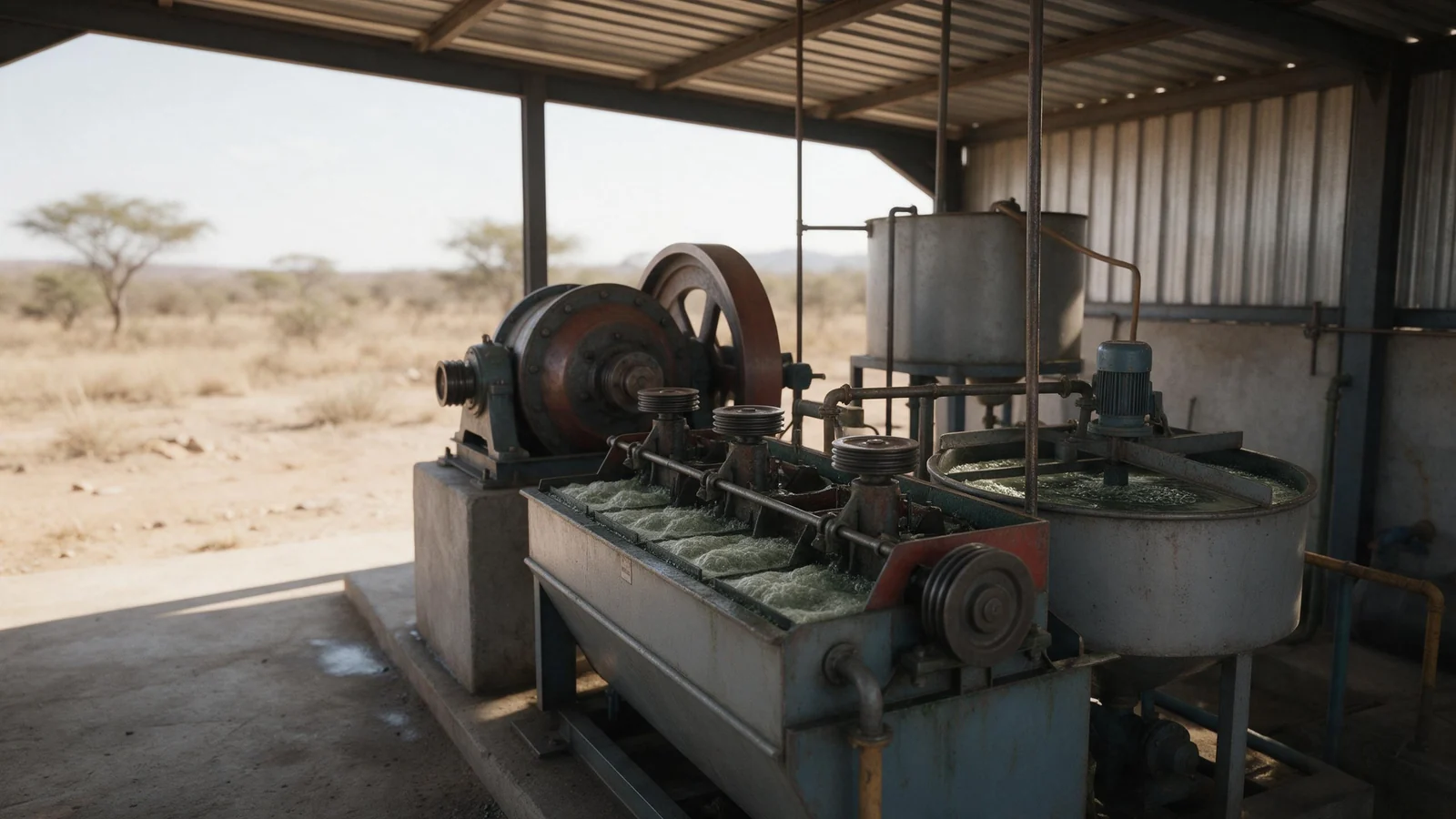
Header image: illustrative, not a photograph of a specific project.
Say a mine owner asks whether a small scale copper processing plant can treat 1 per cent Cu oxide ore from a small African deposit. You won't answer with a catalogue number. You'll answer with three questions: what's the oxidation ratio, what's the acid-soluble copper, and what particle size do you need to liberate. Where do you start? You start with the phase analysis. That's the whole gate.
Ores and grades this plant suits
Most owners arrive with an average grade near 1 per cent copper. That's workable if the ore mineralogy cooperates. Oxidation ratio is the first selector. It's the share of copper sitting in oxide minerals rather than sulphides, and it's normally reported as a percentage of total copper. Acid-soluble copper, also a percentage of total copper, tells you how much of that oxide content will actually dissolve in weak acid under standard leach conditions. A high oxidation ratio with high acid-soluble copper pushes you toward leaching. A low ratio with chalcopyrite pushes you to flotation. In between sits mixed ore.
The minerals you'll meet in this grade band are chalcopyrite, malachite, azurite and chrysocolla. Chalcopyrite floats well after a standard grind. Malachite and azurite respond to sulphidisation flotation or acid leaching. Chrysocolla is the awkward one. It's a copper silicate, it slimes, and it often refuses both flotation and leaching. Phase analysis matters because two ores with the same 1 per cent Cu can demand entirely different plants. See the general copper processing page for the wider route map.
Imagine a small deposit with a 300,000 tonne resource and a 5,000 t/d flowsheet. It won't get funded. The 200 to 1,500 t/d band is the natural fit because a modest reserve can still repay a plant that size, and the tailings footprint stays manageable.
Capacity range
For small African deposits, the natural band runs from 200 to 2,000 tonnes per day, and most plants land between 300 and 1,500 t/d. That range balances orebody size, power availability and capital spend without forcing a big tailings footprint. Common modular sizes are 300, 500, 700, 1,000 and 1,500 t/d. Modular plant design suits this band because you can ship pre-assembled modules and cut site construction time.
Xinhai reports copper projects at 200 t/d (Philippines), 500 t/d (Laos and Myanmar), 1,000 t/d (Nigeria, Bolivia, Yunnan), 1,100 t/d (Namibia), and 1,500 t/d (Pakistan). The Namibia case treated ore from two pits at 1.46% and 1.26% Cu, the Nigerian case was oxide copper-silver at 1,000 t/d, the Pakistani case ran 1,500 t/d at 0.80 per cent Cu, and the Bolivian case was oxide-mixed at 1,000 t/d. Those are not maximums. They're just the published examples in this band. For contrast, U.S. recoverable copper production was an estimated 1.0 million tonnes in 2025, down 5 per cent from 2024, according to the USGS. Small plants don't replace that output. They serve a different deposit class.
Typical flowsheet
The sulphide route is standard. Two-stage crushing, normally jaw then cone, feeds a closed-circuit ball mill. The mill discharge goes to flotation: rougher, scavenger and cleaner cells. Concentrate is thickened and filtered, tailings go to a thickener and then to a tailings storage facility. That's the skeleton for a 500 to 1,500 t/d chalcopyrite plant. Reagent control is simple: a xanthate collector, a frother and lime for pH. Liberation is the main lever on recovery.
Oxide and mixed feed needs a decision before you buy the flotation cells. If the copper is mostly malachite or azurite and acid-soluble copper is high, leaching plus solvent extraction and electrowinning may be testwork's pick. If acid supply is poor, the ore is too clay-rich or the carbonate content is high, sulphidisation flotation is the fallback. You add sodium sulphide or sodium hydrosulphide ahead of flotation to coat oxide surfaces. It works well on malachite and azurite, less well on chrysocolla.
Mixed ore sometimes splits: oxide zones go to leaching, sulphide zones go to flotation, with separate stockpiles and a split plant. That's more capital but avoids forcing one chemistry to do two jobs. The flowsheet decision is never a desk judgement. It follows batch flotation, bottle roll leach and locked-cycle tests on your actual ore.
| Route | What it suits | What it produces | Main risk |
|---|---|---|---|
| Sulphide flotation | Chalcopyrite and other sulphide copper, low oxidation ratio | Copper concentrate | Poor liberation if grind too coarse |
| Sulphidisation flotation | Oxide and mixed copper where leaching is not viable | Copper concentrate | Chrysocolla and slimes reduce recovery |
| Leaching with SX-EW | High acid-soluble Cu, low carbonate and clay, reliable acid supply | Copper cathode | Acid consumption and solid-liquid separation |
| Mixed route | Separate oxide and sulphide zones in one deposit | Concentrate plus cathode | Higher capital cost and more interfaces |
P80 is the size 80 per cent of the mass passes. For copper flotation you'll commonly check a P80 between 75 and 150 micrometres. Leach feeds can be coarser, but permeability, heap stability and acid consumption decide that.
What the EPC+M+O contractor delivers
EPC+M+O stands for engineering, procurement, construction, mine construction management and mine operation management. For a small plant, that scope runs from metallurgical testwork through detailed design, equipment manufacture, civil and structural work, installation, commissioning and optional operations. You're not buying drawings plus a mill. You're buying one contract with one technical interface.
According to Xinhai's published figures, the company reports 600+ mine EPC+M+O projects and 1,000+ equipment types. Xinhai's Intelligent Equipment Research Institute reports it can provide complete main and auxiliary equipment for mines below 50,000 t/d. That's useful for a 300 t/d deposit because you don't have to patch equipment from five suppliers. The first step is always metallurgical testwork, not equipment selection.
Operation scope can extend beyond start-up. You may want a contractor to run the plant for a year, train your crew and manage tailings, reagents and maintenance. That's where the O in EPC+M+O earns its keep. A small oxide circuit can surprise you with reagent consumption patterns in the first wet season.
Schedule
For a 500 to 1,500 t/d flotation plant, you can typically expect 12 to 18 months from the day representative testwork finishes to the day you feed ore. Design takes 2 to 4 months. Manufacturing and procurement run 4 to 7 months. Civil and installation work takes 5 to 8 months. Commissioning and ramp-up add 1 to 2 months. Brownfield sites with ready power often land at 10 to 14 months. Remote greenfield sites can stretch to 18 to 24 months.
These are industry ranges, not contractual promises. The critical path changes case by case: power connection, tailings permit, road access or a long-lead mill can set the real finish date. Budget shape matters too, but prices belong in the cost guide.
The biggest schedule killer is not the mill. It's usually the grid connection or the tailings permit. If your site has no reliable power, add diesel or solar and the schedule shifts. If the tailings dam needs a geotechnical study, that alone can eat six months.
What we need from you to quote
A vendor cannot quote a small copper plant without ore data and site constraints. You'll speed things up if you send:
- Representative samples from each ore zone, not a single grab sample.
- Full multi-element assays for Cu, Fe, S, Au, Ag, As, Sb, Pb, Zn and gangue elements.
- Quantitative mineralogy or at least a phase analysis showing oxidation ratio and acid-soluble copper.
- Bond work index and abrasion index results, or enough sample for us to run them.
- Target throughput, site location, available power, water quality, road access and your product choice, concentrate or cathode.
If you're heading toward a public listing, your Mineral Resources and Ore Reserves must be reported under a recognised code. The JORC Code sets minimum standards for public reporting in Australasia. Early sampling should already respect that discipline because it affects how a bank or a partner reads your data.
Do not composite all your samples into one bucket before phase analysis. A mixed deposit needs zone-by-zone splits. If the oxide zone assays 1.5 per cent acid-soluble Cu and the sulphide zone sits at 0.6 per cent, one blended sample will hide both and steer you to the wrong plant.
Send your ore data through the inquiry form below and we'll tell you which route the testwork should test first.
Frequently asked questions
Is copper mining profitable at small scale?
It can be, but profit at 200 to 1,500 t/d depends less on the copper price and more on three local numbers: head grade, metallurgical recovery and power cost. A 1 per cent oxide ore that leaches poorly will burn cash even in a rising market. Run a proper phase analysis and batch flotation or leach tests before any investment. Small plants suit small deposits because capital and tailings footprints stay low, but they rule out many high-volume economies of scale.
What does a small scale copper processing plant cost?
We don't publish prices. The honest answer is that the cost is set by route, capacity, site earthworks, power supply, water treatment and tailings construction. Sulphidisation flotation is usually less equipment-heavy than leaching plus SX-EW, but a remote site with poor roads will change the number more than the flowsheet does. See the cost guide on this site for the cost drivers.
How many years of copper are left in the world?
There is no fixed number. Reserves grow with exploration, price and technology. USGS reports U.S. recoverable copper production was an estimated 1.0 million tons in 2025, down 5 per cent from 2024, which shows how annual output moves, but it doesn't set a countdown. The more useful question for a project is how many years your own resource can sustain the plant you're planning.
What is the difference between processing copper oxide and copper sulphide ore?
Sulphide ore, mainly chalcopyrite, floats well after fine grinding. Oxide ore, such as malachite or azurite, doesn't respond to ordinary flotation. It needs either sulphidisation flotation, where you add a sulphidising agent to coat the surface, or acid leaching followed by SX-EW if the copper is acid-soluble. Mixed ore often needs a split flowsheet. The oxidation ratio and acid-soluble copper decide which route wins.
Request a proposal for your ore
What to send for a useful reply
- Head assays and, if you have them, a phase or mineralogy report
- Target throughput in t/d and the product you want to sell
- Project stage: exploration, feasibility, financing or expansion
- Site basics: country, power, water and access
Not ready to share data yet? Read the EPC turnkey delivery page first.