Choosing an EPC Contractor for a Mine
You're about to sign a contract that decides whether your plant starts on schedule or drains working capital for years.
You're an owner deciding whether to run the plant yourself or hand it to an EPC contractor. The choice rarely hinges on price alone. It hinges on whether the contractor owns the engineering, fabrication, and testing functions that keep you off the hook when a pump fails at 3 a.m. This checklist gives you the questions to ask and the documents to request.
Start with scope, not logo
EPC stands for engineering, procurement, and construction. EPC+M+O adds mine management and operation. Get that terminology straight before you compare bids. One bidder may quote a bare EPC. Another may fold in two years of operations support. You can't compare apples to oranges.
Ask each bidder: What exactly is in your EPC scope? Does engineering cover only process design, or does it include civil, structural, electrical, and tailings? Who signs the construction drawings? If the contractor brokers design to a third party, you lose a single point of accountability.
Question 1: Who owns the process design?
You want a contractor that keeps process design in-house, not one that passes your flowsheet to an external designer. When design and construction sit in the same company, conflicts get resolved before they reach site. Ask for the design team's organogram and the qualifications of the lead process engineer.
Xinhai's mine design institute, for example, integrates 17 disciplines—geology, mining, mineral processing, civil, electrical, automation, steel structure, and others—under one roof. That's a specific structural indicator you can verify. In China, Xinhai's design institute holds a Class B metallurgical qualification. That credential does not transfer to other jurisdictions, so ask what local design authority applies to your project.
Don't accept a promise. Request the design quality plan and a list of deliverables at each stage: scoping, prefeasibility, feasibility, and detailed engineering. If the contractor stumbles at naming the differences between a PFS and a DFS, walk away.
Question 2: Does the contractor build its own equipment?
Procurement often hides the largest risk: traded equipment. A broker buys a mill from one vendor, a flotation circuit from another, and hopes they fit. That's how you end up with a six-month commissioning delay while two suppliers blame each other.
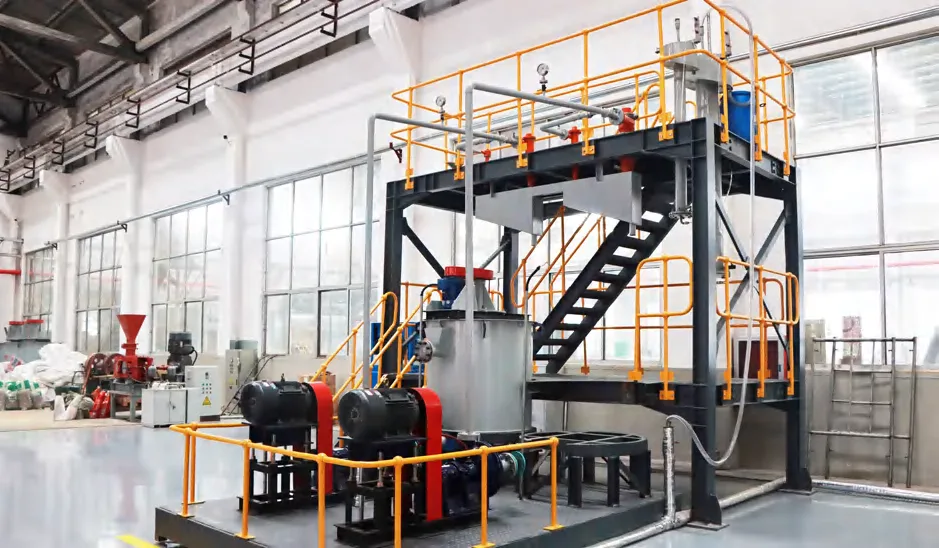
Ask for the contractor's fabrication list. Can they produce mills, flotation cells, leach tanks, and thickeners themselves? What are their machining limits? Xinhai, for instance, reports manufacturing capacity for ball mills up to φ7 m in diameter, flotation cells up to 320 m³ per cell, leach tanks up to φ20 m × 20 m, and thickeners up to φ100 m. Those are engineering limits you can compare against tender documents.
You'll also want to see welding and quality certifications. Request ISO 9001:2015, ISO 14001:2015, and ISO 45001:2018 certificates, plus any product approvals like CE or CSA where relevant. If the contractor cannot show a controlled factory inspection procedure, treat every delivered item as a prototype.
Question 3: Has your ore been tested?
Flowsheet selection without testwork is guesswork. A contractor that promises recovery from a photo of your core tray isn't serious. Ask for a metallurgical test program before design starts.
Request the laboratory's accreditation. ISO/IEC 17025 is the international standard for testing and calibration laboratory competence. A CNAS-accredited lab, or equivalent under ILAC MRA, shows someone audits the balances and assays. Xinhai operates a CNAS-accredited laboratory and an industrial-scale pilot base. That means you can run batch tests, locked-cycle tests, or pilot campaigns before committing capital.
Ask for recent testwork reports in the same ore family. Copper, gold, iron, lithium, fluorite—each behaves differently. If the lab reports come back with no mass balance and no reagent consumption data, you're not getting testwork; you're getting marketing.
Question 4: Can they produce reference plants in comparable ore?
A contractor's brochure is cheap. A reference plant is expensive. Ask for names, locations, feed grades, throughput, and recovery numbers you can verify—then call the owner. If the contractor ducks, that's your answer.
Look for plants in your ore type, not just your country. Xinhai's project list includes a 3,000 t/d gold CIP plant in Guinea with a feed grade of 1.2 g/t and an overall recovery around 93%, according to company project data. It also lists a 1,200 t/d fluorite EPC plant in Italy—the company's first full-scale EPC project in Europe—and a 3,500 t/d iron ore operation in Mongolia producing concentrate above 65% Fe.
If you're developing a lithium deposit, ask about the 2 Mt/a spodumene operation in Zimbabwe where Xinhai reports mill throughput 7.6% above design, equipment availability at 95.7%, and concentrate grade stable at or above 5.5% Li₂O. That's the level of specificity you should demand from any contractor.
Question 5: What happens after commissioning?
Commissioning exposes weak contractors. Ask for a commissioning plan that names the responsible engineer, the punch list procedure, and a performance test definition. If the contract has no liquidated damages for late start-up, the schedule is a suggestion.
Spares are the next trap. You need a vendor-managed inventory or a guaranteed spare parts list with lead times. Ask where the warehouse is, how many critical spares are held, and what happens if the mill trunnion bearing fails in month 13. A contractor with its own manufacturing base can often ship replacements faster than one that trades equipment.
Xinhai's EPC+M+O model folds in mine management and operation, so the same team that commissions the plant stays accountable for its first years of operation. That changes how a contractor treats equipment selection. When they'll operate it, they don't buy cheap pumps.
Question 6: What contract structure are you signing?
Fixed-price EPC sounds safe until change orders start. Cost-reimbursable feels flexible until your budget evaporates. You need a structure that matches your risk profile.
Ask for the contract form before the commercial negotiation. Does it separate engineering, procurement, construction, and operations? Is payment tied to milestones or to time? Who carries the risk of geotechnical surprises or ore variability? A blended model—fixed price for defined scope, target cost for undefined ground—often works.
If you plan to hand over operations later, look at an EPC+M+O contract. Xinhai offers that model, including pure contract mining and performance-based O&M arrangements. The key is to define the handover criteria in the contract, not after commissioning.
Documents to request before you shortlist
Compile a due-diligence file for each bidder. Here's a minimum document set:
- Design organogram and lead engineer CVs
- Factory list and machining capacity table
- Testwork reports and laboratory accreditation certificate
- Reference plant contact list with throughput and recovery data
- Commissioning plan and spare parts price book
- Contract template with payment milestones and handover criteria
If a contractor stalls on item four, end the conversation. You're not buying a brochure; you're buying a plant that must run for fifteen years.
Anchor your review with recognised codes
Two external references anchor your technical review. The JORC Code, published by the Joint Ore Reserves Committee (jorc.org), defines how mineral resources and ore reserves must be reported. The Canadian Institute of Mining, Metallurgy and Petroleum (cim.org) provides parallel definitions used in NI 43-101 filings. If a contractor's feasibility study doesn't align with one of these codes, ask why.
Frequently asked questions
What is an EPC contractor in mining?
An EPC contractor handles engineering, procurement, and construction for a mine or processing plant. Some contractors add M+O for mine management and operation, giving one party accountability from design through start-up and often into production.
How do I verify a contractor's equipment manufacturing capability?
Ask for a factory list, machining capacity table, and quality certifications such as ISO 9001:2015. Xinhai reports manufacturing capacity for ball mills up to φ7 m in diameter and flotation cells up to 320 m³, which you can compare against your tender requirements.
What testwork should I request before signing an EPC contract?
Request an ISO/IEC 17025-accredited laboratory program covering head assays, grindability, flotation or leach kinetics, and locked-cycle or pilot tests. Xinhai runs a CNAS-accredited lab and industrial-scale pilot base, so you can validate the flowsheet before design.
Does Xinhai publish reference plant data?
Yes. Xinhai's project list includes a 3,000 t/d gold CIP plant in Guinea with around 93% recovery and a 1,200 t/d fluorite EPC plant in Italy. For lithium, Xinhai reports a 2 Mt/a spodumene operation in Zimbabwe with mill throughput 7.6% above design.