Feldspar Processing: Flotation and Iron Removal
Feldspar processing is a mineralogy-led sequence: crush, grind, wash, magnetically separate, and float out mica and quartz.
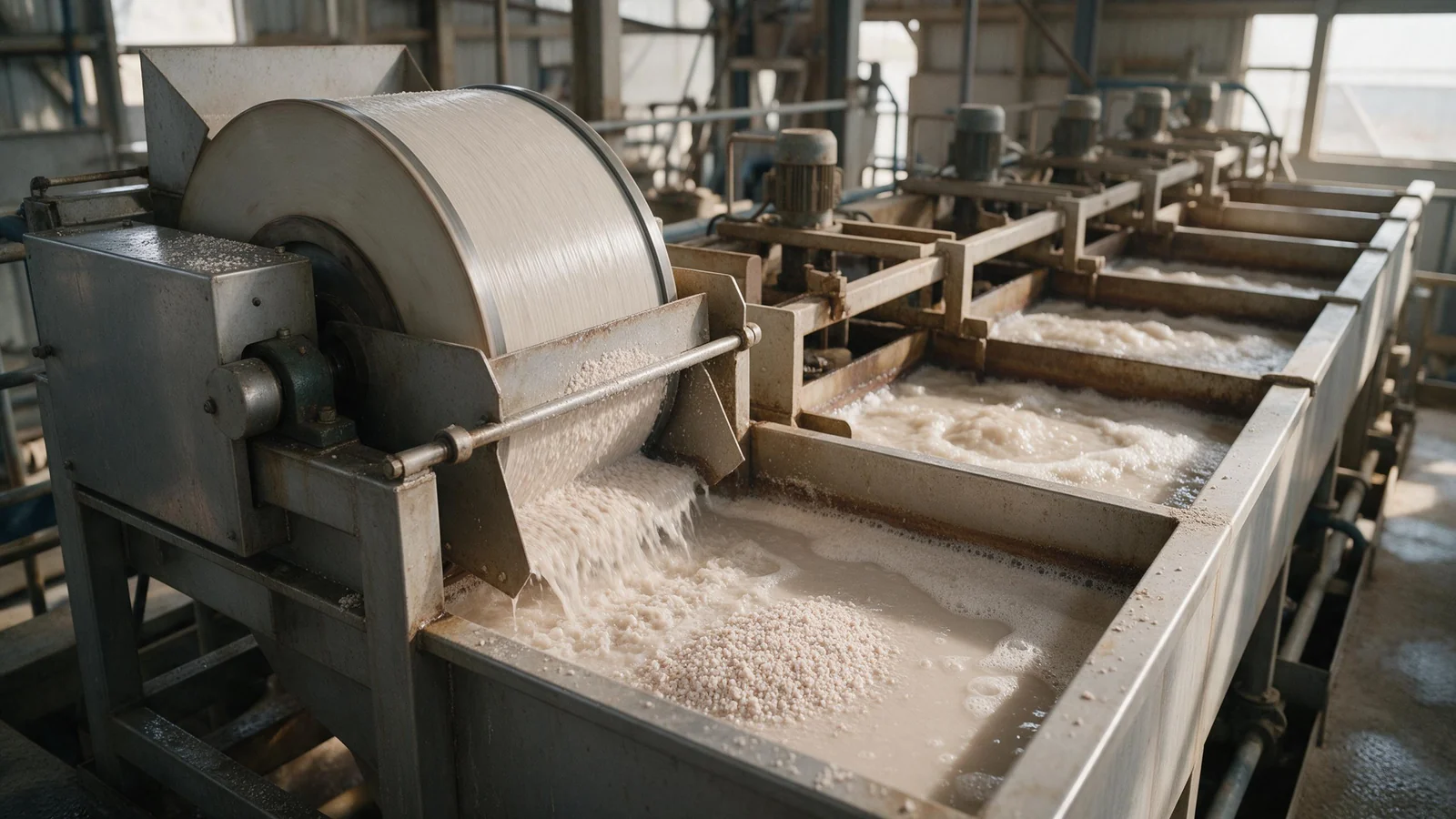
Header image: illustrative, not a photograph of a specific project.
Say a mine owner asks how to turn run-of-mine feldspar into a saleable glass-grade product. Feldspar processing isn't one machine or one reagent. It's a sequence of mineralogy-led unit operations. You'll need crushing, grinding, ore washing, magnetic separation, and flotation. Arrange them to suit your ore. Don't copy another plant.
Feldspar mineralogy and why impurities matter
Feldspar is a group of framework aluminosilicate minerals built around potassium, sodium, or calcium. The three main end members are potassium feldspar (orthoclase or microcline), sodium feldspar (albite), and calcium feldspar (anorthite). Most commercial ores mix these. They're intergrown with quartz and mica.
The impurities that matter are iron-bearing minerals: magnetite, haematite, biotite, garnet, tourmaline, and sometimes amphibole. These show up in the lab. Quartz can be an impurity, too, if the buyer wants a high K2O or Na2O product. Quartz dilutes the alkali content. Mica is both an iron source and a physical nuisance. It complicates flotation and filtration.
Iron makes or breaks value in glass and ceramic markets. It colours the melt. In glass, it can shift the transmission spectrum. Ceramic bodies are more forgiving. But iron still causes fired colour shifts. According to the USGS, feldspars are estimated to constitute 60 percent of Earth's crust (USGS Mineral Resource of the Month). That abundance doesn't mean every feldspar ore is saleable. Impurities decide that.
What feldspar processing must achieve
Feldspar processing has three jobs. First, remove iron-bearing minerals to raise whiteness and chemical grade. Second, separate feldspar from quartz and mica. Otherwise the alkali content gets diluted. Third, produce a concentrate with stable K2O, Na2O and Fe2O3 levels. Lot after lot.
The exact limits come from the buyer's specification. Not from a textbook. Glass batch sheets set a maximum Fe2O3. Often a minimum combined alkali, too. Ceramic tile consumers accept higher iron. But they'll reject colour inconsistency just as quickly. The USGS estimated end-use distribution in 2021 was glass, 65%, and ceramic tile, pottery, and other uses, 35% (USGS Mineral Commodity Summaries 2022). So don't design a flowsheet around a generic iron number. Design around the specification your buyer signs. Build in enough polishing capacity to hold that spec when ore variability hits.
This is where testwork pays for itself. Run a mineralogical scan, then a bench-scale flowsheet, then a locked-cycle test. That tells you which unit operations can actually reach the spec. Ordering equipment before that work is a bet. Not a design.
How to validate a flowsheet before EPC
Don't order a single piece of equipment until the flowsheet is proven on your own ore. Start with mineralogy. Identify the feldspar species, the iron minerals, the mica types, and the liberation size. Then run batch flotation and magnetic tests. Use them to set reagent dosages and magnetic intensity. Move to locked-cycle tests. They simulate the closed circuit and show the circulating load and final concentrate grade. If the ore is complex or the plant is large, run a pilot campaign on a few tonnes. It catches scale-up problems.
Write acceptance criteria into the EPC contract before construction. These aren't guesses. They're the test results your flowsheet achieved. For example, the contract can list a target concentrate Fe2O3, a minimum K2O plus Na2O, a moisture limit, and a threshold recovery at the specified grind size. Put them in writing. If the pilot can't meet those numbers, don't proceed. Fix the flowsheet first.
An accredited laboratory helps here. Xinhai's mining research institute operates a CNAS-accredited laboratory covering 70+ ore types, about 5,000 element analyses per month, and Bond work index testing. Use external lab results to challenge internal assumptions. A second opinion on mineralogy and flotation response is cheap. A failed plant is not.
Crushing and grinding flowsheet design
Crushing starts with a jaw crusher for primary reduction. Then a cone crusher or high-pressure grinding roll takes the feed down to about 10 to 20 mm. Don't grind in the crusher. You're just giving the mill a feed it can handle without overloading.
Grinding is usually done in a ball mill. It runs in closed circuit with a spiral classifier or hydrocyclone. The circulating load keeps the mill working on coarse particles. The classifier sends fines to the next stage. You can grind dry or wet. Dry grinding saves water. It can cut the downstream drying load. But it makes dust and often needs an air classifier. Wet grinding is smoother and easier to control. But it lets steel media and liners introduce iron into the pulp.
That's a key point. If you want a low-iron product, don't add iron faster than magnetic and flotation can remove it. Options include high-alumina or rubber liners, ceramic grinding media, or a combination. Try them. Then the downstream iron-removal circuit only has to handle the ore's own iron. Not the mill's.
| Criterion | Dry grinding | Wet grinding |
|---|---|---|
| Water use | Minimal | Requires process water |
| Dust control | Baghouse or air filtration needed | Dust contained in slurry |
| Iron contamination | From steel media and liners if used | From steel media and liners, often higher due to corrosion |
| Product size control | Air classifier | Hydrocyclone or spiral classifier |
| Common in feldspar | Used where water is scarce or downstream is dry | Most common because flotation is wet |
After grinding, the pulp goes to washing and desliming. Do that before any magnetic or flotation step.
Ore washing and desliming
Ore washing isn't optional on weathered granite or placer feldspar. Clay and fine silt coat the mineral surfaces. They carry iron. A rotary scrubber or log washer, then screens and a hydrocyclone, removes the slimes before separation. Desliming also pulls out fine mica and clay. Otherwise they'd blind magnetic separators and over-consume flotation reagents.
The benefit is immediate. Fe2O3 drops. K2O and Na2O rise. Downstream machines see clean surfaces. But don't over-deslime. Some fine feldspar is valuable. Cutting too much of the -20 micron fraction can hurt recovery. Set the cut point from the ore's particle size distribution and flotation kinetics. Testwork determines it. Not guesswork.
Magnetic separation for iron removal
Magnetic separation is the workhorse for iron removal in feldspar processing. The iron minerals in feldspar ore are usually weakly magnetic. Haematite, biotite, garnet, tourmaline, and sometimes amphibole. They won't respond to a low-intensity drum magnet. You need high-intensity or high-gradient separation.
A rare-earth roll separator or a wet high-gradient magnetic separator (WHGMS) can pull out fine iron-bearing particles down to a few microns. That's the range you want. For dry fine feed, a rare-earth roll with an induced magnetic field works well. It's a simple setup. For wet slurries, use a vertically oriented WHGMS with a matrix of steel wool or expanded metal. High capture efficiency.
Run magnetic separation before flotation. It cuts the iron load. Then flotation doesn't have to do the heavy lifting. It also removes magnetic particles that would otherwise contaminate the feldspar concentrate. Good riddance. In some ores, a single pass is enough. In iron-rich ores, you may need rougher and cleaner magnetic stages.
Flotation to separate mica and quartz
Flotation is where the final purification happens. Two tasks. First, remove mica and residual iron or titanium minerals. Then split feldspar from quartz. That raises the alkali content.
Mica flotation is usually done first. Acidic or alkaline conditions, depending on the collector. The mica floats away as a froth product. You're left with a feldspar-quartz mixture. Then, in a second flotation stage, feldspar is floated from quartz. Use an amine collector in an acidic circuit. Often with hydrofluoric acid or a fluoride-free alternative. The fluoride-free route is increasingly preferred. You avoid handling strong acid and get cleaner effluent.
Reagent selection depends on the impurity minerals present. A heavy biotite content needs a strong mica collector. Simple as that. Titanium minerals like rutile or sphene may require a separate stage or a depressant. Test to find out. You can't copy a reagent scheme from another ore body and expect it to work. Run bench flotation, then locked-cycle tests. They'll tell you what floats first, what depresses, and the final concentrate grade.
That's why flowsheet validation before EPC isn't a formality. It's the difference between hitting spec on day one and chasing a recovery curve for years. Learn more about the testwork sequence in our mineral processing test services.
Dewatering, tailings and plant integration
After flotation, you have a slurry. Thicken and filter it before shipping. A high-rate thickener removes most of the water. Then a vacuum disc or plate-and-frame filter brings the concentrate to the buyer's moisture spec. Don't underestimate this step. A wet concentrate can freeze, dust, or pay freight on water. All bad.
Tailings management is just as important. Thicken the iron-rich, mica-rich tailings from magnetic and flotation circuits. Where the site permits, dry stack them. Water recovery is standard engineering now. Not an option. Recycle process water back to grinding and flotation. It cuts fresh water demand and reduces effluent volume.
In an EPC flowsheet, these steps aren't bolted on later. They're part of the mass and water balance from the start. A modular plant can package crushing, grinding, magnetic separation, flotation, and dewatering into transportable skids. But the same principles apply. The flowsheet must close the water loop, handle the tailings, and still hit the concentrate spec. If it can't do that on paper, it won't do it on site. For a broader view of plant configuration, see modular mineral processing plants and the factors that shape mineral processing plant cost.
Frequently asked questions
What are the three main types of feldspars?
The three main types are potassium feldspar (orthoclase or microcline), sodium feldspar (albite), and calcium feldspar (anorthite). Easy to remember. Commercial ores are usually solid solutions between these end members. It's a spectrum.
What is feldspar used for in industry?
The USGS estimated the 2021 end-use distribution: glass, 65%, and ceramic tile, pottery, and other uses, 35%. Feldspar acts as a flux. It also supplies alumina and alkalis in glass and ceramic bodies.
How is iron removed from feldspar?
You remove iron with high-intensity magnetic separation and flotation. Magnetic separation pulls out weakly magnetic iron minerals. Haematite, biotite, garnet. Flotation then removes residual mica and iron/titanium minerals. It also separates feldspar from quartz.
What equipment is used in feldspar processing?
A typical flowsheet uses a jaw crusher, cone crusher, ball mill in closed circuit with a classifier, ore washing and desliming equipment, high-gradient or rare-earth magnetic separators, flotation cells, thickeners, and filters. That's the lineup. The exact selection depends on the ore's mineralogy and the buyer's specification. Those two rule.
Request a proposal for your ore
What to send for a useful reply
- Head assays and, if you have them, a phase or mineralogy report
- Target throughput in t/d and the product you want to sell
- Project stage: exploration, feasibility, financing or expansion
- Site basics: country, power, water and access
Not ready to share data yet? Read the EPC turnkey delivery page first.