Types of Gold Ore and How Each Is Processed
A mine owner's field guide to classifying gold ore by behaviour, not by appearance.
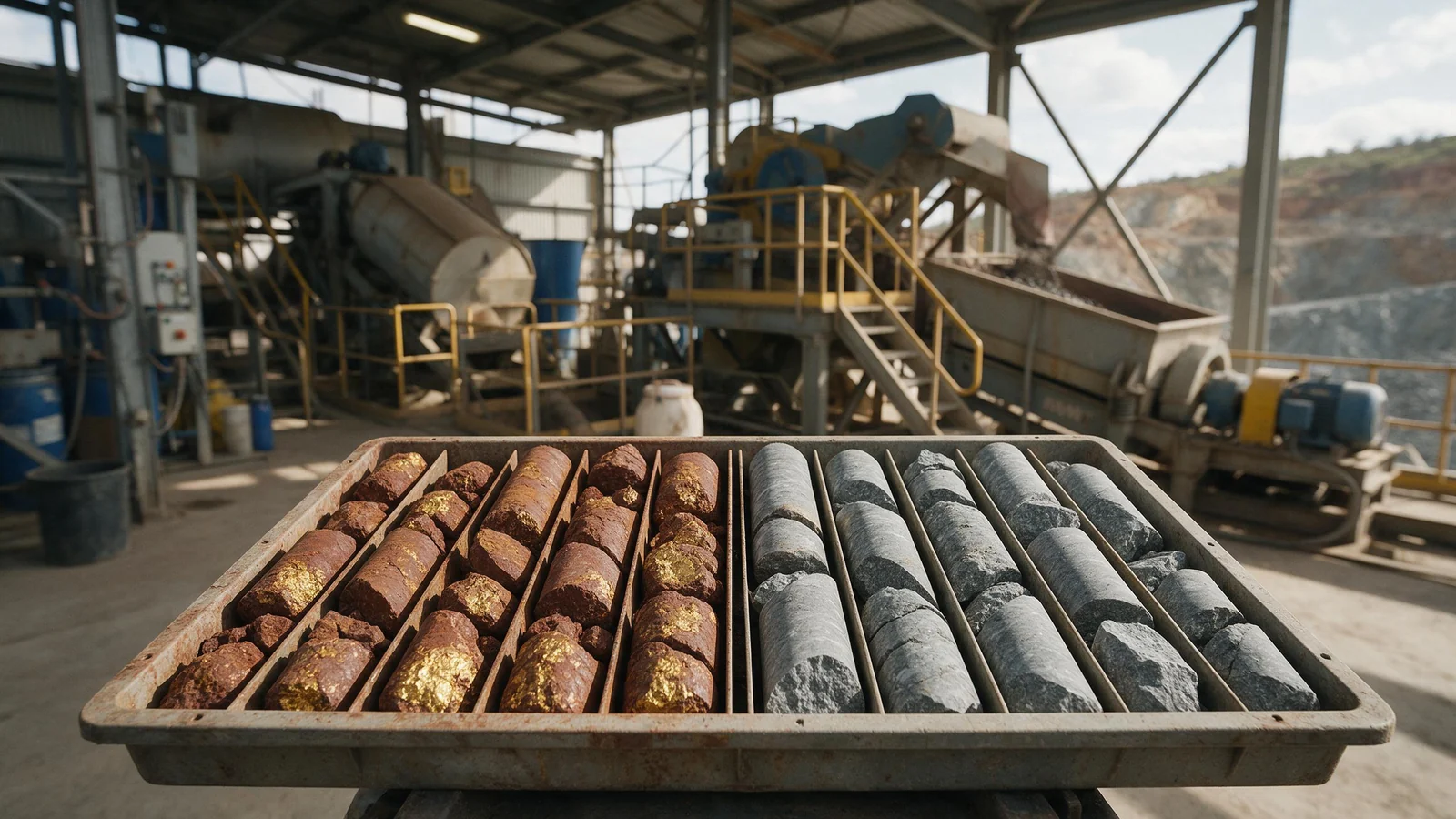
Say a mine owner asks how to classify types of gold ore before committing capital. You can't answer from a photograph. You answer from testwork. It's that simple.
What Actually Defines a Gold Ore Type
Gold ore isn't one rock. It's a behaviour. What matters to a plant builder is how the gold occurs: free or locked, visible or invisible, hosted in quartz or sulphide, oxidised or unoxidised. A single deposit can hold several ore types. The boundary between them isn't visible in the pit. You define the types from mineralogy and metallurgical response, not from the colour of the rock. Fair enough?
That distinction drives everything downstream. Free gold in quartz behaves differently from gold locked inside pyrite. Carbonaceous preg-robbing ore behaves differently from both. The processing route, the capital cost and the operating strategy all follow the ore type. So before you buy a mill, you run tests. No shortcuts.
You almost always have a blend. The top of a deposit may be oxidised, the bottom fresh, and the boundary can be gradational. Don't classify the whole orebody as one type. Classify domains. Test each domain separately.
Free-Milling and Oxide Gold Ores
Free-milling ore is the kind everyone wants first. Crush it, grind it, and the gold particles expose themselves. They aren't locked inside sulphide minerals. Quartz-vein ore, granite-hosted ore and weathered or oxidised ore usually start in this group.
Gravity separation pulls out the coarse gold first. A simple Knelson concentrator or a jig will recover the larger free particles. Then cyanide leaching, usually CIP or CIL, dissolves the fine gold that gravity missed. Heap leaching works for some oxidised ores that are too low grade to justify milling. The exact choice between CIP, CIL and heap leach depends on grade, clay content, and grind size. Heap leaching suits low-grade oxides where clay is not excessive and the ore is permeable. Milling and CIP suit higher grades or ores with swelling clays. Simple, right? Not always.
P80 is the size 80 per cent of the mass passes. It's the grind target your metallurgist will set for the leach test.
We cover oxidised ore in far more depth on our oxidised gold ore page, so I won't repeat that here.
At the Porgera Gold Mine, coarse free gold is recovered using Knelson Concentrators. The remaining slurry is treated by flotation for fine free gold and refractory gold locked in sulphide minerals (Cyanide Code summary). Gravity first, then flotation. That sequence is a practical pattern for many free-milling ores that also carry a small refractory fraction.
For a free-milling or oxide ore, a CIP plant is often the workhorse. Xinhai reports a 3,000 t/d gold EPC+M+O operation contract in Guinea, and the project page shows the kind of circuit that follows from that testwork. It's a useful reference, not a universal answer.
Sulphide and Refractory Gold Ores
Refractory gold is the opposite. The gold is fine, often invisible. It sits inside pyrite or arsenopyrite. Direct cyanidation gives poor recovery because the cyanide can't reach the gold through the sulphide lattice. You need an extra step to break the sulphide first. Ever seen a roast lab test? That smell tells you a lot.
Flotation concentrates the gold-bearing sulphides. Then you oxidise the concentrate. Roasting, pressure oxidation and bio-oxidation are the three common routes. The Kittilä Gold Mine in Finland uses pressure oxidation in an autoclave, followed by dissolution, electrowinning and smelting before pouring doré bars, as described in the mine's Cyanide Code report. That's a textbook refractory flowsheet.
Arsenopyrite-hosted gold is a classic refractory case. It's not rare. It punishes a flowsheet that assumes free-milling behaviour. Before you choose flotation or oxidation, test the ore's cyanide response after fine grinding. If the extraction is poor, treat it as refractory until proven otherwise. Sound harsh? It's cheaper than rebuilding a plant.
Roasting is simple but produces off-gases. Pressure oxidation is capital heavy but handles arsenic. Bio-oxidation is slower but runs at lower temperature and pressure. The choice depends on the concentrate mineralogy and the site's environmental constraints.
The Cuiabá Process at the Queiroz Gold Plant reports a gold recovery of 93.5% for its ore type, as documented in the Cyanide Code report. That shows what a well-designed oxidation step can unlock. It's a specific plant, not a promise for yours.
Carbonaceous and Preg-Robbing Gold Ores
This ore type deserves its own category, and too many guides skip it. Carbonaceous matter in the ore adsorbs dissolved gold from the cyanide solution, stealing it back after you've dissolved it. That is preg-robbing. You can't see it by looking at the rock. You detect it with a preg-robbing test: you spike a cyanide solution with a known amount of gold, contact it with the ore, and measure how much gold disappears from solution. If the ore grabs a significant fraction, you have a preg-robbing problem. Does that sound like a lab curiosity? It's not.
Processing options include blanking agents that coat the carbon, roasting to burn it off, or running CIL with enough activated carbon to outcompete the natural carbon. The choice depends on the carbon content and the ore's response. Don't let anyone sell you a standard CIP circuit for a preg-robbing ore without that test. I've seen that mistake more than once.
The preg-robbing test is not standard in every laboratory. You may have to ask for it specifically. If the ore contains graphitic schist or black shale, insist on it before any leach plant decision.
Alluvial and Placer Gold Deposits
Alluvial gold is free gold that has already left the hard rock. It sits as loose particles in river sands, gravels or blue clay. No crushing, no grinding, no cyanide. You recover it with gravity alone: sluices, jigs, shaking tables, spiral chutes and centrifugal concentrators.
Capital costs are lower. Small operations can start quickly. The trade-off? The deposit is usually shallow and limited in tonnage. You still need testwork, but the test is a simple gravity recovery test on a representative bulk sample, not a full leach programme.
The first question for alluvial is not the process, it's the deposit. Drill or pit the gravel to get a grade and a volume. Then run a bulk sample through a pilot sluice or jig. Sounds obvious, but plenty of startups skip it.
Explore the full gravity and leaching options on our gold processing solutions page.
Diagnostic Testwork: Matching Ore Type to Process Route
Here's the part most ranking pages miss. You don't choose a process route by reading a list. You choose it from a testwork sequence that maps the ore's behaviour. Make sense?
Start with sampling. Then sample preparation, chemical assay and mineralogy. Then exploratory tests, condition tests, locked-cycle tests and, if the ore justifies it, a pilot run. Each step answers a question: Is the gold free? Does gravity recover it? Does cyanide dissolve it? Does carbon steal it back? Four questions, four routes.
The mapping is sequential. Gravity first, because it's cheapest. Then cyanide leach on the gravity tail. If cyanide extraction is poor, run a diagnostic leach with a stronger oxidant to see whether the problem is sulphide locking or preg-robbing. That single result changes the flowsheet. It's that specific.
Xinhai reports, according to its published figures, a CNAS-accredited laboratory that supports 70+ ore types and about 5,000 element analyses per month. You can see the company background on the about page. But don't take that on faith. Ask any supplier for the full test report before you approve a flowsheet. A glossy brochure won't save a bad leach test.
Copy this checklist for your next testwork campaign:
- Collect representative samples from each ore zone, not one blended grab sample
- Run chemical assay and mineralogy before any process test
- Run a gravity recovery test on a sized fraction
- Run cyanide leach tests at two or three grind sizes
- Run a preg-robbing test if the ore contains any carbonaceous matter
- Ask the supplier to map each test result to a specific unit operation
That sequence is the decision tree. You don't need a full pilot for every ore, but you need the first four tests as a minimum. Skipping them is gambling, not engineering.
Ore Type vs Processing Method: A Quick Reference
| Ore type | Typical host minerals | Testwork trigger | Processing route |
|---|---|---|---|
| Free-milling | Quartz, granite | Visible gold or high gravity recovery | Gravity + CIP/CIL or heap leach |
| Oxide | Weathered rock, iron oxides | Low sulphide sulphur, good cyanide response | CIP/CIL or heap leach |
| Sulphide/refractory | Pyrite, arsenopyrite | Poor cyanide extraction after fine grinding | Flotation + oxidation (roasting, POX, bio-oxidation) |
| Carbonaceous preg-robbing | Carbonaceous shale, graphitic schist | Positive preg-robbing test | Blanking agents, roasting, or CIL with high carbon |
| Alluvial/placer | River sands, gravels, blue clay | Free gold in loose sediment | Sluice, jig, shaking table, spiral, centrifugal concentrator |
Use this table as a starting point, not a substitute for testwork. The ore in your ground will have its own quirks. Count on it.
Frequently asked questions
How can I tell if a rock is gold ore?
You can't tell reliably by eye. Gold in ore is often fine, locked in sulphides, or invisible to the naked eye. A rock with visible gold in quartz or heavy sulphide staining is a hint, but only a laboratory assay tells you the grade. Start with sampling and sample preparation, then run a chemical assay and mineralogy. That sequence gives you a real answer. No guesswork.
What rock is most likely to have gold in it?
Quartz veins and sulphide-bearing rock, especially arsenopyrite and pyrite, are common hosts. But there's no single rock type that's most likely everywhere. Gold occurrence depends on fluid pathways and host rock chemistry in a particular district. Chalcopyrite and galena can also carry byproduct gold. Local geology matters more than rock name. Surprised? Most people are.
What are the ores of gold called?
Gold ores are usually named by host mineral or processing behaviour. You'll hear free-milling ore, oxide ore, refractory sulphide ore, carbonaceous preg-robbing ore, and alluvial or placer gold. The names reflect how the gold responds to extraction, not just what the rock looks like. That's the key.
How do I identify gold ore before choosing a processing route?
You don't identify it by visual inspection. You collect a representative sample and run a testwork sequence: chemical assay, mineralogy, gravity recovery test, cyanide leach test, and preg-robbing test if carbonaceous matter is present. The results map the ore to a route. Gravity for coarse free gold, CIP/CIL for fine free gold in oxide ore, flotation plus oxidation for refractory sulphides, and blanking or roasting for carbonaceous ore. Without those tests, any route choice is a guess. Plain as that.