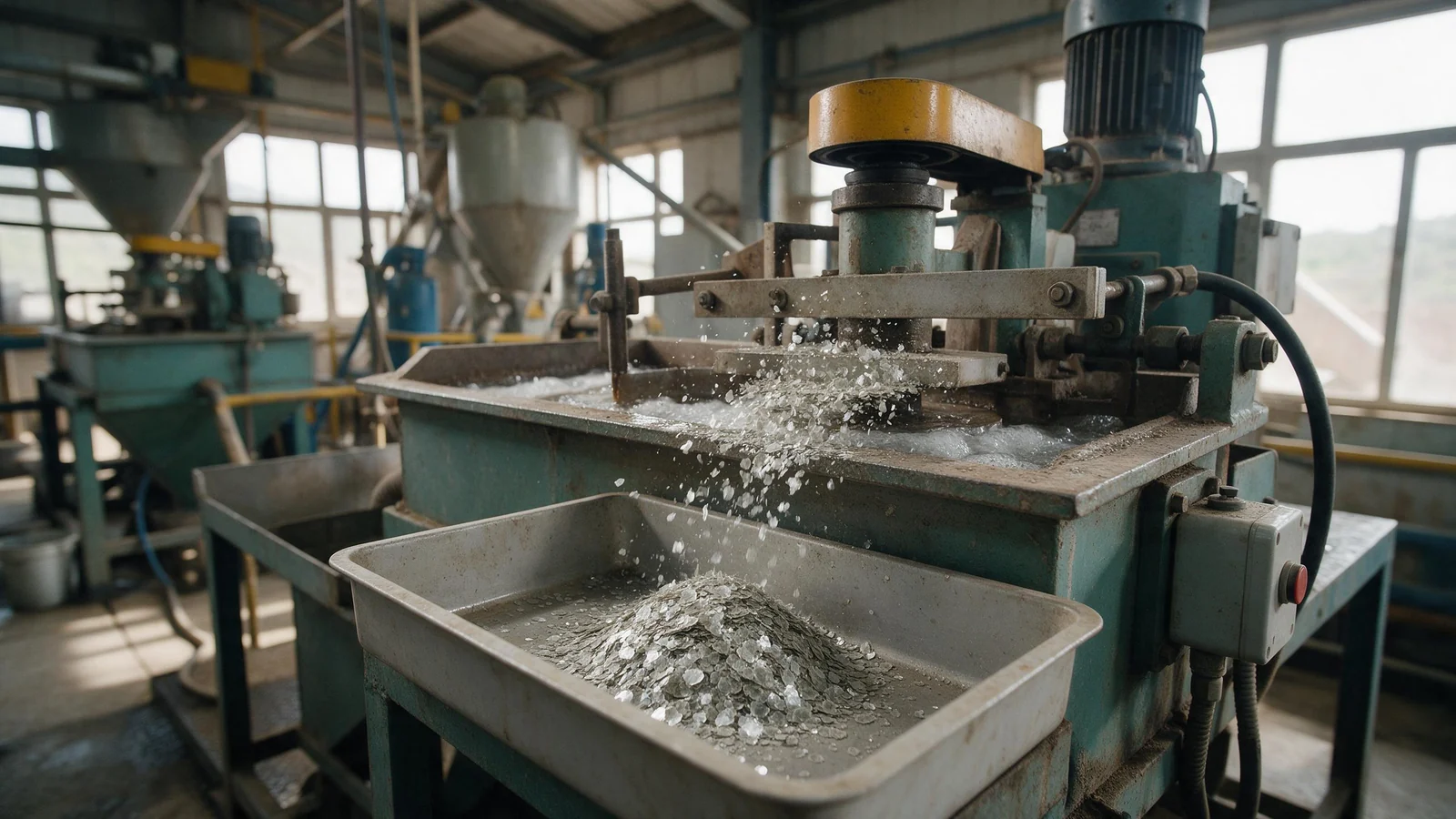
Mica Processing: Flotation and Grinding
Mica processing is a study in trade-offs: grind too hard and you ruin the flakes, grind too little and liberation suffers. These field notes stake out the dry and wet routes.
Header image: illustrative, not a photograph of a specific project.
Mica mineralogy and product types
Say a mine owner asks why two mica samples that look identical end up in completely different markets. That's the core question in mica processing, and you'd better answer it before drawing any flowsheet. Mica isn't one mineral. It's a group of platy phyllosilicates. The main industrial species are muscovite, phlogopite, biotite and lepidolite.
Sheet mica gets mined and sold as large, flexible books or splittings. Flake mica and scrap mica are the far bigger tonnage products. They feed paints, plastics, drilling fluids and construction materials. The U.S. Geological Survey publishes statistics and information on worldwide mica supply and demand, and it's a solid reference when you need market context. USGS mica statistics draw those product streams clearly.
What makes mica useful is its platy structure, high temperature resistance, electrical insulation and chemical inertness. But the value of a mica product hinges on flake size and aspect ratio. A thick, clean muscovite sheet behaves very differently from a fine, delaminated flake. Ore type matters. Pegmatite mica is coarse. Schist mica is finer and often loaded with iron-bearing minerals.
Mica mining and run-of-mine characteristics
Open-pit mining dominates mica-bearing pegmatites, but some underground operations chase high-value sheet mica. Mica also shows up as a by-product from feldspar and kaolin plants. That by-product route shapes the economics. You're not building a mica mine. You're building a plant that must recover mica without hurting the primary product.
Run-of-mine mica ore is variable. One bench may hold coarse books, the next a mass of fine flakes and clay. Slimes content drives flowsheet choice more than most owners expect. Fine clays blind screens, consume reagents and choke flotation. Before you commit to a plant, get a proper mineral processing test. Batch and locked-cycle tests on your own ore answer the slimes question. Skip that, and you'll design the plant twice: once on assumptions, once on real ore.
An EPC contractor with Xinhai's published record of 600+ mine EPC+M+O projects, according to the company's published figures, has likely seen the same mistake in several forms. The fix doesn't change. Characterise the ore. Count the slimes.
Crushing, screening and classification
Mica flakes need liberation, not destruction. Two-stage crushing is common. The first stage reduces run-of-mine rock. The second stage opens the rock without over-grinding the flakes. The U.S. Environmental Protection Agency's AP 42 Section 11.19.2 describes how crushing and screening work for stone processing. It notes jaw, impactor or gyratory crushers for initial reduction, and cone crushers for secondary crushing. AP 42 Section 11.19.2 is worth reading if you're specifying a crushing plant.
After crushing, screening separates flakes by size. Coarse flakes go one way, fine flakes another. Classification then removes fine slimes before the separation stage. Xinhai's XHCV hydrocyclone series covers 50 to 800 m³/h, and that sort of range is what you'll discuss with any equipment supplier when you're sizing a desliming circuit. Plant design services can help match classification equipment to your slurry volume.
Dry grinding vs wet grinding
Here's the decision most mica projects get wrong. Dry grinding is simpler. No water. No slurry handling. But dry grinding damages flake morphology. You get lower aspect ratio, more fines and often higher impurity because liberated gangue stays mixed in. Wet grinding preserves flakes better. It produces higher aspect ratio, smoother surfaces and lets you feed flotation or magnetic separation directly.
| Criterion | Dry grinding | Wet grinding |
|---|---|---|
| Flake preservation | Lower aspect ratio, more crystal damage | Higher aspect ratio, smoother surface |
| Water and reagent load | No slurry water, fewer reagents | Slurry circuit, reagent conditioning |
| Impurity control | May lock in liberated gangue | Allows flotation and magnetic removal |
| Typical use | Low-value fillers, early liberation | High-value mica, phlogopite, wet separation |
Choose dry grinding when water is scarce, the end-use is a low-grade filler, and the plant can tolerate mineral impurities. Choose wet grinding when flake quality, aspect ratio and purity matter. That's not a cost decision alone. It's a product specification decision. Ask any supplier for particle size distribution and aspect ratio test data before you select a route.
Gravity, flotation and magnetic separation
Coarse flake mica can be recovered by gravity methods in some deposits. Spiral or table separators exploit the flat particle shape. But the real workhorse for mica-quartz-feldspar separation is flotation. Cationic collectors float mica in acidic or alkaline circuits. Anionic collectors work with certain activators. The reagent scheme depends on the gangue mineralogy and water chemistry.
Desliming is not optional. Fine slimes consume collector and blind the froth. If you don't remove them, the circuit recovers dirt, not mica. Magnetic separation then removes iron-bearing contaminants like biotite, tourmaline or garnet. The order matters. Float first, remove iron later, or the reverse, depends on assay data. A rational process design checklist looks like this.
- Run ore characterisation: XRD, particle size distribution, slimes content.
- Test flotation collectors and pH on the actual slime-free feed.
- Confirm magnetic susceptibility of iron contaminants.
- Closed-circuit test the full route, including water recycling and tailings handling.
That checklist is short. Running it properly takes months. But it saves a plant that otherwise won't meet specification. Modular plants work particularly well for mica projects because the process can be locked in at pilot scale before committing to full site construction.
Dewatering, drying and product grading
Wet mica slurry needs thickening and filtration. A thickener recovers process water. A filter press or vacuum filter produces a cake. Then you dry it to a stable moisture. The drying step is where many plants lose money. Overdrying is waste. Underdrying causes caking in bags and silos.
After drying, product grading separates the final mica into market fractions. Screens do the coarse work. Air classifiers handle fine cuts. The final specification is usually flake size distribution plus aspect ratio plus impurity content. A buyer doesn't care how you dried it. They care that the flake opens correctly in their polymer or coating.
Your process design should include a grading loop that returns oversize to the mill. That return load must be designed for. If you don't include it, the mill becomes the bottleneck.
Mica as a gangue mineral in feldspar and lithium processing
Mica is not always the product. In feldspar and spodumene circuits, mica is a penalty mineral. It carries iron, potassium and sometimes fluorine. It must be separated cleanly, or the ceramic or battery-grade product fails specification. This is the second life of mica processing: as a gangue removal step.
Flotation schemes reject mica early. A common approach floats mica with a cationic collector, then floats feldspar from quartz in a second stage. In spodumene circuits, mica removal is often the first flotation bank. The target is simple: remove mica without losing lithium. Fine mica slimes are the enemy again. They consume reagents and stabilise froths that entrain spodumene.
Process water quality also shifts. Mica surface charge changes with pH and dissolved ions. Recycle water can accumulate collectors and depressants. A closed water balance is not a nice-to-have. It's part of the design. Ignore it, and the mica removal circuit works in the pilot plant and fails on site.
Ask a supplier about their laboratory support before you sign anything. Xinhai's mineral research institute operates a CNAS-accredited laboratory covering 70+ ore types and about 5,000 elemental analyses per month. That level of analytical throughput is what you need when you're troubleshooting a gangue rejection circuit. Contact a process engineer and ask for the ore characterisation report format they expect.
Frequently asked questions
Which country has the largest deposits of mica?
A buyer asking that question is usually deciding where to seek supply or where a deposit sits in the global cost curve. Deposit size alone is the wrong filter. Sheet mica, flake mica and scrap mica trade in separate markets, and a huge deposit of fine flake mica can be worth less than a small deposit of thick, high-aspect-ratio sheet. The U.S. Geological Survey publishes worldwide mica statistics and deposit information. Ask any supplier for the flake size distribution, aspect ratio and impurity profile, not the headline tonne number.
Is mica similar to asbestos?
No. Mica and asbestos belong to different mineral groups. Mica is a platy phyllosilicate that splits into elastic sheets. Asbestos is a fibrous silicate group regulated for its respirable fibre hazard. Some mica deposits may contain amphibole or other minerals, so a proper mineralogical check matters. For plant design, the key question is whether your ore contains fibrous minerals at all, and what your local dust and workplace exposure rules require.
Is mica worth money?
It can be, but value depends on flake size, aspect ratio, purity and whether it is sheet mica, flake mica or scrap. Coarse, high-aspect-ratio flakes with low iron command premium markets. Fine powder for filler is a different product. A mine owner should not ask 'is mica worth money' but 'which mica products can this orebody make and what specifications do those buyers require'.
Is mica a hazardous material?
Mica itself is not classified as hazardous in the same way as asbestos or silica, but dry mica dust can be a nuisance particulate. Processing plants still need dust collection, ventilation and correct personal protective equipment. If the mica contains free silica or fibrous contaminants, the hazard profile changes. Always check the ore mineralogy and your local occupational exposure rules.
Request a proposal for your ore
What to send for a useful reply
- Head assays and, if you have them, a phase or mineralogy report
- Target throughput in t/d and the product you want to sell
- Project stage: exploration, feasibility, financing or expansion
- Site basics: country, power, water and access
Not ready to share data yet? Read the EPC turnkey delivery page first.