Dolomite Processing Plant: Crushing to Powder
Say a mine owner asks what a dolomite processing plant should look like before the testwork is done.
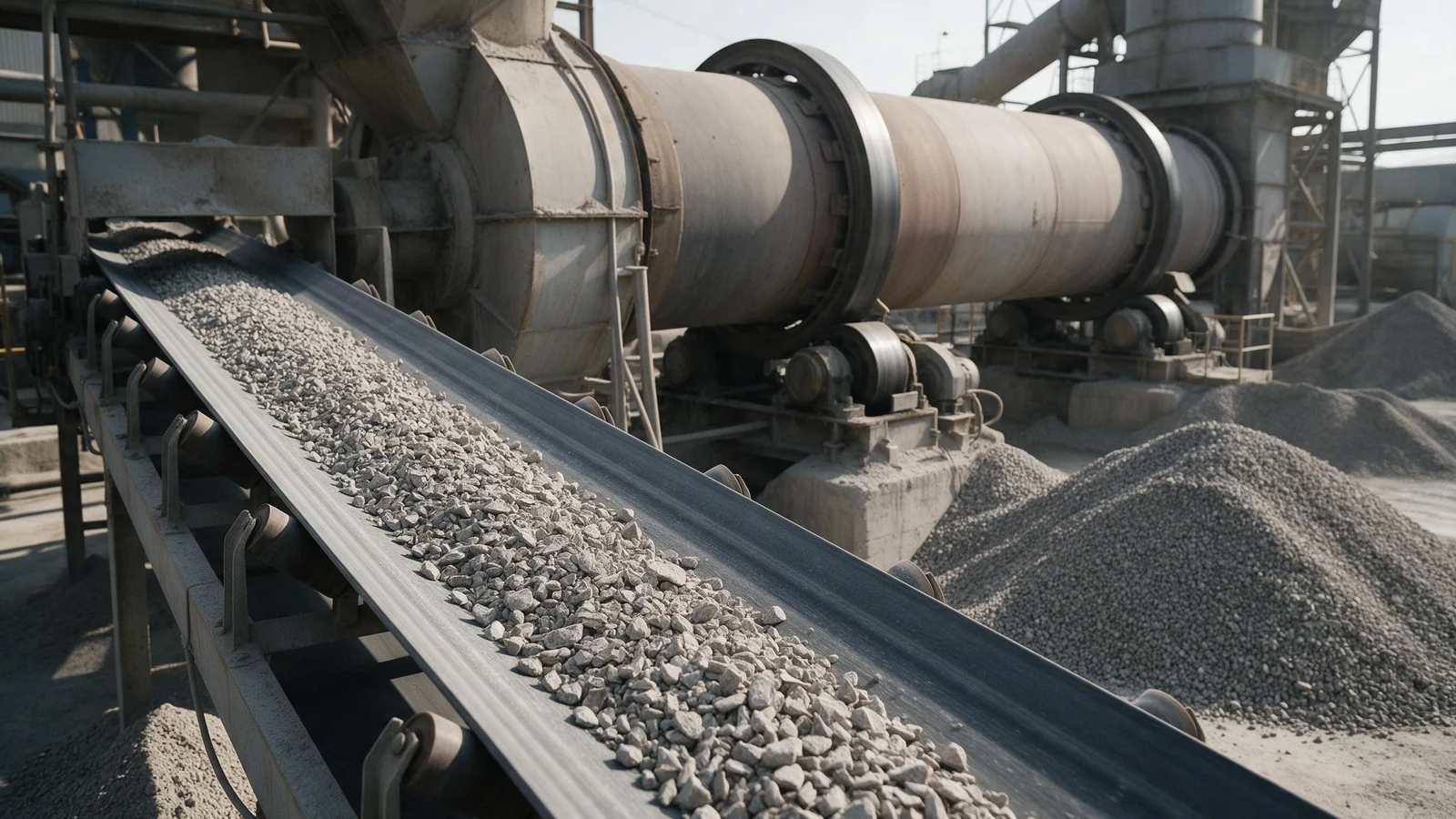
Header image: illustrative, not a photograph of a specific project.
Say a mine owner asks what a dolomite processing plant actually does before any capital is committed. They aren't after a brochure. They need a route. Crushing, grinding or calcining. Each route changes the plant, the capital plan and the environmental permit. If you pick the wrong one, you'll spend months fixing it.
What a dolomite processing plant actually does
Dolomite is calcium magnesium carbonate, CaMg(CO3)2. That double carbonate makes it useful in construction aggregate, glass manufacture, steel flux, agricultural lime and as a raw material for refractory products. But the plant isn't defined by the mineral. It's defined by the saleable product. A road base producer and a filler powder producer both start with the same rock. They don't share a flowsheet.
| Plant type | Typical product | Core process sequence | Selecting factors |
|---|---|---|---|
| Crushing and screening | Road base, concrete aggregate, sized stone | Primary jaw, secondary cone or impact, screens, washing | High tonnage, low unit value, feed moisture, particle shape |
| Grinding and classification | Fillers, glass flux, drilling mud, mineral wool | Mill, classifier in closed circuit, dust collection | Target fineness, brightness, contamination, energy cost |
| Calcination | Dolomitic lime, dead burned dolomite, refractory raw material | Preheater, rotary kiln, cooler, gas cleaning | Fuel cost, kiln retention time, CO2 emissions, product reactivity |
That table is your first decision framework. Start with the product specification, not the ore. A filler plant rarely makes sense at aggregate tonnage, and a calcination plant won't run on aggregate margins. If you're unsure, run a market study before a test programme.
Crushing and screening: from run-of-mine to usable stone
The first stage is blunt. The US EPA's AP 42 section on crushed stone processing states that quarried stone normally is delivered to the processing plant by truck and is dumped into a hoppered feeder, usually a vibrating grizzly type, or onto screens. Jaw, impactor or gyratory crushers are usually used for initial reduction. On a dolomite operation, you'll usually pick a jaw for the primary unless the feed is exceptionally blocky. The jaw reduces the run-of-mine lump to something a cone can handle. The crusher product is normally 7.5 to 30 centimetres (3 to 12 inches) in diameter, and the grizzly throughs are discharged onto a belt conveyor, according to the same AP 42 source. Cone crushers then take it down to about 2.5 to 10 centimetres, as the same document notes. Screening closes the loop. Oversize goes back to the cone. If your deposit is weathered, add a washing stage. Clay blinds screens and quietly cuts your throughput. Test the feed moisture before you buy the screen. The jaw crusher's product shape is blocky, not cubical. That works for road base but not always for concrete aggregate. If your market wants cubical particles, a secondary impactor may be needed. Ask the concrete spec first.
Grinding and classification for dolomite powder
Once the product is a powder, the plant changes shape. The mill is the heart, but the classifier controls what leaves the circuit. You'll see ball mills, vertical roller mills and Raymond-style mills used across the industry. The right choice depends on hardness, moisture and target fineness, not on brand loyalty. The target fineness is usually expressed as a P80, the size 80 per cent of the mass passes. A filler customer may want nearly all of the product under a certain micron size. The classifier returns the coarse fraction to the mill. That loop is the heartbeat. Break it and you'll either send oversize to the customer or waste energy grinding fines. Dust collection is not an afterthought. A dolomite grinding plant runs under negative pressure so fine product doesn't escape into the building. Baghouse filters, cyclones and proper ducting are part of the process, not optional extras. If the plant isn't tight, your operators will know before the environmental inspector does. A vertical roller mill can dry and grind in one machine, which helps if your feed arrives wet. A ball mill in closed circuit with a classifier is more forgiving on hard or abrasive feed. The choice is economic, not universal.
Calcination: making dolomite lime and refractory raw material
Calcination is where dolomite becomes a different chemical product. The double carbonate decomposes in two stages. The magnesium carbonate breaks down first, then the calcium carbonate at a higher temperature. The kiln's job is to hold each stage long enough without dead burning the quicklime. A standard arrangement has a preheater, a rotary kiln and a cooler. Preheating recovers waste heat and saves fuel. The kiln provides the residence time for decomposition. The cooler stabilises the product and recovers heat back into the process air. Gas cleaning is not separate; it's built into the flow because the kiln off gas carries dust and CO2. The exact temperature profile depends on your feed chemistry and kiln atmosphere, so a test burn on your ore is worth more than a generic curve from a brochure. Dead burned dolomite needs a higher temperature than agricultural dolomitic lime. The term dead burned means the material has been fired long enough to reduce its reactivity. Refractory buyers measure porosity and hydration resistance. Your kiln operator will care about that. The USGS lime commodity chapter covers production of quicklime and hydrated lime, including dolomitic lime made by this route. If your market is steel or environmental use, that chapter is the first place to check demand. The broader USGS Mineral Commodity Summaries data sheets cover over 90 individual minerals and are where you'll find both lime and crushed stone chapters.
Beneficiation routes for higher-purity dolomite
Not every dolomite deposit is clean. Iron stains, silica and clay can downgrade a filler product or a refractory feed. Three beneficiation routes appear most often. Gravity separation works when the impurity is liberated at a coarse size. Magnetic separation attacks iron-bearing minerals. Flotation handles fine silicate gangue. None of these is selected from a textbook. You need a sample campaign first. A heavy liquid separation test will show if gravity can work. A magnetic susceptibility scan will show if iron can be pulled. A flotation batch test will show if the silicate can be floated away. Use a mineral processing test laboratory that understands separation, not just chemical assay. Some dolomite deposits can be upgraded simply by washing and attrition scrubbing to remove clay. That's the cheapest beneficiation there is, and it is often overlooked. Test it first.
How to evaluate an EPC contractor for a dolomite plant
This is where buyers get hurt. An equipment vendor sells machines. An engineering contractor sells a plant. The difference is scope. You need to see engineering, procurement, construction, commissioning and operation as five separate work packages, each with a named owner. Ask any contractor to map those five packages to your flowsheet. Who signs the process performance test? Who pays if the mill doesn't reach the target fineness? Who supplies critical spares in year two? Who holds the environmental permit? A one-page answer is a red flag. A full responsibility matrix is what you want. One contractor model is EPC+M+O: Engineering, Procurement, Construction, Mine Construction Management and Mine Operation Management. According to the company's published figures, Xinhai reports experience across more than 70 ore types. That breadth is a fact about their testwork laboratory and equipment manufacturing, not a claim that they have built a dolomite plant. Testwork is not optional. The flowsheet for this ore is set by testing the client's sample. A contractor who quotes equipment without a test programme is guessing. You'll want bond work index tests, chemical analysis, and beneficiation bottle tests before the first drawing is issued. Process guarantees are usually structured around a defined feed. If the feed changes, the guarantee may not apply. Read the testwork annex before you sign. If the contractor won't put the feed window in writing, you haven't got a guarantee, you've got a hope. After sales is usually where the pain shows up. Ask for the actual response procedure, not a promise. Ask which parts are held in stock. Ask about environmental compliance for dust and waste gas in your jurisdiction.
Plant design factors buyers should prepare
Before you approach a contractor, gather four things. Feed size distribution. Hardness and abrasiveness. Moisture and clay content. Target capacity and product specification. If you don't have these, the first conversation will be vague. Permits and logistics shape the layout more than most owners expect. A modular plant can shorten site construction, but only if the modules can be transported and erected within your site constraints. If a modular plant service appeals because of a short site season, check the transport width of each module against your access road. Utilities are another blind spot. Calcination needs fuel and cooling water. Grinding needs stable power. Dust collection needs compressed air. If your site is diesel powered, a rotary kiln might be a poor fit. Work the utility balance before you lock the flowsheet. Environmental controls for dust and waste gas are not a line item at the end. They influence the plant elevation, the layout and the capital budget. A calcination plant needs gas cleaning for particulate and CO2, while a grinding plant needs a baghouse sized for the full air volume. Get the air balance right before the concrete is poured. Send a sample before you send a purchase order. The test sequence is cheap compared with a wrong process route. If you're ready to start testwork, use the contact page to request the laboratory programme you need.
Frequently asked questions
What is the process of dolomite manufacturing?
Dolomite manufacturing covers crushing, screening, grinding, classification and sometimes calcination. The route depends on the product: aggregate plants stop after crushing and screening; powder plants add grinding and classification; lime producers add a preheater, rotary kiln and cooler. Before any of this, the feed needs chemical and physical testing. No single flowsheet fits every dolomite deposit.
Which country is the largest producer of dolomite?
There isn't one clean answer. Dolomite is not reported as a single primary commodity in the USGS Mineral Commodity Summaries; it is covered within the lime and crushed stone chapters. For the latest country level data, check the USGS Mineral Commodity Summaries page. Production rankings shift year to year.
What is the price of dolomite per ton?
No published price exists here. The cost per tonne depends on mesh size, chemical purity, moisture, packaging, delivered distance and the quantity you buy. A 200 mesh filler grade and a run-of-mine road base are different products with different supply chains. Request quotes with a written specification, not just "dolomite price".
How do you choose the right dolomite processing plant layout?
Start with the product specification and feed characterisation. A crushing and screening plant suits aggregate; a grinding and classification plant suits powder; a calcination plant suits lime and refractory raw material. Then test the ore for hardness, moisture, clay content and impurity minerals. The test results, plus site logistics and permit limits, determine the layout. Don't start with equipment brochures. Start with a sample.
Request a proposal for your ore
What to send for a useful reply
- Head assays and, if you have them, a phase or mineralogy report
- Target throughput in t/d and the product you want to sell
- Project stage: exploration, feasibility, financing or expansion
- Site basics: country, power, water and access
Not ready to share data yet? Read the EPC turnkey delivery page first.