Diamond Processing Plant: DMS and Recovery
Say a mine owner asks what a diamond processing plant actually costs to build and run.
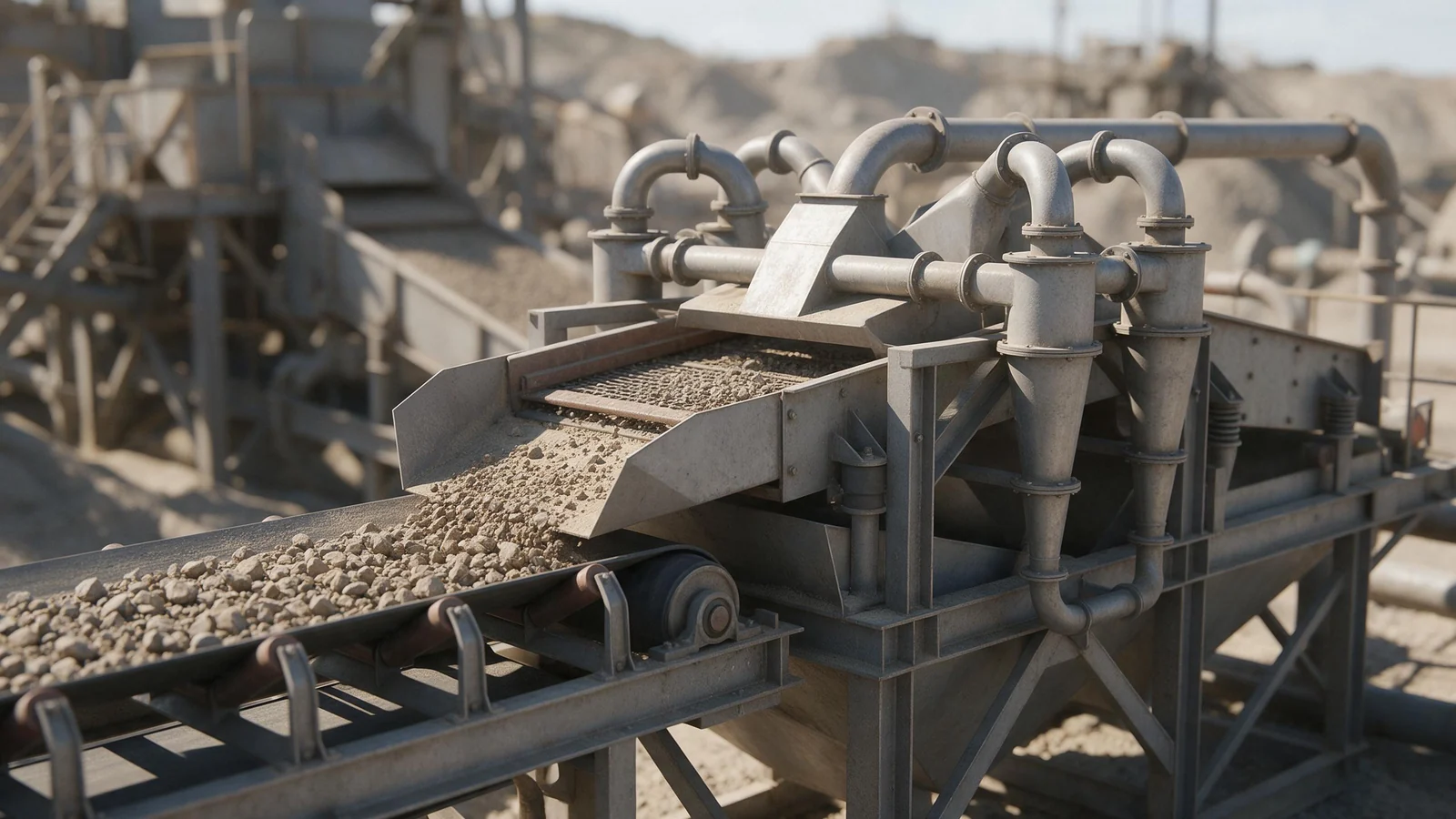
Header image: illustrative, not a photograph of a specific project.
Say a mine owner asks what a diamond processing plant actually costs to build and run. The honest answer starts with ore characterisation, not equipment.Diamond is different.
You're not trying to grind it to liberation in the usual sense; you're trying to liberate the host rock while leaving the diamond unbroken. That changes the entire flowsheet, from the first crusher to the final sort room. It also changes how you design security, water circuits and chain-of-custody documentation.
Diamond-Bearing Ore Types: Kimberlite vs Alluvial Deposits
Kimberlite is the primary host rock. It's a volcanic rock that carries diamonds from deep in the mantle. Over millions of years, weathering breaks kimberlite down. The diamonds are dense and tough, so they survive. They end up concentrated in gravels and river channels as alluvial deposits. Alluvial diamond resource potential can be significant. For Guinea, the U.S. Geological Survey estimates roughly 40 million carats in alluvial resources (USGS). This difference drives flowsheet choice. Kimberlite often arrives as hard, competent rock with a sticky clay matrix when weathered. Alluvial feed may be sand and gravel with less clay, but it often carries more oversize cobbles and fine slimes. You'll need to test both the clay content and the full particle size distribution before you pick a single machine.
Weathering is not a minor detail. It dictates whether the ore needs aggressive scrubbing before crushing or can go straight to primary breakage. In fresh kimberlite, diamonds are held in a tough rock. In deeply weathered kimberlite, the rock is soft and clay-bound, which changes dust control and screen blinding.
Crushing and Liberation Without Breaking the Diamond
Stage crushing is standard: a jaw crusher for primary, a cone crusher for secondary, and sometimes a roll crusher for tertiary. But the design philosophy is unusual. You're not chasing fine liberation. You're trying to reduce the host rock enough to release diamonds while keeping the diamond crystals intact. Diamonds are hard, but they're not indestructible. A diamond caught in a closed-side setting can fracture. Most diamonds are smaller than the crusher openings, so they usually pass through before being struck. But that's not something you assume. You test it. The P80 is the size 80 per cent of the mass passes; that's a useful number for comparing breakage. If your ore contains large stones, you'll need to pay attention to the gap and the feed rate. Over-grinding destroys diamonds by attrition, so many flowsheets avoid ball mills entirely for kimberlite processing. If a mill is used, it's often a low-speed, low-charge unit that reduces the host rock without impacting the diamonds. A mineral processing testwork programme can establish the breakage limits for your particular ore (mineral processing testwork).
Scrubbing, Washing and Desliming
Scrubbing is where clay and slime are released before they wrap the diamonds and reduce gravity separation efficiency. A rotary scrubber tumbles the ore in water, breaking down soft clay. Log washers use paddle shafts. Attrition cells scrub particle against particle. You'll choose based on clay content and abrasion index. Removing minus 63 micron slimes is essential. Slimes increase medium viscosity in DMS and blind jig beds. A well-designed desliming circuit sends the minus 63 micron fraction to a thickener rather than into concentration. That thickener is part of the water balance. In water-scarce regions, you'll want a closed water circuit with high underflow density and clean overflow for reuse. Tailings from scrubbing and desliming are not the same as heavy rejects from DMS. You'll need separate containment for coarse waste and fine slimes. A tailings engineer will look at beach slopes and seepage, not just dam volume.
If the site has no water, you'll compare dry screening against a minimal water circuit. Dry scrubbing is possible, but clay-heavy kimberlite rarely handles well dry. A closed-loop wet plant can run with modest make-up water if the thickener underflow is dense and process water is reused. The trade-off is reagent and power, not just water.
Screening and Size Classification for Diamond Recovery
Diamond recovery works best in narrow size fractions. A trommel screen usually handles the first cut, rejecting oversize. Vibrating screens then split the feed into coarse, medium and fine streams. The exact splits come from your testwork; there's no universal recipe. Jigs and DMS both perform better when the feed is narrowly sized. A 1 mm particle and a 10 mm particle behave very differently in a dense medium. You'll also reject any remaining undersize before concentration, because it carries little economic diamond and dilutes the separation. For remote alluvial deposits, a modular plant can reduce site works; the flowsheet still follows the same screening logic (modular mineral processing plant insight).
Dense Medium Separation and Gravity Concentration
Dense medium separation, or DMS, is the workhorse for primary diamond concentration. You mix ferrosilicon powder with water to make a medium at a controlled density. Diamonds sink or float relative to that medium because their density is higher than most host rock. Most host rock is lighter, so it floats and the diamond-bearing sink fraction goes to final recovery.
Gravity concentration isn't one machine. Jigging is older and more forgiving on coarse feed. Centrifugal concentrators suit fine particles. The right choice depends on your ore type, particle size distribution and throughput.
| Method | Best suited to | Watch out for | Typical role |
|---|---|---|---|
| Dense medium separation | Competent feed with narrow size fractions, high throughput | Medium density control, ferrosilicon losses, water chemistry | Primary concentration |
| Jigging | Coarse feed, variable clay content, lower throughput | Bed compaction, jig stroke and water balance | Primary or pre-concentration |
| Centrifugal concentration | Fine diamond recovery, tailings scavenging | Feed consistency, periodic cleanout, particle size limits | Scavenger or secondary recovery |
| X-ray luminescence sorting | Final recovery from DMS sink or jig concentrate | Surface condition, locked particles, security | Final concentration |
The selection logic is simple to state but hard to shortcut. Test the same sample against two methods before committing. DMS usually wins for competent kimberlite. Jigs can be attractive for alluvial gravel. X-ray recovery is not a replacement for gravity concentration; it's the next stage after it. You'll still want to verify that the testwork protocol includes diamond-specific liberation and security handling.
Before you choose, ask the supplier these questions:
- What size fractions will you guarantee for this feed?
- What medium density range and ferrosilicon recovery method do you recommend?
- How do you handle water make-up and slimes disposal?
- What physical security comes with the final recovery circuit?
- Can you run a pilot test on the ore sample before I commit?
Ferrosilicon recovery is a hidden operating cost. You'll use magnetic separators to recover ferrosilicon from the dilute medium. If the medium is too viscous, fine diamonds get misplaced. If the ore contains magnetic minerals, they contaminate the medium. So medium control is a daily chemistry task.
X-Ray Recovery, Grease Tables and Final Sorting
X-ray luminescence is the final recovery step in most modern diamond plants. A diamond fluoresces under X-ray excitation. A detector spots the flash, an air jet ejects the diamond, and the rest continues as tailings. Grease tables are the older cousin. Diamonds are hydrophobic and stick to grease while wet, whereas most gangue does not. Hand sorting still exists for very coarse or locked stones, but it's slow and labour intensive.
Final sorting concentrates are high value and highly portable. That's why security design isn't an afterthought. Locked concentrate routes, dual-person access, CCTV and weighbridge reconciliation all matter. You don't keep a bucket of diamond concentrate on the corner of a bench. For remote sites, a modular design can still include a secure sort room; the layout changes but the control logic does not (modular plant services).
Kimberley Process and Chain-of-Custody in Plant Design
Every diamond export must be accompanied by a valid Kimberley Process certificate (Kimberley Process certificate) certifying that the diamonds are conflict-free. The Kimberley Process is an international initiative and intergovernmental forum to exclude conflict diamonds from the legitimate trade (Kimberley Process). Plant design supports that certificate. You need locked concentrate storage, sealed sample packets, and a documentation trail from the recovery floor to the export parcel. Many operations assign a chain-of-custody officer. Every time concentrate changes hands, the movement is recorded. You'll also need security cameras on the final recovery circuit and a secure vault for sealed parcels.
Certification doesn't require a specific machine list. It requires that the operation can show where every diamond came from and who handled it. A plant that cannot explain its concentrate movements will struggle to export under the scheme. That's a plant design constraint, not just a paperwork constraint.
The first step is a sample, a test plan and a process engineer who understands diamond recovery (get in touch).
Frequently asked questions
What are the main steps in diamond processing?
The main steps are ore preparation, crushing with liberation care, scrubbing and desliming, screening into narrow size fractions, primary concentration by DMS or jigging, and final recovery by X-ray sorting. Each step depends on the ore type and particle size distribution. There is no fixed recipe; testwork sets the sequence.
How is kimberlite different from alluvial diamond ore?
Kimberlite is hard volcanic host rock, often clay-rich when weathered. Alluvial ore is natural gravel and sand that has already released diamonds from the host rock. That difference changes the front end: kimberlite needs careful crushing and scrubbing, while alluvial feed often needs more screening and desliming but less breakage.
What equipment is used in a diamond processing plant?
A typical plant will use jaw, cone and sometimes roll crushers; rotary scrubbers or log washers; vibrating screens; DMS cyclones or drums or jigs; and an X-ray recovery machine. Supporting equipment includes thickeners, pumps, and a secure final sort room. The exact list follows testwork.
How does dense medium separation recover diamonds?
DMS uses a liquid made of water and ferrosilicon powder at a controlled density. Diamonds, with a higher specific gravity than most host rock, sink into the dense medium, while lighter gangue floats. The sink product, containing diamonds and some heavy minerals, goes on to X-ray recovery. Medium density and particle size distribution control the separation.
Request a proposal for your ore
What to send for a useful reply
- Head assays and, if you have them, a phase or mineralogy report
- Target throughput in t/d and the product you want to sell
- Project stage: exploration, feasibility, financing or expansion
- Site basics: country, power, water and access
Not ready to share data yet? Read the EPC turnkey delivery page first.