Cobalt Processing: Routes and Testwork Decisions
Cobalt is mostly a by-product metal, and its processing route follows the host ore before anything else.
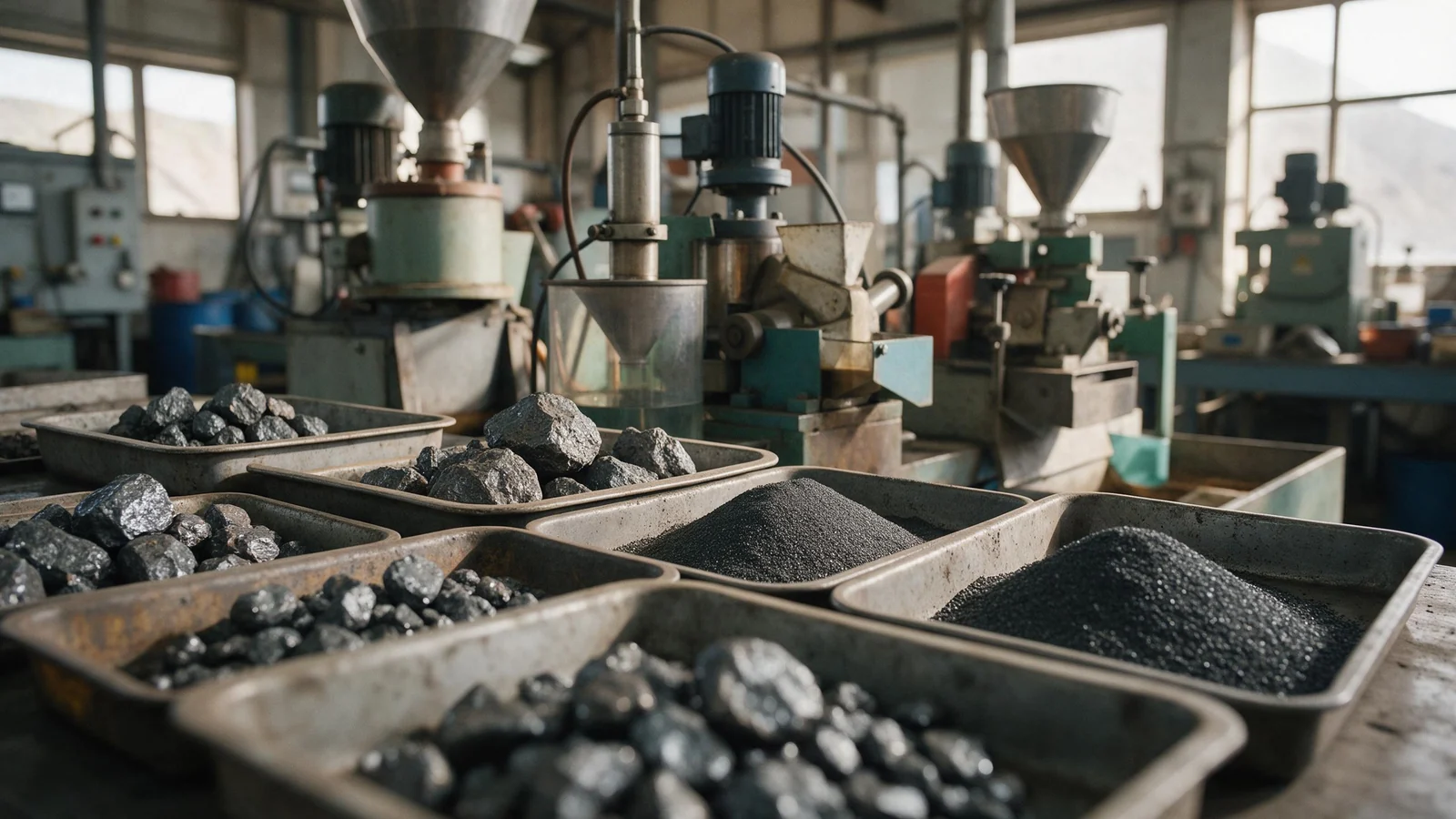
Header image: illustrative, not a photograph of a specific project.
Say a mine owner asks why cobalt processing so often looks like a copper or nickel flowsheet with extra steps. It's geology, not marketing. Cobalt is mostly recovered as a by-product. You rarely mine cobalt for its own sake. The host ore dictates the first unit operations.
USGS data puts this in perspective. The Democratic Republic of the Congo supplied nearly 70% of world mined cobalt production in 2019 (USGS 2019). China produced nearly 70% of the world's refined cobalt that same year (USGS 2019). The United States did not refine cobalt ores or concentrates in 2019, and it remains import-reliant for the metal (DOE/Penn State report). So the supply chain splits: mining concentrates in one region, refining in another.
The leading use is rechargeable batteries, followed by superalloys. That demand pattern matters for processing. Battery-grade cobalt usually means a hydrometallurgical route, while superalloy feed may tolerate different impurities. You'll care about that distinction from the first test.
Why ore type dictates the processing route
You can't pick a cobalt flowsheet off a shelf. Sulfide, oxide and arsenide ores respond to different chemistry. That's the first question for any testwork programme.
Sulfide ores: flotation first
Sulfide cobalt ores commonly carry cobalt in carrollite or linnaeite, usually alongside copper sulfides. Flotation is the standard first step. You float a bulk sulfide concentrate, then separate copper and cobalt sulfides in cleaner circuits. Reagent choice and pulp potential make or break that split. It's that simple, and that hard.
Oxide ores: reductive leaching
Oxide cobalt ores, often heterogenite in copper-cobalt deposits, don't float well. Cobalt sits in the trivalent state, Co(III), which dissolves slowly in plain acid. You need a reductant, typically ferrous iron or sulphur dioxide, to reduce Co(III) to Co(II) before acid leaching works. That's not a detail; it's the entire leach kinetics.
Arsenide ores: roast, capture the arsenic
Arsenide ores, like cobaltite or skutterudite, force a thermal step. Roasting drives off arsenic, and the roaster off-gas needs full arsenic capture. No one skips this step. The environmental permit usually decides whether an arsenide route is viable at all. Think about that for a second. Your permit, not your metallurgist, may have the final word.
| Ore type | Typical host minerals | First processing step | Main risk to manage |
|---|---|---|---|
| Sulfide | Carrollite, linnaeite | Flotation to separate copper and cobalt sulfides | Selectivity between copper and cobalt |
| Oxide | Heterogenite | Reductive acid leach | Co(III) is slow to dissolve without a reductant |
| Arsenide | Cobaltite, skutterudite | Roasting with arsenic capture | Arsenic gas and effluent control |
The table above is a decision aid, not a specification. Ore type sets the starting point, but mineral associations and impurities change everything downstream.
Mineral processing: concentrating cobalt before leaching
For sulfide ores, the mining side still involves crushing and grinding. Wet, clay-rich copper-cobalt ores sometimes call for a semi-autogenous grinding circuit with pebble crushing, known as SABC. Grind size is set by liberation, not convenience. You want the cobalt sulfide particles free enough for the rougher cells to grab them without over-grinding slimes.
Flotation then separates copper sulfides from cobalt sulfides. It's a selective flotation exercise, often with depressants for one metal while the other floats. Magnetic and gravity separation play auxiliary roles. Some cobalt minerals respond to gravity if the specific gravity difference is wide enough. Magnetics can pull pyrrhotite or iron sulphides away from cobalt. But flotation remains the main concentrator. Don't let the auxiliary toys distract you.
Concentrate storage matters too. Cobalt sulfides can oxidise in a stockpile. Oxidation changes surface chemistry and hurts downstream recovery. Keep retention time short, or blanketed, if testwork shows sensitivity. Why risk recoveries over a stockpile detail?
Hydrometallurgical routes: leaching, purification, recovery
Once you have a cobalt-bearing concentrate or a leachable ore, hydrometallurgy takes over. Atmospheric acid leaching works for many oxide and some sulfide feeds if you control redox. High-pressure acid leaching suits refractory sulfides and some laterite ores. Reductive leaching is compulsory for Co(III) oxides, as I said earlier.
After leaching, purification is the real battle. Solvent extraction separates cobalt from nickel, copper and zinc. Ion exchange polishes dilute streams. The choice depends on your pregnant leach solution chemistry, impurity load and target product. Sometimes you'll take a hydroxide or carbonate intermediate and sell that. Battery refiners often prefer an intermediate to direct metal, because transport and impurity control are easier. It's a practical call, not a purity contest.
Electrowinning produces cobalt metal from a purified sulphate or chloride electrolyte. It's capital intensive. You need clean solution, stable power and disciplined cell operation. Not every deposit justifies that. Many by-product operations stop at a hydroxide or carbonate and let a third party finish the metal. That's a commercial decision, not a technical failure.
Safety note: cobalt dust can form explosive mixtures in air, and the OSHA permissible exposure limit for cobalt metal, dust and fume is 0.1 mg/m3 as an 8-hour time-weighted average (OSHA eTool). Design your bagging, drying and crushing areas with that limit in mind. No shortcuts here.
Why testwork on your actual ore is the starting point
Mineralogy comes first. You need quantitative mineralogy, not guesswork. Chemical assay alone will mislead you. The same cobalt grade can sit in a sulphide, an oxide or a locked silicate, and each demands a different route. Have you seen a locked silicate fool a grade report? It happens.
After mineralogy, run a Bond work index test to size the grinding circuit, then flotation or leaching scoping tests. Open-circuit tests tell you what's possible. Closed-circuit tests tell you what's stable when middlings recycle. If you skip the closed circuit, you'll overstate recovery and understate reagent consumption.
Pilot-scale continuous testing is the last step before engineering. Run it on a representative bulk sample. Let it run long enough to see steady state, not just a good shift. A mineral processing testwork programme on your own sample is not a formality. It's the only way to know whether your cobalt feed will respond to the flowsheet you think you want.
Ask any test lab for the complete mass balance, including tails and recycle streams. A single reported recovery figure without that balance is a marketing line, not an engineering result. You'd be amazed how often that gets waved away.
From testwork to a bankable cobalt processing plant
Once the testwork closes, you can move to engineering with a clear conscience. The EPC+M+O model covers engineering, procurement, construction, mine construction management and mine operation management. It's a delivery model, not a magic box. You still need to fix the flowsheet first.
If you're weighing stick-built against modular plant options, that decision follows testwork. A modular plant can reduce site construction time, but it won't save a flowsheet that failed in the pilot plant. A failed flowsheet is a failed flowsheet, modular or not.
Before you sign any EPC contract, ask the contractor to show you a mass balance built from your own sample, not from a similar deposit. Ask what happens if the ore type shifts. And ask for the safety design basis for cobalt dust and arsenic, where relevant. Then talk about project scope.
Frequently asked questions
Where does the USA get its cobalt?
The United States did not refine cobalt ores or concentrates in 2019 (USGS 2019). It is import-reliant for cobalt (DOE/Penn State report), with imports covering its apparent consumption.
How toxic is cobalt to humans?
Cobalt is a silvery, bluish-white, odorless, magnetic metal. Inhalation of cobalt metal fume and dust may cause interstitial fibrosis, interstitial pneumonitis, myocardial and thyroid disorders, and sensitization of the respiratory tract and skin. The OSHA permissible exposure limit for cobalt metal, dust and fume is 0.1 mg/m3 as an 8-hour TWA (OSHA eTool), and the NIOSH recommended exposure limit is 0.05 mg/m3 (NIOSH/NIST SDS).
What is cobalt used for?
The leading use of cobalt globally is rechargeable batteries, followed by superalloys (USGS 2019). It is also a magnetic metal, which matters for some alloys and coating applications.
How is cobalt extracted from its ore?
The route depends on ore type. Sulfide ores usually go through flotation to make a concentrate, then leaching or smelting. Oxide ores need reductive acid leaching because Co(III) dissolves slowly. Arsenide ores require roasting with arsenic capture. After leaching, solvent extraction or ion exchange purifies the solution, and cobalt is recovered as metal by electrowinning or as a hydroxide or carbonate intermediate.
Request a proposal for your ore
What to send for a useful reply
- Head assays and, if you have them, a phase or mineralogy report
- Target throughput in t/d and the product you want to sell
- Project stage: exploration, feasibility, financing or expansion
- Site basics: country, power, water and access
Not ready to share data yet? Read the EPC turnkey delivery page first.