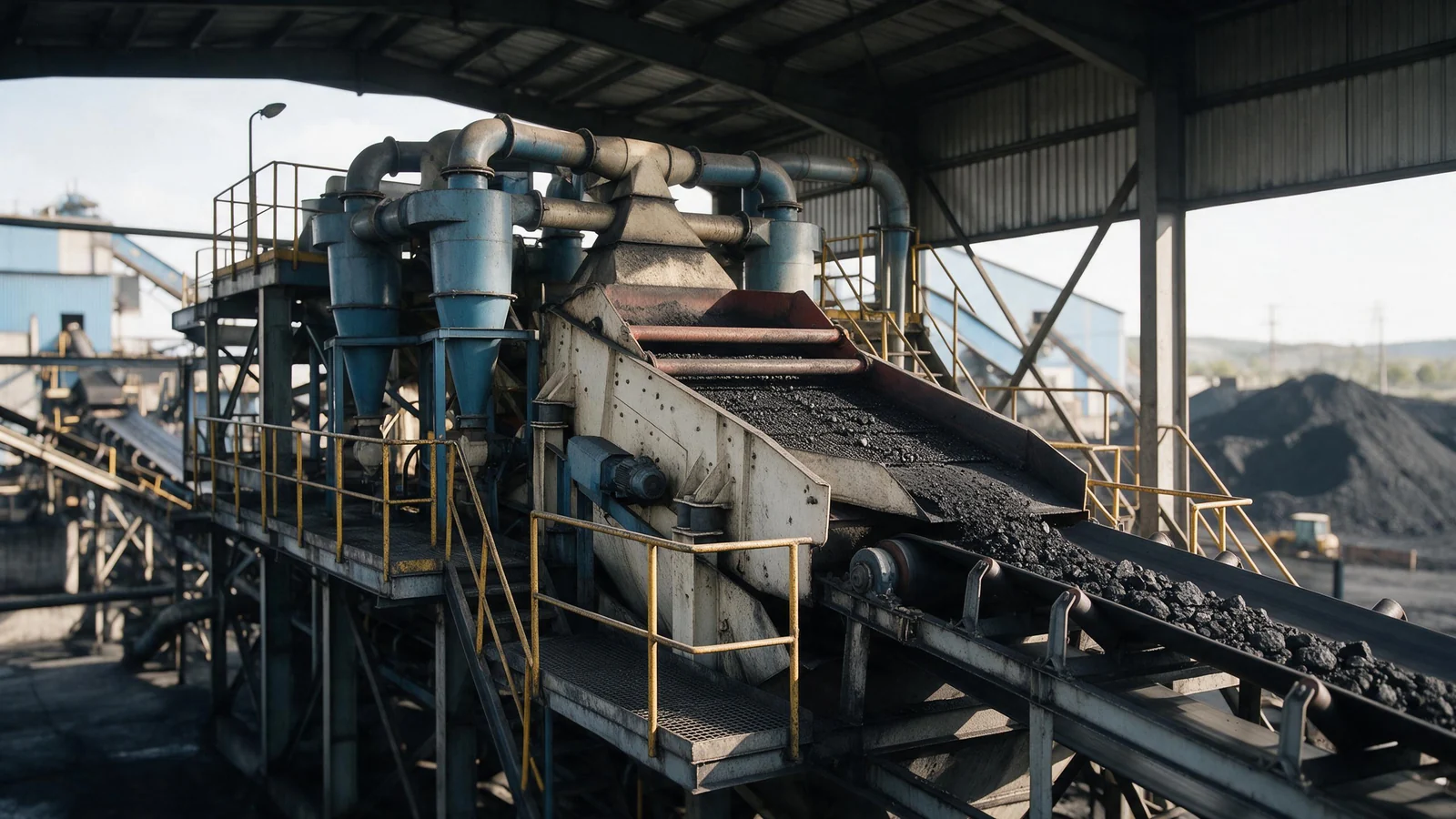
Coal Washing Plant: Process and Equipment
A coal washing plant is a set of mechanical processes that separate run-of-mine coal from rock, ash and sulfur before sale.
Header image: illustrative, not a photograph of a specific project.
Say a mine owner asks why run-of-mine coal can't go straight to the boiler. The answer is usually dirt. Coal arrives at the surface with rock, shale, pyrite, clay and water. A coal washing plant exists to remove those before the coal reaches a customer. The aim is not cleanliness for its own sake. It's giving the buyer a fuel or feedstock with less ash, lower sulfur and more heat per tonne. That's the whole point.
A coal washing plant is a set of mechanical processes that separate coal from waste by density, surface chemistry and size. The phrase covers everything from a simple jig circuit to a multi-stage dense medium plus flotation and dewatering facility. In the United States, 1,378 domestic coal cleaning facilities were counted in the background report for AP-42 Section 11.10, Coal Cleaning (EPA). That number tells you the installed base is large and varied.
Typical products from the plant are clean coal, middlings and rejects. Clean coal goes to the customer. Middlings may be recrushed or sent to another circuit. Rejects usually end up in the coarse discard pile or tailings pond. The split between those products is controlled by the selected cut point and the washability of the feed. Benefits are lower ash and sulfur, higher calorific value, reduced transport weight. That matters before you spend money on rail or shipping.
Crushing and screening: preparing the feed
Crushing is not an optional step. Coal and rock arrive together, locked at the seam. The plant first crushes the run-of-mine coal to a top size that suits the washing unit. You'll often see a top size around 50 mm for dense medium, but that is a process setting, not a universal rule. Some operations crush to 100 mm then screen at 13 mm or 6 mm. The U.S. Energy Information Administration covers the broader mining and transport steps in its Coal Explained pages (U.S. EIA).
A rotary breaker can reject large rock before fine crushing. Roll crushers then reduce the coal to the target top size. The choice between a rotary breaker and a roll crusher depends on the hardness and the amount of stone in the feed. After crushing, screens separate the feed into coarse, intermediate and fine fractions. Each fraction goes to a different machine. Coarse coal, roughly plus 13 mm, typically goes to dense medium. Intermediate coal, roughly 13 mm by 0.5 mm, can go to a jig or spiral. Fine coal below 0.5 mm often ends up in froth flotation or is dewatered directly if the ash is already low. The screen apertures and feed moisture dictate which fraction splits are practical on any given day.
Dense medium separation for coarse coal
Dense medium separation does the heavy lifting for coarse coal. It's efficient and well understood. A dense medium is a suspension of fine, dense material, usually magnetite or ferrosilicon, in water. The ISO vocabulary defines dense medium process as a process for cleaning coal in which the desired separation is achieved in a dense medium (ISO). The medium density is controlled to set the cut point between clean coal and reject. If your coal has a lot of near-density material, dense medium handles it better than a jig. You'll recover more coal at the same ash.
Two vessel types are common: baths for very coarse sizes and cyclones for intermediate sizes. Cyclones add centrifugal force, so they can treat finer particles at higher throughput per unit volume. Density control is the heart of the circuit. You'll measure medium density at the correct point continuously. A nuclear density gauge is common, but there are other options. The magnetite is recovered on drain and rinse screens, then sent to a magnetic separator. Medium loss can be kept low if the screens are properly maintained and the rinse water is right. Don't underdesign the medium recovery circuit. Losing magnetite to tailings is an operating cost you control by screen condition and rinse water rate.
Jigs, spirals and tables for intermediate and fine coal
Not every coal needs dense medium. Jigs are simpler and cheaper to run. In coal preparation, jigs are applied to a wide size range of coal, according to an EPA assessment from the 1970s that is still used as a reference (EPA). Jigs pulse water through a bed of coal. Denser rock sinks; lighter coal floats on top. The cut point is less sharp than dense medium, but the circuit is forgiving. You'll often see jigs on smaller operations or where the coal is easy to wash. A jig can be a fixed screen or a movable screen design; the operating principle is the same.
Spirals treat fine coal with a different cut-point trend versus particle size. Tables provide high-precision cleaning for smaller streams. A table can salvage coal from a spiral tailings stream when every tonne counts. But tables need uniform feed and careful deck maintenance. You won't get good results from a neglected deck.
Comparing the main washing units
| Unit | Usual feed size | Sharpness of separation | Main advantage | Main limitation |
|---|---|---|---|---|
| Dense medium bath | plus 13 mm | High | Precise cut point | Medium recovery cost |
| Dense medium cyclone | 13 mm to 0.5 mm | High | High capacity per volume | Wear from medium |
| Jig | wide range, often 50 mm to 0.5 mm | Moderate | Simple, low operating cost | Less precise cut |
| Spiral | 1 mm to 0.1 mm | Moderate | No dense medium | Sensitive to feed variations |
| Froth flotation | below 0.5 mm | High | Effective on ultra fines | Reagents and froth control |
Flotation for the finest coal
Below about 0.5 mm, gravity separation loses its grip. Flotation takes over. Fine coal attaches to air bubbles and rises to the froth; ash and clay stay in the water. The performance of a flotation bank is described by rate constants and bubble loading limits. Aeration rate gives limited but real control. You can't just turn up the air and expect more coal. Too much air breaks the froth.
Reagent choice matters. Frothers create a stable froth. Collectors make the coal surface hydrophobic. If your flotation feed is oxidised or high in clay, you'll need to test reagent schemes before locking the flowsheet. Froth flotation for coal usually runs at high solids concentration. The tailings are thickened and the product is filtered. Flotation columns can give a cleaner product than mechanical cells, but they need a steady feed. Batch tests will show whether your coal floats easily or needs heavy reagent doses. A laboratory batch test is cheaper than a full-scale failure.
Dewatering, slurry and tailings handling
Clean coal leaves the separation circuit wet. Dewatering screens remove most of the water before stockpiling. Centrifuges take it further. The moisture content you can reach depends on particle size, screen opening and vibration settings. Small coal holds more water than coarse coal. You'll set the product moisture target through dewatering tests, not from a brochure.
Wash water and fines go to a thickener. The underflow is pumped to a filter press or belt press. Clarified water returns to the washing circuit. The tailings cake goes to a disposal area. That loop is not an afterthought. If the thickener is undersized, the whole plant floods. Thickener sizing is governed by the settling rate of the finest solids. A rake thickener with flocculant can handle fine coal tailings. Filter press selection depends on cake moisture, cycle time and feed solids. Don't size a filter press on guesswork. Run a leaf test. Ask any supplier for a water balance diagram before you buy a single pump.
How to specify a coal washing plant
Say you're writing a specification for a new coal washing plant, or upgrading an old one. Don't start with equipment. Start with three numbers you control: feed rate in tonnes per hour, size distribution, and target ash in clean coal. Feed rate sets the mass balance. Size distribution determines which machines you'll need. Target ash sets the cut point and may force dense medium over jigs.
You'll also need to nail down the water balance: how much fresh water is available, how much can be recycled, and where the tailings go. If your flowsheet includes thermal drying, ask any supplier for the stack emission factor. The EPA background report for AP-42 lists an average filterable PM emission factor of 1.3 kg per megagram of coal feed for coal cleaning dryers (EPA). That number tells you the dust collection system must be sized seriously.
Before you commit to any numbers, send a representative sample for washability testing. Sink-float analysis at different densities will tell you the theoretical yield. It's the cheapest way to avoid buying the wrong plant. Design decisions follow the testwork. For a small or remote site, a modular plant built as a series of skids may suit you (modular plant services). The process engineering logic is the same as any modular mineral processing plant (modular plant design insight). If you don't have a strong construction team, an EPC contractor can take the whole thing from testwork to commissioning (EPC services). Talk to an engineer before you freeze the flowsheet (contact).
Frequently asked questions
How does a coal wash plant work?
A coal wash plant separates coal from rock, ash and sulfur by using differences in density and surface chemistry. Run-of-mine coal is first crushed and screened into size fractions. Coarse coal typically goes to dense medium separation, where a suspension of fine magnetite or ferrosilicon in water is controlled to set a cut point between coal and waste. Intermediate coal may be cleaned with jigs or spirals. Fine coal below about 0.5 mm is often treated by froth flotation. Clean coal is then dewatered on screens and centrifuges, while the wash water and fine tailings go to a thickener and filter press before the water is recycled.
Why is it called a coal washery?
A coal washery is another name for a coal washing plant. The term comes from the fact that the plant washes the mined coal with water and mechanical energy to remove impurities. It is widely used in India, Australia and parts of Europe. The process is fundamentally the same as a coal cleaning or coal preparation plant.
What is the difference between coking coal and thermal coal washing?
Coking coal is washed to a much lower ash specification because the coke must have very low impurity levels for blast furnace use. The washing circuit for coking coal often includes dense medium separation plus flotation and may require a finer grind to liberate the coal from mineral matter. Thermal coal is usually washed to a more moderate ash target, and a jig or dense medium circuit may be enough. The cut point and target ash are set by the customer's boiler or kiln requirements, not by a universal rule.
What equipment is used in a coal washing plant?
A coal washing plant typically uses crushers, screens, dense medium baths or cyclones, jigs, spirals, shaking tables, froth flotation cells, dewatering screens, centrifuges, thickeners and filter presses. The exact mix depends on the feed size distribution, the washability of the coal and the target clean coal ash. A simple plant may use only a jig and a dewatering screen. A complex plant may combine dense medium cyclones, spirals and flotation with a full tailings handling circuit.
Request a proposal for your ore
What to send for a useful reply
- Head assays and, if you have them, a phase or mineralogy report
- Target throughput in t/d and the product you want to sell
- Project stage: exploration, feasibility, financing or expansion
- Site basics: country, power, water and access
Not ready to share data yet? Read the EPC turnkey delivery page first.