Bentonite Processing: Drying, Grinding, Activation
Bentonite processing is controlled preparation of a montmorillonite-rich clay to meet application-specific limits on moisture, particle size and rheology.
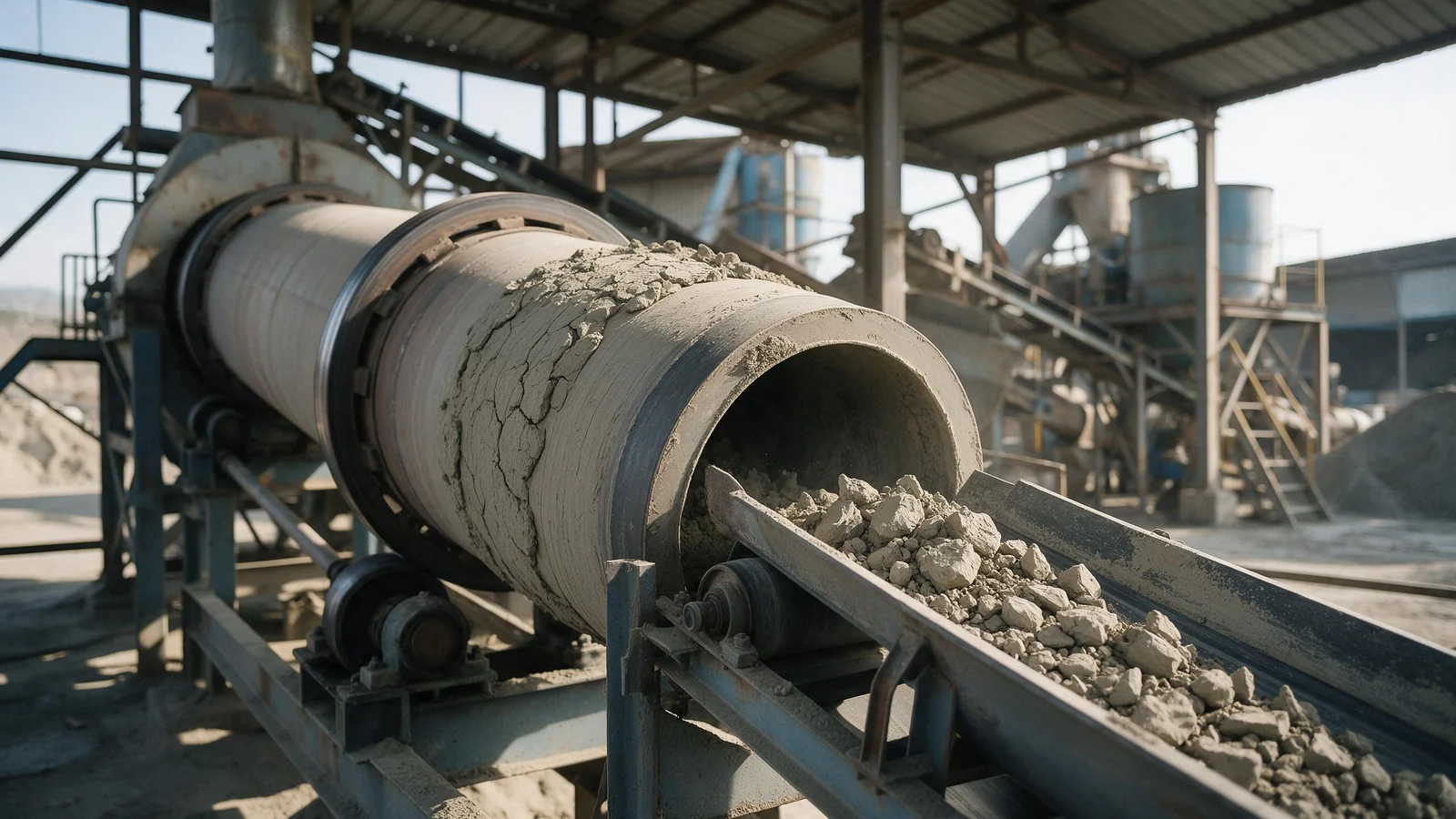
Header image: illustrative, not a photograph of a specific project.
Say a mine owner asks what bentonite processing actually involves before they commit to a flowsheet. It's a fair question. Bentonite is not one mineral; it's a rock made mostly of montmorillonite. The processing route changes with how that clay behaves.
What bentonite processing actually means
Bentonite is a clay dominated by montmorillonite, a smectite group mineral. The U.S. Geological Survey tracks bentonite as one of several clay commodities because its markets differ from ball clay, common clay or kaolin. Processing means turning that raw clay into a product that meets a buyer's limits on moisture, particle size, swelling or viscosity. It's not a single recipe. Two deposits a few kilometres apart can need completely different unit operations.
The exchangeable cation in the interlayer space matters more than most operators expect. Sodium bentonite swells strongly in fresh water. Calcium bentonite does not, unless it is modified. That difference determines whether your flowsheet needs an activation step and which product grades you can realistically sell.
| Characteristic | Sodium bentonite | Calcium bentonite |
|---|---|---|
| Dominant exchangeable cation | Sodium | Calcium |
| Swelling in fresh water | High, often several times its dry volume | Low unless activated |
| Common processing need | Dry, grind, maybe blend | Dry, grind, activate with soda ash |
| Typical end uses | Drilling fluid, pond sealant, civil engineering | Foundry sand binder, cat litter, iron ore pelletising |
If you don't know your interlayer cation, don't start equipment selection. You'll design the wrong plant. Characterisation comes first.
From mine to plant: how bentonite is extracted
Bentonite is almost always surface mined. Scrapers, bulldozers and excavators remove overburden and load run-of-mine clay into haul trucks. Because the deposit can vary in montmorillonite content and moisture over a few metres, mining is followed by layering and blending on a stockpile. You'll blend for days, not hours. This is the first place variability gets controlled.
Strip ratio and pit water matter. Bentonite pits are usually shallow, but wet conditions can slow the operation. Pumping water from the pit is common. The clay arrives wet and sticky. It is rarely dry enough to feed directly to a mill or bagger. A covered stockpile or a short inventory time helps, but the dryer is the real moisture control point.
Crushing and drying: the critical first steps
Primary crushing for bentonite is usually not a jaw crusher. A toothed roll crusher or a feeder breaker works better on wet, plastic clay because it shears and tears rather than compressing a sticky mass against a fixed plate. The goal is to reduce large lumps to a size the dryer can handle, not to produce fine material.
Rotary dryers dominate the industry. They can accept a sticky feed and deliver a controlled outlet moisture if the burner and residence time are set correctly. A co-current dryer often suits a high-moisture feed because the hottest gas meets the wettest clay, reducing the chance of overheating dry particles. Keep the drying temperature low enough. If you drive off structural hydroxyl groups from the montmorillonite lattice, you permanently lose swelling and viscosity. That loss cannot be reversed by re-wetting. The dryer must remove free water, not crystal water.
Dust and fume control belongs in this section, not as an afterthought. Mine safety regulators require surveys as often as necessary to verify controls; the rules are described in MSHA Volume IV. A rotary dryer without proper cyclones and bag filters will not meet a site permit.
Grinding and classification for target particle size
Dried bentonite becomes friable. That means it can be milled without turning into a sticky paste. Roller mills, sometimes called Raymond mills, are common for mid-range and fine products. The material passes between grinding rolls and a ring, then goes to an air classifier inside the mill circuit.
Closed-circuit classification is essential. Oversize returns to the mill, while product is carried out as fines. Air classification gives a more consistent cut than screening for very fine clay because screens blind and wear. You can tune the classifier's rotor speed to change the top size without changing the mill. You don't always want the finest possible grind. A drilling-grade bentonite needs a controlled particle size distribution for good mud yield, not just a low top size. A foundry grade may need a coarser, more uniform product. Match the grind to the end use, then standardise it.
Activation and blending: modifying bentonite performance
If your ore is calcium bentonite and your market wants high swelling, you'll consider sodium activation. This is usually done by mixing a small amount of soda ash with the dried clay at controlled moisture, then allowing the material to cure. The sodium cation replaces calcium in the exchange sites, and the clay's water uptake rises. This is not a full chemical conversion, just an ion exchange step. It works only if the starting clay has enough montmorillonite.
Cure time and mixing matter. The soda ash reaction is not instantaneous. You'll need residence time in a stockpile or curing bin, and thorough blending. A poorly mixed activation gives variable swelling from bag to bag. Acid activation is a different route. Hot acid attacks the clay structure and increases surface area, which makes the product useful for bleaching oils and other adsorbent uses. Don't mix the two. Sodium activation and acid activation are different operations with different safety and corrosion issues.
Blending follows activation. You'll blend lots to stabilise swelling, viscosity and rheology. Standard lab methods help here. The swell index test in ASTM D5890-19 measures clay swelling in reagent water. For drilling-grade bentonite, ISO 13500:2006 covers the physical property tests and acceptance values. These are the numbers your buyer will hold you to.
Granulation and final product forms
Some bentonite products go out as powder. Others perform better as granules. Cat litter, fertiliser carriers and some adsorbents are granulated to control dust and improve handling. A disc or drum granulator with a water or binder spray builds spherical granules from fine powder. The wet granules are dried, screened and sometimes hardened before packaging.
Packaging is part of the product, not just logistics. You'll ship in 25 kg bags, one-tonne bulk sacks or bulk trucks, depending on your customer. Every lot should have final quality checks: moisture, particle size, swell or viscosity, and a methylene blue index if montmorillonite content is part of the sale.
How to specify a bentonite processing plant for EPC
Most EPC enquiries for bentonite start too late. The buyer sends an enquiry but no defined feed or product specification. Fix that before you contact a contractor. Write down your as-mined montmorillonite content, moisture, plastic limit and the main impurity minerals. Then define the product you need to sell: mesh or particle size range, moisture limit, swelling or viscosity target, and packaging form.
After that, request process testwork. A competent supplier will not quote a flowsheet without running bench-scale tests on your sample. The testwork programme should cover characterisation, drying behaviour, grindability, activation response and final product quality. Mineral processing testwork is the only way to turn your ore into a mass balance and an equipment list. That capacity is useful for index tests, but a bentonite flowsheet is still set by your own clay sample.
Small or remote operations may suit a modular plant. Modular design reduces site work, but you'll still need the same testwork.
Get the sample into a laboratory early.
The flowsheet follows the clay, not the catalogue. If you're unsure where to start, ask for a testwork programme.
Frequently asked questions
How is bentonite processed?
Bentonite is processed by crushing the wet clay, drying it to a controlled moisture, grinding it to the required particle size, and then either blending or activating it. Sodium bentonite may only need drying and grinding. Calcium bentonite often goes through sodium activation with soda ash to increase swelling. Final products are bagged or shipped in bulk.
Which country is the largest producer of bentonite?
There isn't one clean public number for all bentonite. The U.S. Geological Survey reports bentonite within its wider clays group. The United States is a significant producer, especially of sodium bentonite from the western states, but rankings shift depending on whether you count all bentonite or only swelling grades. Check the USGS Clays Statistics and Information page for current commodity data.
Where is bentonite mined in the US?
Sodium bentonite is mined mainly in Wyoming, Montana and South Dakota. Calcium bentonite deposits occur in other states, including Mississippi and Alabama. The USGS clays summary gives commodity-level production, not mine-by-mine detail, so you won't find every operation in one public table.
What equipment is used in bentonite processing?
The main machines are toothed roll crushers or feeder breakers, rotary dryers, roller mills with air classifiers, soda ash blenders or activator mixers, and disc or drum granulators for granular products. Bagging and bulk loadout equipment follows. Equipment selection depends on feed moisture, clay mineralogy and the product specification.
Request a proposal for your ore
What to send for a useful reply
- Head assays and, if you have them, a phase or mineralogy report
- Target throughput in t/d and the product you want to sell
- Project stage: exploration, feasibility, financing or expansion
- Site basics: country, power, water and access
Not ready to share data yet? Read the EPC turnkey delivery page first.