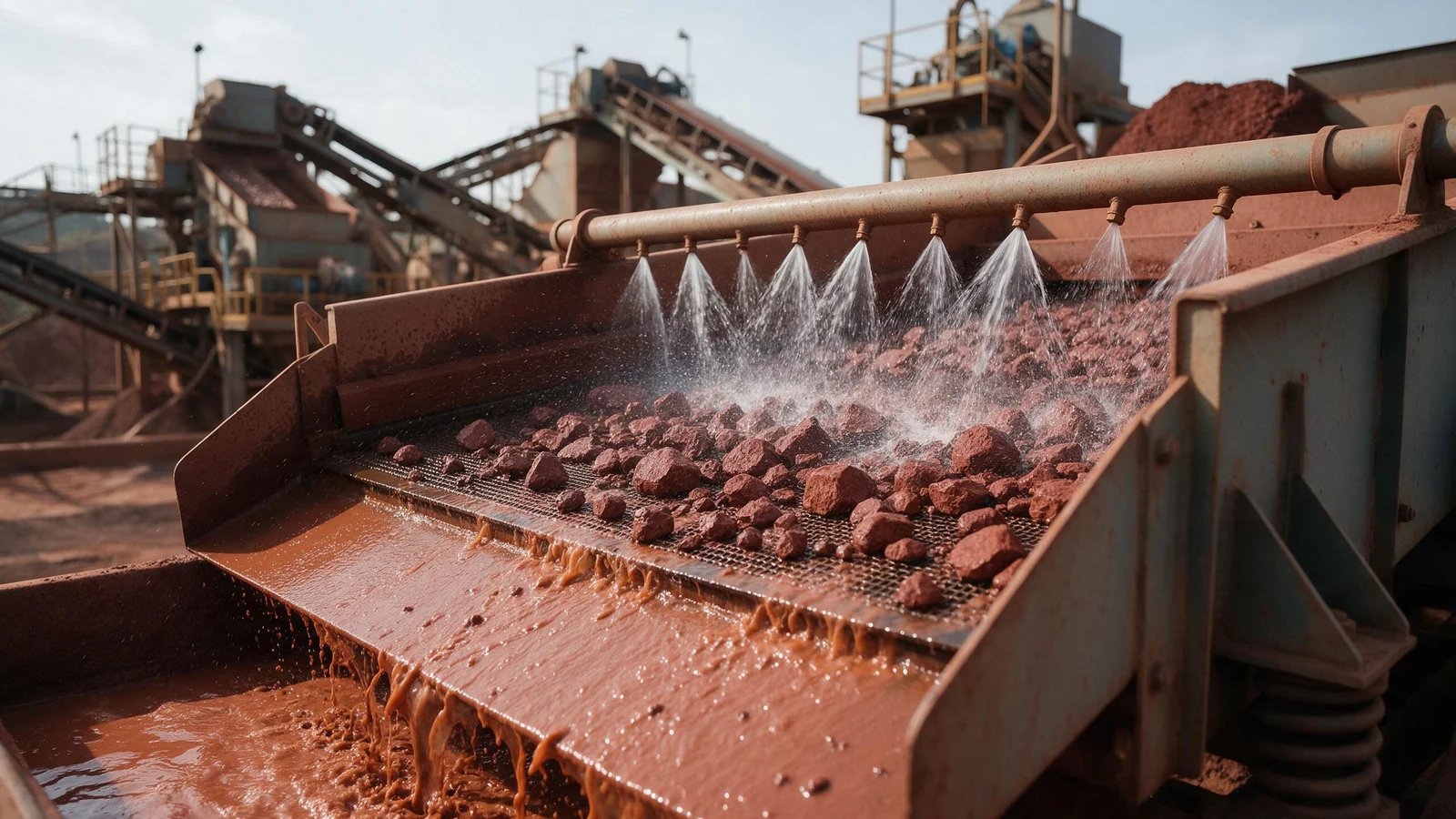
Bauxite Washing Plant: Upgrading Before the Refinery
What a bauxite washing plant does, where it fits, and how testwork sets the cut.
Header image: illustrative, not a photograph of a specific project.
Say a mine owner asks why a bauxite washing plant matters before the refinery. The answer starts with the Bayer process, and with clay. Bauxite is not one mineral. It's a loose mix of aluminium hydroxide minerals, iron oxides, clays and quartz. When that mix reaches a Bayer circuit, the reactive silica in clay consumes caustic soda and forms desilication products. Those products thicken red mud and increase disposal cost. So you wash the ore first.
Bauxite is the raw material for alumina, refined mainly by the Bayer process (USGS Mineral Commodity Summaries 2025). According to the USGS Mineral Commodity Summaries 2026, an estimated 63% of the bauxite consumed in the United States in 2025 was refined by the Bayer process for alumina or aluminium hydroxide. The same source reports 1.7 million tons consumed that year. That refinery pathway is exactly where washing creates value. It upgrades the alumina-to-silica ratio, often called the A/S ratio, before the ore ever sees a digestion vessel.
Why bauxite is washed before alumina refining
Clay minerals like kaolinite contain alumina in a form the Bayer process can't recover efficiently. Reactive silica dissolves in hot caustic and precipitates as sodalite or cancrinite. That precipitation consumes sodium hydroxide and alumina. You lose reagent. You also grow red mud volume. Washing before refining reduces both losses when the ore is amenable.
Not every bauxite is washed. Some lateritic ores are already low in clay. Karst bauxites can carry sticky clay that needs aggressive scrubbing. The decision is not automatic. It comes from testwork on the actual ore, not from a generic flowsheet.
Where washing fits in the bauxite flowsheet
A washed bauxite flowsheet sits before the Bayer refinery. It typically follows feeding, primary crushing, scrubbing or washing, screening, classification and dewatering. You don't wash inside the refinery itself. The Bayer plant begins at digestion, not at the mine. From the crusher, the ore is normally 7.5 to 30 centimetres in diameter, according to the EPA's crushed stone processing description. That size range is the feed for the scrubber or washer.
Jaw, impactor, or gyratory crushers are usually used for initial reduction. Cone crushers commonly handle secondary crushing, which reduces material to about 2.5 to 10 centimetres. But in bauxite washing, you often don't need fine crushing before scrubbing. The aim is to liberate clay from coarse bauxite, not to make fine particles. Oversize bauxite lumps can go back to the crusher after screening.
Core washing and scrubbing equipment
The heart of the plant is the scrubber. It uses water and mechanical friction to break clay balls and strip coatings. Four families dominate: rotary scrubbers, trommel scrubbers, drum washers and log washers. They aren't interchangeable. The choice turns on clay type, feed top size and how much water you can recycle.
| Equipment | What it does | Best for | Watch out for |
|---|---|---|---|
| Rotary scrubber | Tumbling drum with lifters, high-energy clay detachment | Sticky, plastic clays on coarse ore | High water and power, requires good liner |
| Trommel scrubber | Rotating screen drum with internal lifters, combines washing and screening | Moderate clay, smaller feed | Screen panel wear, not for massive boulders |
| Log washer | Inclined trough with counter-rotating shafts and paddles | Tough clay balls, heavy scrubbing | High wear, needs careful feed control |
| Vibrating screen | Rinses and separates washed coarse from fine mud | Final size separation after scrubbing | Not a scrubber alone, needs upstream washing |
Vibrating screens and linear vibrating screens come after the scrubber. They separate washed coarse bauxite from fine mud. A rinsing screen with spray bars does two jobs at once: it removes more clay and washes it through the deck. The screen aperture becomes your cut size. That cut determines how much mass goes to waste and how much silica stays in the product.
Classification, desliming and water recovery
The fines from screening still contain bauxite, clay and silica mixed together. Hydrocyclones and spiral classifiers split that slurry by size and settling behaviour. Clay-rich and silica-rich fines report to the overflow. Coarser, denser bauxite particles report to the underflow. You can recover some fine bauxite by desliming at a selected cut point. But if you cut too fine, clay goes with it. If you cut too coarse, you lose bauxite. The cut is a testwork decision, not a guess.
Water is expensive to lose. A thickener concentrates the slimes so clarified water can return to the wash circuit. Dewatering screens and filters produce a handleable tailings cake. If you don't close the water balance, the plant will either run dry or drown the tailings facility. You design water recovery together with the washing circuit. Not after it.
When washing is not enough: flotation, magnetic and chemical routes
Some ores carry fine-grained silica locked inside bauxite particles. Washing and desliming won't touch that. Flotation can separate fine silica or clay minerals from bauxite, but it needs fine grinding and reagents. It costs more than washing. Use it when the A/S ratio after washing is still too low for the refinery.
Magnetic separation removes iron-bearing minerals, usually after roasting or calcination changes their magnetic response. Chemical beneficiation is the Bayer process itself. That's not part of a washing plant scope. It belongs downstream, where alumina is extracted. So a washing plant should be specified as a pre-refinery upgrade step, not a chemical plant.
Design inputs for a bauxite washing plant
You can't size a bauxite washing plant from a brochure. You start with the ore. Characterise the clay minerals by X-ray diffraction, measure reactive silica, and plot the particle size distribution. Then run washability tests at several cut sizes. Each test gives a mass yield and an A/S ratio. You trade yield against quality. If a finer cut gives a big quality gain but loses 30% of the bauxite, you may accept that. Or not. The point is the data.
Before design is frozen, fix these inputs:
- Feed clay content and mineralogy
- Washability response at three cut sizes
- Cut size that meets refinery A/S target
- Water source, recycle rate and slimes thickening
- Scrubber residence time and liner wear
- Screen media aperture and spray water pressure
The washability test is the single most important piece of data. If a lab hasn't run it on your sample, any flowsheet is speculative. Don't accept a flowsheet that starts with equipment selection. It should start with sample characterisation.
How an EPCM contractor approaches a bauxite washing project
An EPCM contractor can deliver engineering, procurement, construction, mine construction management and mine operation management as one integrated scope. That's the EPC+M+O model. For a bauxite washing plant, it means the same team runs the testwork, writes the design criteria, builds the plant and then operates it. You can hold that team to the operating targets, not just to mechanical completion.
Xinhai reports experience across more than 70 ore types, according to the company's published figures. That breadth is not a flowsheet for your ore. It's a reason to ask for a disciplined testwork programme. A contractor with its own laboratory and equipment manufacturing can move from sample to detail design without losing the data. Some bauxite washing plants are delivered as modular units. You can read the general logic in modular mineral processing plants and consider whether modular delivery fits your site. For a full service scope, see modular plant services.
If you're ready to set up testwork, send a representative sample and your refinery's A/S target. The first question is not what machine to buy. It's whether your ore washes at all. You'll find that answer in the laboratory, not in a catalogue. Use the contact page to start that conversation.
FAQ: Bauxite washing plant questions
How much bauxite is needed to produce 1 ton of alumina?
There isn't a single number. The ratio depends on available alumina content, reactive silica and the Bayer circuit's extraction efficiency. A high-grade ore with a good A/S ratio needs less bauxite than a low-grade, high-silica ore. You calculate it from a mass balance based on your ore's assay, not from an industry average.
How much is 1 ton of bauxite?
Bauxite price varies with grade, location, moisture and freight. Buyers don't quote a single figure. They specify A/S ratio, reactive silica, iron content and moisture. You negotiate on delivered ore quality. The USGS publishes annual bauxite trade data, not contract prices.
What is the purpose of washing bauxite before refining?
Washing removes clay and silica fines that would consume caustic soda and expand red mud volume in the Bayer process. It upgrades the A/S ratio and can reduce refinery reagent and disposal costs. Whether it pays depends on the ore's clay content and washability.
What equipment is used in a bauxite washing plant?
Typical equipment includes rotary scrubbers, trommel scrubbers, log washers, vibrating screens, hydrocyclones, spiral classifiers, thickeners and dewatering screens. The exact set depends on how difficult the ore is to wash and where the cut size falls.
Frequently asked questions
How much bauxite is needed to produce 1 ton of alumina?
There isn't a single number. The ratio depends on available alumina content, reactive silica and the Bayer circuit's extraction efficiency. A high-grade ore with a good A/S ratio needs less bauxite than a low-grade, high-silica ore. You calculate it from a mass balance based on your ore's assay, not from an industry average.
How much is 1 ton of bauxite?
Bauxite price varies with grade, location, moisture and freight. Buyers don't quote a single figure. They specify A/S ratio, reactive silica, iron content and moisture. You negotiate on delivered ore quality. The USGS publishes annual bauxite trade data, not contract prices.
What is the purpose of washing bauxite before refining?
Washing removes clay and silica fines that would consume caustic soda and expand red mud volume in the Bayer process. It upgrades the A/S ratio and can reduce refinery reagent and disposal costs. Whether it pays depends on the ore's clay content and washability.
What equipment is used in a bauxite washing plant?
Typical equipment includes rotary scrubbers, trommel scrubbers, log washers, vibrating screens, hydrocyclones, spiral classifiers, thickeners and dewatering screens. The exact set depends on how difficult the ore is to wash and where the cut size falls.
Request a proposal for your ore
What to send for a useful reply
- Head assays and, if you have them, a phase or mineralogy report
- Target throughput in t/d and the product you want to sell
- Project stage: exploration, feasibility, financing or expansion
- Site basics: country, power, water and access
Not ready to share data yet? Read the EPC turnkey delivery page first.