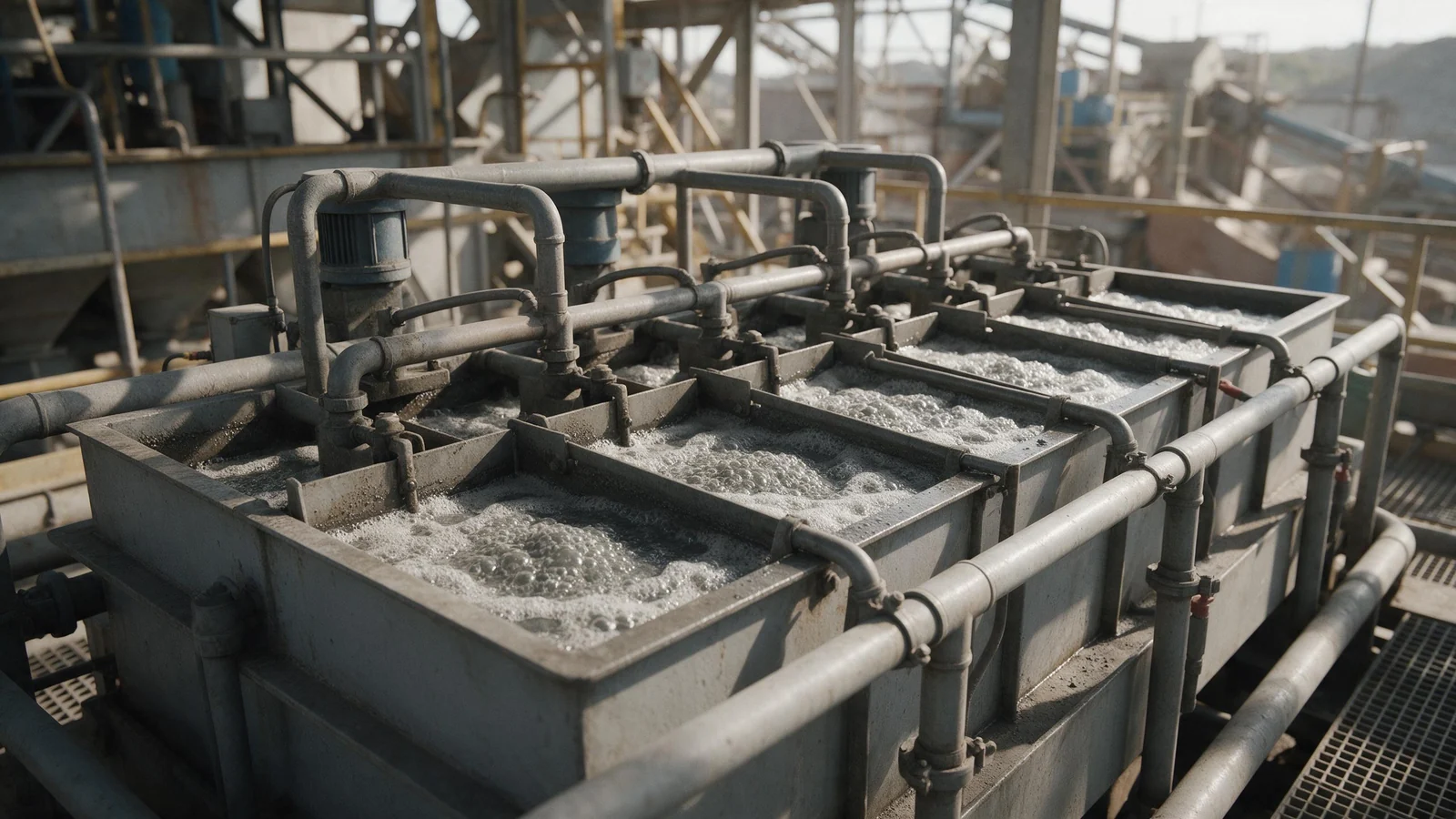
Antimony Ore Processing: Flotation and Gravity
Antimony ore processing is a sequence of decisions, not a single machine purchase.
Header image: illustrative, not a photograph of a specific project.
Say a mine owner rings up and asks how to start antimony ore processing on a stibnite deposit. The honest answer is not "buy a flotation cell". It's a sequence: characterise the ore, reject waste early, concentrate by gravity where the crystals are coarse, and use flotation for the fine sulphide. That sequence changes with every deposit. You can't skip the testing.
Antimony Ore Types and What They Mean for Processing
Stibnite, antimony trisulphide Sb₂S₃, is the main ore mineral. Grey, metallic, soft. It floats well with a simple xanthate collector. That's why flotation dominates. But not every antimony deposit is clean stibnite. Cervantite and stibiconite are oxide minerals. They don't respond to xanthate the same way. Oxide antimony often needs gravity separation or a different reagent scheme, and recovery drops. So the first question is mineralogy, not machinery. Would you design a plant without knowing the mineral? No.
Complex ores are common. Arsenopyrite and pyrite ride along, and gold can hide in the sulphide lattice. Lead-antimony sulphosalts add another complication. A flowsheet that works on clean stibnite will fail on a dirty ore. You need to know what you're dealing with before choosing hand sorting, gravity, or flotation. In 2024, no marketable antimony was mined in the United States, according to the U.S. Geological Survey. That single fact drives many project decisions: if a deposit is remote, the owner must plan for imported supplies and off-take. It's a supply chain problem, not just a metallurgical one.
In 2023, U.S. net import reliance for antimony was 82% of apparent consumption, according to the U.S. Geological Survey.
Hand Sorting and Coarse Pre-Concentration
Hand sorting still matters for coarse crystalline stibnite. Miners pick high-grade lumps by colour, lustre, and crystal form. It's simple. Cheap too. In many small operations it removes half the waste before grinding. You don't need a metallurgist to do it, but you need visible stibnite. Fine grained ore? Hand sorting does nothing. Then you move to gravity or flotation.
For a plant, hand sorting can be mechanised with optical sorters or X-ray transmission machines. Those sensors replace the human eye. The goal stays the same: reject barren rock early, cut grinding energy, and raise feed grade to the concentrator. A pre-concentration step can turn an uneconomic deposit into a workable one, especially where stibnite occurs as discrete veins. Think of it as free money before you spend a cent on grinding.
Gravity Separation for Antimony
Stibnite has a specific gravity around 4.6. Gangue minerals like quartz sit near 2.65. That density contrast is enough for jigs and shaking tables. Gravity separation works best on liberated particles above 1 mm or so, though tables can go finer with careful operation. You won't get a final concentrate with gravity alone, but you can produce a pre-concentrate that reduces flotation feed tonnage. Less tonnage means smaller downstream kit.
Jigs handle coarse feed. Tables handle finer feed. For a low-grade oxide antimony ore, gravity often removes half the mass while keeping most of the antimony. Then flotation only sees a smaller, richer stream. That's sound engineering. You'd be mad not to consider it.
Flotation: The Core Antimony Concentration Route
Flotation is the workhorse for fine-grained stibnite. You grind to liberate the sulphide, add a collector like xanthate, and float the antimony away from quartz and calcite. Activators like lead nitrate can improve stibnite recovery when the surface is oxidised. Frothers build a stable froth. The reagent scheme is simple compared with copper or lead-zinc flotation. A competent mill operator can tune it in a day.
Oxide antimony minerals are another story. Cervantite and stibiconite do not float well with xanthate. They may need flotation with a different collector after sulphidisation, or they may go straight to gravity. Oxide ores almost always recover less antimony than sulphide ores. Wait for the lab tests before you promise a number. Promising 90% recovery on an oxide ore is a good way to lose your shirt.
One common mistake is designing a flotation circuit for stibnite and ignoring the arsenic. Arsenopyrite floats with the same collectors. If arsenic is present, you may need pre-aeration, elevated pH, or a selective depressant. Smelters penalise arsenic. Sometimes the penalty is bigger than the antimony credit. Have you checked your arsenic levels lately?
| Method | Best for | Typical particle size | Role | Key limitation |
|---|---|---|---|---|
| Hand sorting | Coarse crystalline stibnite in veins | Above 20 mm (hand) or 10 mm (sensor) | Pre-concentration | Needs visible mineral; labour intensive for hand sorting |
| Gravity (jigs, tables) | Liberated stibnite, oxide ores | 0.1 mm to 25 mm depending on machine | Pre-concentration or roughing | Poor for fine grained sulphide; middlings need further treatment |
| Flotation | Fine grained stibnite, complex sulphide ores | Below 0.5 mm typical feed | Primary concentration | Struggles on oxide antimony; arsenic control needed |
Gold and By-Product Recovery in Antimony Processing
Gold in an antimony ore often out-values the antimony itself. Imagine a stibnite concentrate running 60% antimony and 30 grams per tonne gold. The gold may be worth more than the antimony. If the flowsheet is designed only for antimony recovery, the gold may be lost to tailings or locked in an unsaleable concentrate. You have to design for total value. It's not just about the antimony.
Flotation concentrates from antimony-gold ores typically go to a specialist smelter. The smelter recovers both metals. For that reason, concentrate grade and impurity levels matter as much as recovery. Before you build a plant, ask the smelter what they will accept. Then work backwards to the flowsheet. Your smelter contract will dictate your reagent scheme more than any textbook.
From Testwork to Flowsheet: What to Ask Before You Build
Every antimony flowsheet should start with mineralogical identification. XRD, QEMSCAN, or a polished section will tell you whether the antimony is stibnite, oxide, or a mix. Skip that and you're guessing. Then run laboratory flotation and gravity tests. Pilot testing matters if the ore is complex or the grade is low. A metallurgical testwork programme answers three questions: what recovery can you expect, what reagent scheme works, and what impurity levels will the concentrate carry.
Before you commit to a contractor, ask for proof. Ask to see the mineralogy report. Ask for locked-cycle flotation results, not open-circuit rougher numbers. Ask what happens to arsenic and gold. If the answer is a generic stibnite flowsheet copied from another deposit, walk away. A complex antimony ore is not a commodity. Would you buy a car without a test drive?
Xinhai's mining research institute operates a CNAS-accredited laboratory covering 70+ ore types and performs about 5,000 elemental analyses per month, according to the company's published figures. That kind of facility is what you should look for in a testwork provider, whether you use Xinhai or another lab. See the mineral processing test services for what a full programme includes.
Antimony Processing Plant Equipment and Layout
The front end is standard: crushing, grinding, classification. A jaw crusher feeds a cone crusher, then a ball mill in closed circuit with a hydrocyclone. The target grind depends on liberation. For stibnite flotation, you often grind to 80% passing 150 micrometres, but fine grained ore may need 45 micrometres. Mineralogy decides. Not the equipment salesman.
The concentration core depends on the ore. A typical sulphide plant uses flotation cells as roughing, cleaning, and scavenging stages. A coarser deposit may use jigs or shaking tables before flotation. Dewatering follows with thickeners and filters. Tailings go to a conventional storage facility or underground backfill. For a remote site, a modular plant can reduce site work and speed up construction. See the notes on modular mineral processing plants.
Xinhai has an intelligent equipment research institute with a 110,000 m² plant area and can supply complete main and auxiliary equipment for mines below 50,000 t/d. That scale covers most antimony operations, because few antimony mines process more than a few thousand tonnes per day. Equipment selection, however, must follow the testwork, not the catalogue. Before you commit, ask for the mineralogy report and the locked-cycle results. If a contractor can't produce them, find one who can. You can reach out through the contact page for a discussion of your ore.
Frequently asked questions
Where does the U.S. get its antimony?
The United States has no domestic mine production. In 2024, no marketable antimony was mined in the U.S., according to the U.S. Geological Survey. Primary antimony metal and oxide came from one company in Montana using imported feedstock. Secondary antimony came from recycled lead-acid batteries. In 2023, net import reliance for antimony in the United States was 82% of apparent consumption, per the U.S. Geological Survey.
What is antimony used for?
Antimony's main uses in the United States in 2024 were metal products including antimonial lead and ammunition, 40%; flame retardants, 39%; and nonmetal products including ceramics, glass and rubber, 21%. It's a minor metal with critical defence and safety applications.
How is antimony ore processed?
Processing depends on ore type. Sulphide antimony (stibnite) is typically concentrated by flotation after crushing and grinding. Coarse crystalline ore may be hand sorted or gravity separated to reject waste early. Oxide antimony minerals often require gravity separation or special flotation after sulphidisation because they float poorly with standard collectors. The final concentrate goes to a smelter.
What is stibnite?
Stibnite is antimony trisulphide, Sb₂S₃. It is the most important antimony ore mineral. It has a metallic grey colour, softness, and often forms needle-like crystals. It floats readily with xanthate collectors, which makes it the main target in flotation plants.
Request a proposal for your ore
What to send for a useful reply
- Head assays and, if you have them, a phase or mineralogy report
- Target throughput in t/d and the product you want to sell
- Project stage: exploration, feasibility, financing or expansion
- Site basics: country, power, water and access
Not ready to share data yet? Read the EPC turnkey delivery page first.