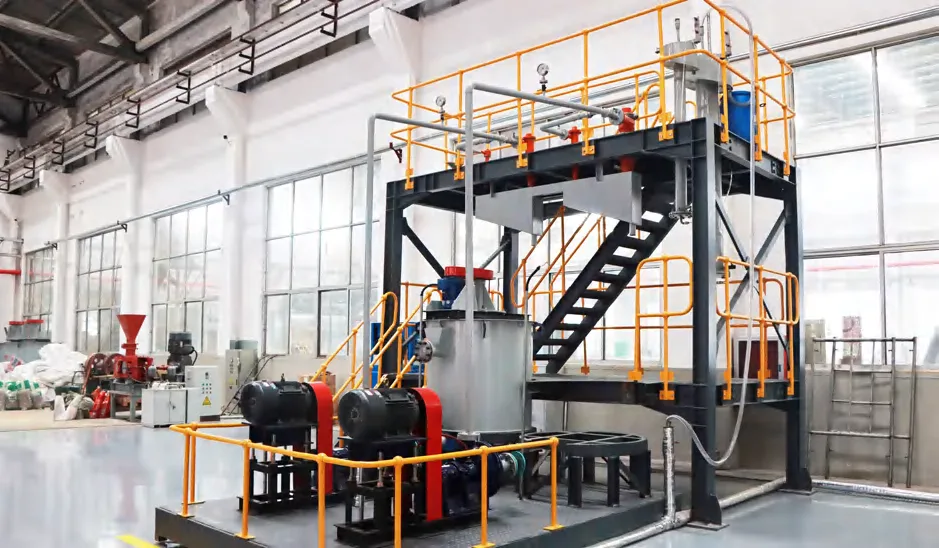
Silica Sand Washing Plant Cost: Scope and Drivers
What you pay for a silica sand washing plant is a function of what you feed it and what grade you need, not a single fixed number.
Say a mine owner asks, "What will a silica sand washing plant cost?" It's a fair question. The honest answer starts with scope, not a number. A silica sand washing plant cost is driven by feed material, target product grade, water availability, and delivery model. You'll see proposals for a small modular unit treating easy dune sand and a full quartz purification line for glass or photovoltaic feedstock. They are not the same thing. Don't compare them as if they were.
What Drives Silica Sand Washing Plant Cost
Start with the feed. Clay content, particle size distribution, iron and impurity levels all change the process. A sand with heavy clay needs aggressive attrition scrubbing and desliming. A clean dune sand may need only classification and dewatering. The harder the feed, the more wear you'll see on pumps, pipes, and screens. These are cost drivers, not abstract design points.
Product grade is the next lever. Construction sand tolerates more iron and alumina. Foundry sand demands tight grain shape and low clay. Glass sand needs high silica content and low iron. High-purity quartz for electronics or photovoltaics can require flotation, acid leaching, and a dust-free environment. Each step adds capital and operating cost.
Capacity matters, but not linearly. A 50 t/h plant shares many fixed costs with a 20 t/h plant: feed hopper, control system, water tank, electrical switchgear. Modular plants can start small and add modules later, which changes how you think about initial versus lifecycle cost. The modular mineral processing plant page explains the trade-off.
Water availability shapes everything. In a dry region, recycling is not optional. You'll need thickeners, dewatering screens, and a clean water return. That's capital and power. In a wet region, discharge permits may still force recycling. So water is both an environmental and a cost variable.
Silica Sand Washing Process Stages and Equipment
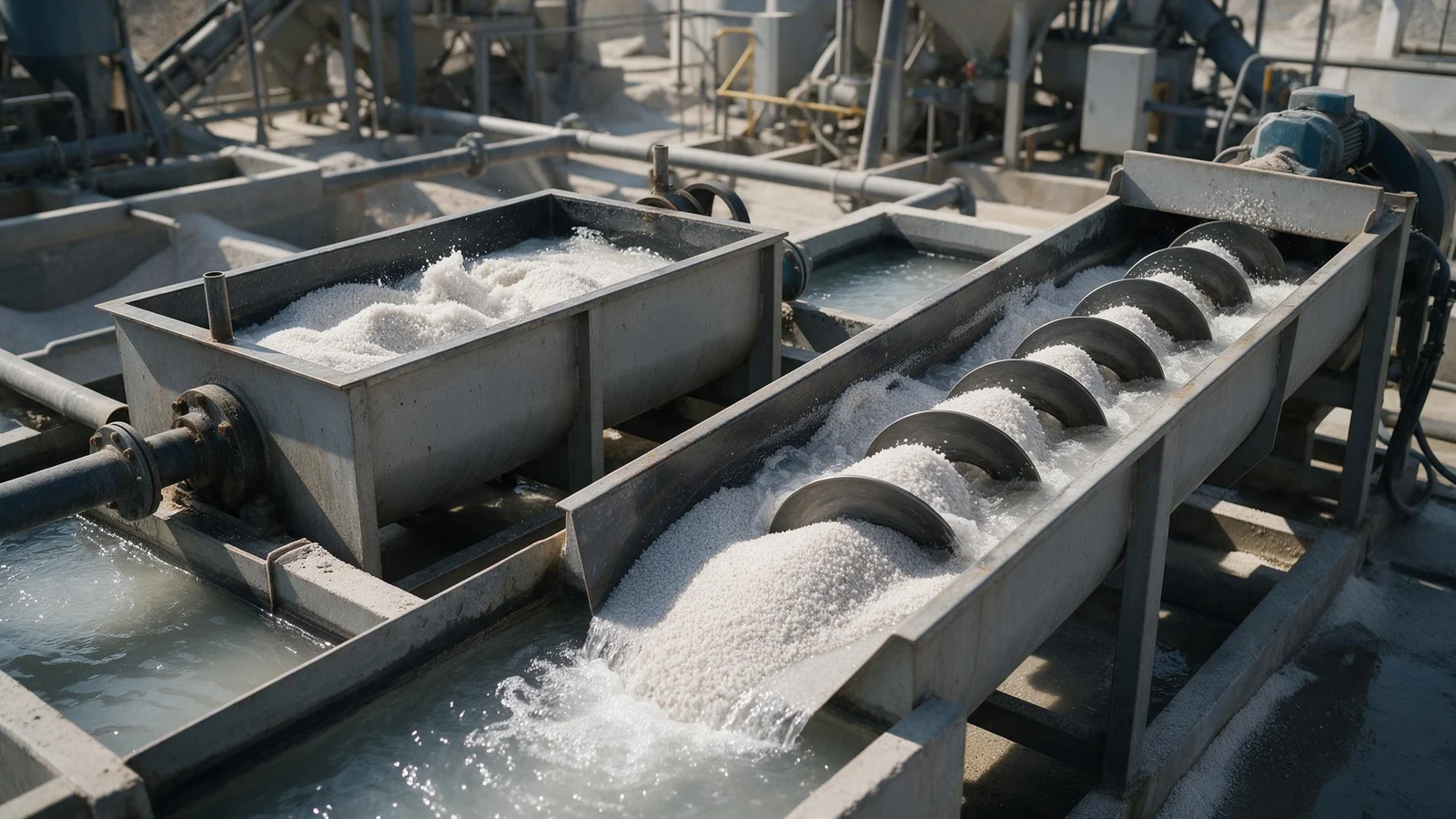
A silica sand washing plant is a sequence of physical separation steps. You're not just washing; you're removing clays, fine slimes, iron minerals, and sometimes heavy minerals. The first stage is feed preparation. If the sand comes from a quarry or a weathered deposit, it'll arrive with lumps and clay. An attrition scrubber rubs particles against each other to break surface coatings. A rotary scrubber handles larger lumps. This stage is power-hungry, and the liner wear is real.
After scrubbing, you need to remove the clay and slimes. A hydrocyclone does the heavy lifting, using centrifugal force to throw coarse sand outward while fine clay reports to the overflow. Hydraulic classifiers and spiral classifiers can do similar work with different footprints and water use. Desliming is cheap to operate but expensive to get wrong. If slimes remain, they'll blind screens and reduce product quality.
Iron is the enemy for glass and foundry sands. A wet high-intensity magnetic separator, or a high-gradient separator for finer material, pulls weakly magnetic iron minerals out of the slurry. The cost of this stage depends on the iron content and liberation size. Fine-grained iron locked in quartz requires higher field strengths and more stages.
Finally, you need a product with the right moisture. Dewatering screens, hydrocyclones, and sometimes a thickener or filter press remove water. That water returns to the process after settling or filtration. Without a water recovery circuit, your OPEX will climb and your permit will be harder to get. More on that below.
Why Metallurgical Testwork Should Come Before the Budget
You can't size a silica sand washing plant from a brochure. You need to know how your sand responds to each unit operation. That's what metallurgical testwork does. A mineralogy check tells you what minerals are present and locked. A particle size distribution tells you how much fine material needs desliming. A heavy liquid test or magnetic fractionation tells you how much iron you can remove.
Testwork starts small. Exploratory tests map the response to scrubbing, classification, and magnetic separation. Condition tests vary scrubber time, pulp density, reagent dose if flotation is needed, and magnetic field strength. Open-circuit tests show what each stage can do alone. Closed-circuit tests recycle middlings until the circuit reaches equilibrium. The result is a mass balance: how much feed enters, how much product leaves, and what goes to tailings. That mass balance is the basis for equipment sizing and therefore for capital cost.
Skipping testwork doesn't save money; it moves the risk into the plant. You might buy a magnetic separator that is too small, or a thickener that is too large. Over-design wastes capital. Under-design forces expensive retrofits later. Send a representative sample and your water analysis to a lab you trust. You can reach us through the contact page if you want a second technical opinion.
Water Recycling and Tailings Management in the Cost Equation
In most silica sand plants, water is not a one-pass utility. You send it to the process, recover it, and send it back. The more you recycle, the less you pump from the borehole and the less you discharge. That lowers the operating cost if water is metered, and it makes the permit much easier. But recycling has a capital cost: thickeners, dewatering screens, collection sumps, and clean water storage.
Silica sand washing produces a tailings stream, often clay and fine silica. You can thicken it and send it to a tailings storage facility, or dewater it further with a filter press for dry stacking. The choice depends on local regulations, land availability, and water cost. Dry stacking usually costs more upfront but simplifies closure and water recovery. For dry crushing and screening ahead of washing, the US EPA's AP42 document 11.19.2 provides emission factors controlled by stone type, moisture, throughput, and crusher type. You'll need dust control on those dry stages, and that equipment is part of the plant cost. See the EPA crushed stone processing reference for detail.
Purity Upgrades: From Glass Sand to High-Purity Quartz
Construction sand needs almost no upgrading beyond washing and sizing. Foundry sand may need a simple magnetic separation. Glass sand usually needs both magnetic separation and sometimes flotation to remove heavy minerals and iron-bearing particles. High-purity quartz, the stuff used in photovoltaic crucibles and semiconductor applications, is a different animal. You're now chasing parts-per-million levels of iron, aluminium, and other contaminants.
That route adds flotation cells to remove feldspar and mica, acid leaching to dissolve surface iron, and a clean, dust-free handling environment so the product isn't recontaminated after purification. Xinhai reports a 5N quartz purification capability with a dust-free laboratory, suitable for high-end electronic, photovoltaic, and optical glass applications. You can see more on the quartz sand page. Each purification step adds capital equipment, reagent cost, and process control complexity. The jump from 99.5% SiO2 to 99.999% SiO2 is not one extra machine; it's a different plant philosophy.
Different market specifications drive how far you go. ASTM C778, for instance, defines standard sand for cement testing as Ottawa-type silica sand with a white colour and round shape. That standard is not high purity, but it illustrates that even a 'standard sand' has a specification you must hit. Glass and high-purity buyers are far stricter. The ASTM C778 standard gives a useful reference point.
How EPC+M+O Delivery Changes the Cost Picture
A silica sand washing plant can be bought as a set of machines, or as an engineered, procured, constructed, and operated facility. The first quote you get from a machine vendor often covers only equipment ex works. It won't include civil works, piping, electrical, automation, installation, or commissioning. An EPC+M+O contractor, by contrast, takes responsibility for engineering, procurement, construction, mine construction management, and operation management.
That turnkey scope changes the cost picture in two ways. First, you pay one party to manage interfaces. If the pump doesn't match the cyclone, that party fixes it. Second, you can price operation separately as a service, not as a hidden OPEX you'll discover later. Xinhai reports more than 600 mine EPC+M+O projects, according to the company's published figures. That scale shows in standardised modules and repeatable designs, which is what the modular plant page describes. A modular plant can be pre-assembled and tested in a workshop, then shipped and rapidly erected on site. It's not always the cheapest initial purchase, but it often reduces site labour and schedule risk.
Questions to Ask Before You Accept a Plant Quote
Before you accept any quote, ask the supplier what's in it. A cheap number that excludes the water circuit is not cheaper; it's incomplete. Below is a checklist to copy and send to every bidder. It forces apples-to-apples comparison, which is the only comparison that matters.
| Item | What it must include | Why it matters |
|---|---|---|
| Metallurgical testwork | Report on your actual feed sample, not a generic sand | Confirms stage selection and sizing |
| Equipment list | Every pump, screen, cyclone, separator with duty point | Shows what you are actually buying |
| Water circuit | Thickener, dewatering screen, water storage, return pumps | Recycling affects OPEX and permits |
| Tailings handling | Thickening or filtration method, tailings storage plan | Determines closure liability and water recovery |
| Installation scope | Civil works, piping, electrical, automation, commissioning | Ex-works equipment is not a plant |
| Spares and wear parts | Initial liners, screens, pump spares, recommended stock | Wear parts are an ongoing OPEX line |
Ask the supplier whether they've run testwork on your specific feed material. If they haven't, ask why. Ask what product grade the plant is designed to achieve, and ask for the mass balance behind the sizing. These questions separate a real proposal from a parts list.
FAQ
How much does a silica sand washing plant cost?
We don't publish a number here because no responsible engineer can give one without your feed material, target grade, capacity, and water analysis. Ask a supplier for an itemised quote tied to your specific testwork. Any figure offered before testwork is a guess, not an engineering estimate.
What factors influence silica sand washing plant cost?
Feed clay content, particle size distribution, iron content, target product purity, plant capacity, water availability, permitting requirements, and whether you buy equipment ex works or a turnkey EPC+M+O scope. Each of these can shift the cost by a large margin.
How much does silica sand cost per ton?
Silica sand price varies by region, grade, purity, and delivery distance. We do not publish price data. What you should care about is the specification: silica content, iron level, grain shape, and particle size. A high-purity quartz product is a different commodity from construction sand.
What is the operating cost of a silica sand washing plant?
OPEX is dominated by power, water treatment, wear parts, and labour, but the split depends entirely on the process route. A plant with flotation and acid leaching will have reagent costs. A plant with a thickener and filter press will have higher power but lower water costs. Testwork and a mass balance are the only way to estimate it realistically.
Frequently asked questions
How much does a silica sand washing plant cost?
We don't publish a number here because no responsible engineer can give one without your feed material, target grade, capacity, and water analysis. Ask a supplier for an itemised quote tied to your specific testwork. Any figure offered before testwork is a guess, not an engineering estimate.
What factors influence silica sand washing plant cost?
Feed clay content, particle size distribution, iron content, target product purity, plant capacity, water availability, permitting requirements, and whether you buy equipment ex works or a turnkey EPC+M+O scope. Each of these can shift the cost by a large margin.
How much does silica sand cost per ton?
Silica sand price varies by region, grade, purity, and delivery distance. We do not publish price data. What you should care about is the specification: silica content, iron level, grain shape, and particle size. A high-purity quartz product is a different commodity from construction sand.
What is the operating cost of a silica sand washing plant?
OPEX is dominated by power, water treatment, wear parts, and labour, but the split depends entirely on the process route. A plant with flotation and acid leaching will have reagent costs. A plant with a thickener and filter press will have higher power but lower water costs. Testwork and a mass balance are the only way to estimate it realistically.