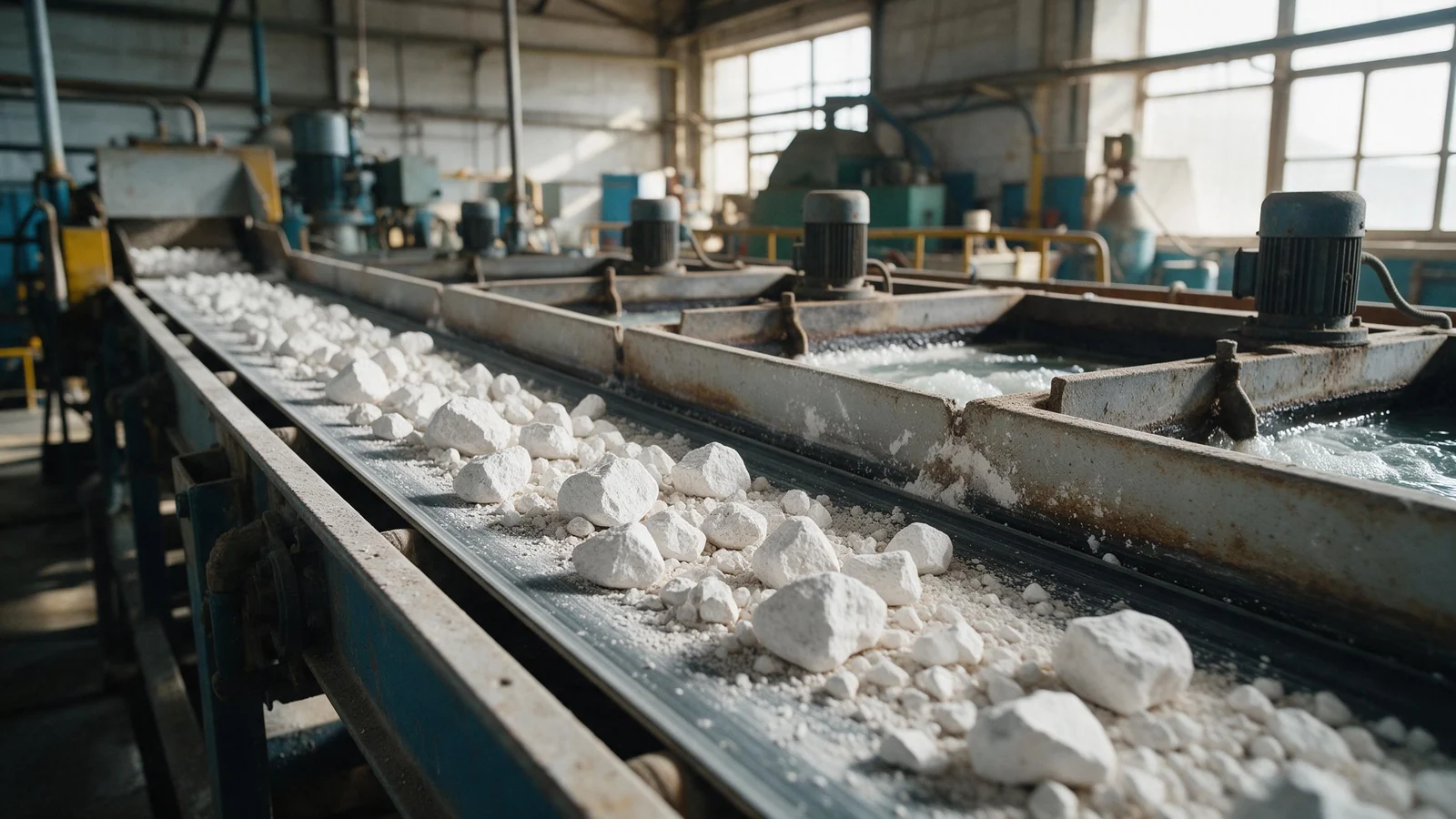
Magnesite Beneficiation: Removing Silica and Calcium
Magnesite beneficiation is a testwork problem before it is an equipment problem.
Header image: illustrative, not a photograph of a specific project.
Say a mine owner asks, 'Which magnesite beneficiation route should I test first?' The honest answer isn't flotation or magnetics. It's mineralogy. You don't have a flowsheet until you know whether the gangue is talc, quartz, serpentine, dolomite or calcite.
Magnesite ore characterization and gangue minerals
Magnesite is magnesium carbonate, but rarely pure. The usual offenders are talc, quartz, serpentine, dolomite and calcite. Talc floats naturally and will follow the magnesite unless you depress it. Quartz is acid insoluble and needs amine removal. Dolomite and calcite are carbonates, so they respond to the same fatty acid collectors as magnesite. The separation becomes a question of surface chemistry, not just density.
That's why a lab programme starts with chemical analysis, mineralogy, particle size distribution and liberation tests. You need to know the MgO grade, CaO and SiO2 levels, and how the impurity minerals are locked. ISO 10058 gives procedures for chemical analysis of magnesite and dolomite products and raw materials. If your sample has high CaO, you'll test for dolomite and calcite. High SiO2 points to quartz or talc. That simple split determines which bench tests come next.
ASTM D 511 - 52 covers the gravimetric determination of calcium ion and magnesium ion after removal of silica, phosphates, iron, aluminum, and manganese.
Flotation routes for magnesite
Flotation is the main separating tool for fine magnesite. Two routes dominate. Reverse flotation floats the siliceous gangue, usually with an amine collector, leaving magnesite in the tailings. Direct flotation floats the magnesite with a fatty acid collector while silicate gangue stays in the cell. Many low grade ores need both: reverse flotation first to remove quartz, then direct flotation to pull magnesite away from carbonates.
Your depressant choice matters more than the collector. Sodium silicate is the workhorse for quartz and silicates. Sodium hexametaphosphate helps disperse slimes and depress carbonate minerals in some circuits. Test them together, not separately. A collector that works in a single mineral test often fails in a mixed slurry. You'll run open circuit tests, then locked cycle tests to see how reagents recycle.
Don't skip the surface chemistry. Magnesite, dolomite and calcite all respond to fatty acids, so selective flotation usually hinges on pH, temperature and depressant dosage. That is testwork territory, not a rule of thumb.
Magnetic separation for iron and weakly magnetic impurities
Iron shows up in two ways: tramp metal from crushers and mills, and iron bearing minerals like magnetite or hematite in the ore. A suspended magnet or drum magnet before flotation protects downstream equipment. Weakly magnetic iron and some iron stained gangue need wet high intensity magnetic separation. Dry magnetic separation works on coarse, liberated material; wet high intensity magnetic separators handle finer particles.
Place magnetic separation before flotation when tramp iron is present. It's cheaper to pull out a lump of mill liner than to deal with it downstream. A magnetic survey will tell you if your ore has enough susceptibility contrast to matter.
Gravity and heavy-medium separation
Gravity works when the magnesite is coarse and the gangue is significantly lighter or heavier. Jigs, shaking tables and heavy medium cyclones all appear in older magnesite plants. But raw magnesite and dolomite or calcite are close in density, so gravity alone rarely achieves saleable grade. Calcination changes the game. Once you heat magnesite to drive off CO2, the resulting magnesia and the remaining gangue respond differently to the thermal step, which can improve density contrast for a subsequent gravity pass.
Heavy suspension separation is useful for coarse fractions, say plus 10 mm, where dense medium separation can pre-concentrate before fine grinding. But it needs a stable feed and good screening. Don't build a heavy medium plant until you have run a sink float test on your own ore.
Thermal processing and calcination to magnesia
Thermal treatment turns magnesite into magnesia and drives off CO2. The temperature selects the product. Caustic calcined magnesia forms around 700 to 1000 degrees Celsius and stays chemically reactive. Dead burned or sintered magnesia forms above about 1800 degrees Celsius and is dense and inert, mainly for refractories. Fused magnesia comes from electric arc furnaces above about 2800 degrees Celsius and has the highest purity and crystal size.
About 78% of magnesium compounds consumed in the United States were used in caustic calcined magnesia, magnesium chloride, magnesium hydroxide and magnesium sulfates across environmental, deicing, chemical and agricultural industries, according to USGS data. The rest, mainly dead burned and fused magnesia, went into refractories. That split drives plant design. If your market is agricultural or water treatment, you'll target caustic product and lower temperature kilns. If your market is steel refractories, you'll need dead burned or fused magnesia and much hotter equipment.
ASTM D605-82(2019) specifies requirements for combined magnesium and calcium silicates content in magnesium silicate pigment (talc).
After calcination, selective crushing and screening can separate some product fractions because impurities often concentrate in certain size classes. But that, too, needs testing.
From beneficiation testwork to EPC plant design
Here's the gap most buyers miss. A beneficiation test is not a flowsheet. It's a starting point. A contractor with an EPC scope will ask for enough sample to run the full sequence: characterisation, grinding work index, flotation batch tests, magnetic tests, and a pilot run if the ore is complex. That lab discipline is what turns a rock into a bankable process.
The EPA's AP-42 Section 11.5 covers refractory manufacturing, which includes processes involving magnesite.
Test data determines mill size, flotation cell volume, magnetic separator type and kiln temperature profile. It also fixes plant layout: reagent storage, product handling and dust collection all follow from the chemistry. A contractor can design to EPC service standards. That matters when you need a plant accepted by lenders or regulators.
Scale up is the risk. A batch test at 1 kg/h is not a 100 t/h plant. You'll need a pilot run to catch froth stability, reagent consumption and wear issues before you commit to long lead equipment.
Selecting the right magnesite beneficiation route
No single route fits every ore. Flotation handles fine, low grade magnesite with silica and carbonate gangue. Magnetic separation is often a pre-step, not a final solution. Gravity works only on coarse, liberated feed or after calcination. Thermal processing is a chemical conversion, not a concentration step. You'll usually combine two or three. That's the essence of beneficiation plant design: it's a sequence of decisions, not a single machine.
| Route | Target impurity | Best suited to | First bench test | Main limit |
|---|---|---|---|---|
| Reverse flotation | Quartz, talc, silicates | Fine feed, high SiO2 | Amine flotation on locked sample | Sliming and reagent cost |
| Direct flotation | Carbonate gangue | Magnesite recovery | Fatty acid flotation with depressants | Selectivity against dolomite |
| Magnetic separation | Tramp iron, magnetite | Pre-concentration | Magnetic susceptibility scan | Weak response to non-magnetic gangue |
| Gravity / heavy medium | Coarse liberated gangue | Coarse fractions | Sink-float or table test | Poor density contrast in raw ore |
| Thermal calcination | CO2, not impurity removal | Product specification | Calcination test at target temperature | High energy, no selective separation |
If your ore has both silica and excess calcium, you're looking at reverse flotation to drop quartz, then direct flotation to separate magnesite from dolomite. Add a magnetic scalper before flotation if tramp iron is present. If your final product is dead burned magnesia for refractories, the calcination step is non negotiable and the preceding beneficiation only has to produce a feed kiln grade.
Ask any supplier for the test report. Not the brochure. If they won't run your sample first, walk away. Then talk to a process engineer, not a sales rep. Contact is where that conversation starts.
Frequently asked questions
What is magnesite used for?
Magnesite is the main raw material for magnesium compounds. Most of it ends up in refractories for steel and cement kilns, while the rest goes into agricultural, environmental and chemical applications. The exact split varies by region, but the thermal processing route determines the product: caustic calcined magnesia for reactive uses, dead burned and fused magnesia for refractories.
Is magnesite hazardous?
Raw magnesite is not generally classified as an acute hazard. Dust from crushing and calcining can irritate the respiratory system, and dead burned magnesia dust requires standard dust control. Mine operators must follow dust, gas, mist and fume survey requirements such as those in MSHA Volume IV for metal and nonmetal mines.
Which country is the largest producer of magnesite in the world?
I don't have a production ranking from the sources I'm allowed to cite here. However, USGS data show that 91% of U.S. crude magnesite imports from 2021 to 2024 came from China, according to USGS. That points to China's dominant supply role, but it is not the same as ranking world mine production. For a buyer, consistent calcined product quality matters more than the country of origin.
What is the difference between caustic calcined magnesia and dead-burned magnesia?
Caustic calcined magnesia, also called light burned magnesia, is produced at roughly 700 to 1000 degrees Celsius. It remains chemically reactive and is used in agriculture, water treatment and chemical processes. Dead burned magnesia is sintered above about 1800 degrees Celsius. It is dense, inert and used mainly in refractories. Fused magnesia from an electric arc furnace above about 2800 degrees Celsius has even higher density and purity. These are process definitions, not product guarantees.
Request a proposal for your ore
What to send for a useful reply
- Head assays and, if you have them, a phase or mineralogy report
- Target throughput in t/d and the product you want to sell
- Project stage: exploration, feasibility, financing or expansion
- Site basics: country, power, water and access
Not ready to share data yet? Read the EPC turnkey delivery page first.