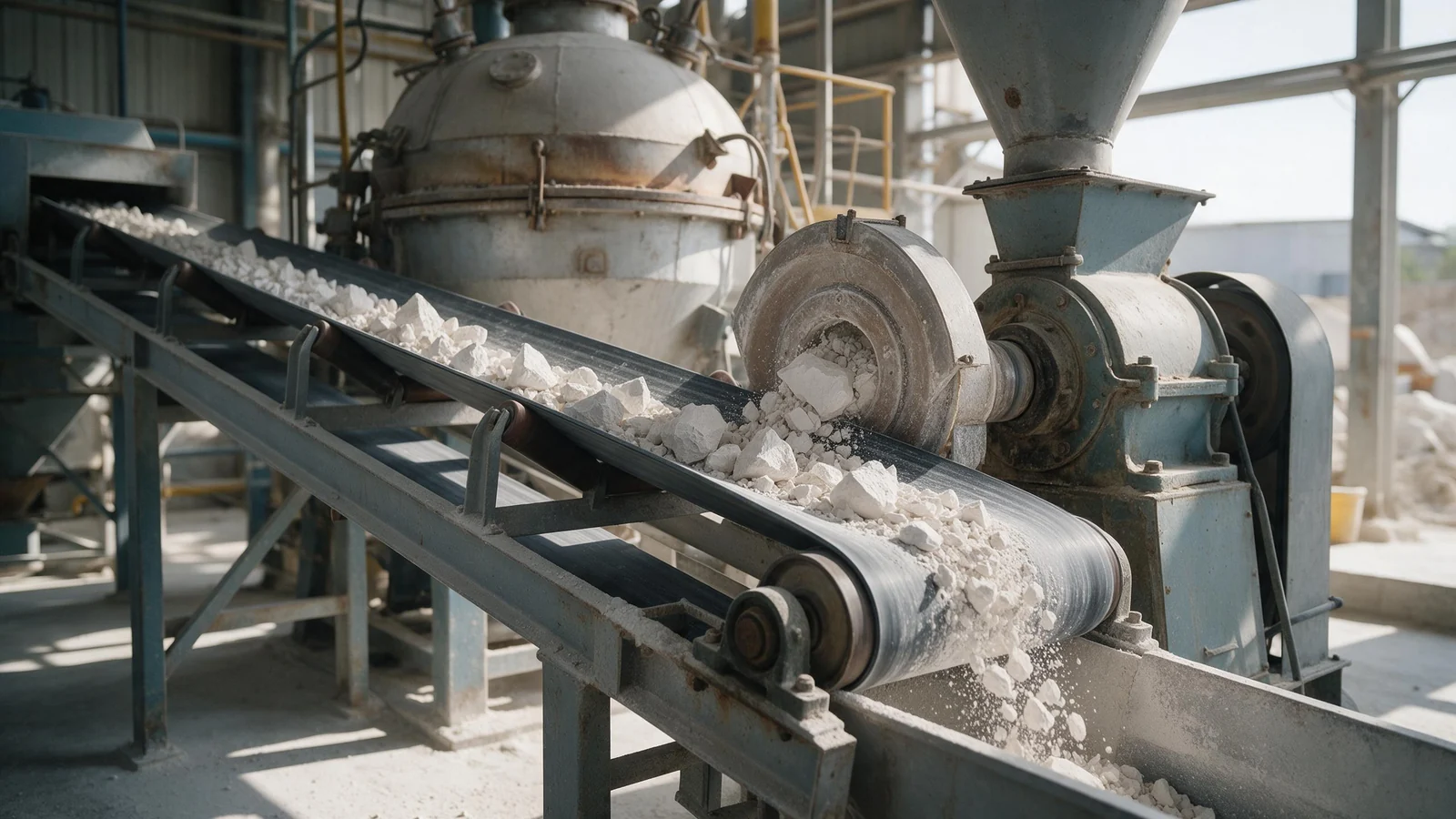
Gypsum Processing Plant: Crushing and Calcining
The flowsheet a gypsum processing plant needs is set by the feed, not by the brochure.
Header image: illustrative, not a photograph of a specific project.
Say a mine owner asks how to set up a gypsum processing plant. The answer starts with the feed, because natural gypsum and synthetic gypsum behave differently in the same kiln. You don't need a universal flowsheet. You need a sequence that matches your rock, your moisture, and your product specification. That's the whole job in one sentence.
So don't buy equipment first. Buy the right testwork first.
Gypsum feedstock: natural rock vs FGD and synthetic gypsum
Natural gypsum is calcium sulfate dihydrate mined as rock. FGD gypsum is the same mineral, but it arrives as a wet by-product from flue-gas desulfurisation at power stations. Synthetic gypsum also includes material from phosphate and citric acid production. The chemistry is similar. The handling is not.
Feed choice changes the first half of the plant. Natural gypsum needs crushing, screening and often drying after outdoor stockpiling. FGD gypsum usually needs dewatering, drying and de-agglomeration before calcination. Purity matters too. Some synthetic gypsum carries soluble salts that shift setting time and cause efflorescence. You'll want a full chemical and mineralogical characterisation before you fix the kiln.
In the United States, the USGS estimated 2025 domestic production of crude gypsum at 20 million tons. That's a large mineral stream, but it moves short distances because gypsum is bulky and low value. U.S. Geological Survey, Mineral Commodity Summaries 2026
| Factor | Natural gypsum rock | FGD / synthetic gypsum |
|---|---|---|
| Form at plant gate | Mined rock, often dusty | Wet cake or dry powder |
| Moisture | Lower if kept dry | Higher, usually needs drying |
| Purity risk | Inert mineral impurities | Soluble salts and trace metals |
| First unit operations | Crushing, screening, drying | Dewatering, drying, lump breaking |
| Calcination response | Predictable if crystal size is uniform | Can vary with particle shape and impurities |
Core gypsum processing flow: crushing, calcining, grinding
If you're processing gypsum rock, the first step is size reduction. A jaw crusher handles the coarse mine feed. A hammer crusher then takes it down to kiln feed size. Screens between stages prevent oversize and protect the downstream equipment. For FGD material, you replace most crushing with drying and lump breaking, but you still need a consistent feed size.
Calcination is where the product is born. Gypsum dihydrate loses part of its chemically bound water and becomes hemihydrate. That's the mineral behind plaster and board. Too much heat makes anhydrite. Too little leaves dihydrate. The calciner's temperature-time profile and the feed's crystal size decide which phases survive. Don't let a supplier sell you a calciner on feed rate alone.
After calcination, most plants grind and classify the hemihydrate. You're targeting a particle size distribution, not just a top size. Fine gypsum sets quickly; coarse gypsum sets slowly. A dynamic separator helps hold that distribution within a narrow band. Then the powder moves to silos for packing or board production. Before you commit to a flowsheet, ask for grindability and calcination testwork. A mineral processing test programme can show whether your rock is fast or slow to calcine.
Key equipment in a gypsum processing plant
Every gypsum processing plant has a short list of critical machines. For natural rock: a jaw crusher, a hammer crusher, screens, and a dryer. For both natural and FGD feed: a rotary kiln or fluidised bed calciner, a grinding mill with air classifier, dosing and mixing units, and bagging or board-forming equipment. These are standard industrial machines. They don't need to be exotic; they need to be matched.
The calciner choice is the main fork. A rotary kiln gives long residence time and suits lumpy, variable feed. A fluidised bed calciner gives fast, even heat transfer and suits fine, homogeneous feed. Neither is objectively better. The decision follows your feed size and your target product consistency. You'll want pilot data from both if your feedstock can swing between natural and synthetic material.
The crusher isn't just a gate. If you feed the hammer mill with too much fine, it packs. If you feed the jaw too little, you waste power. Rock preparation is about steady size.
From gypsum powder to plaster and board products
Plaster is calcined gypsum plus additives. Retarders slow the set. Accelerators speed it. Thickeners, air entrainers and water reducers tune the workability. The exact formulation is a batch recipe, not a flowsheet. You'll lock it after pilot mixing with your own gypsum and your own water.
Gypsum board is a continuous line. The stucco is mixed with water and additives, poured between paper face and back sheets, formed, and then cut. The wet board travels through a multi-deck dryer until it's dry enough to stack. Line speed, board thickness and dryer length set the capacity. Board dimensions follow regional standards, so check the local market before you set line width. ASTM C28/C28M covers four gypsum plasters: gypsum mill-mixed plaster, gypsum neat plaster, gypsum wood fibered plaster, and gypsum gauging plaster. That standard is a useful reference when you're writing a product specification. For plasterboard, ISO 6308:1980 specifies general characteristics and test methods.
Plant capacity, site layout, and cost drivers
Plant capacity should follow your sales volume, not the other way round. In the United States, at the beginning of 2025, gypsum panel manufacturing capacity was about 34 billion square feet per year. Total wallboard sales in 2025 were estimated to be 26 billion square feet. U.S. Geological Survey, Mineral Commodity Summaries 2026 A local plant sized to a regional building market can run near full rate; a large plant serving distant customers often fights freight.
Site layout is simple in concept. Unload raw material at one end. Move it through crushing, calcining, grinding, and packaging in a straight line. Keep the heavy load-out away from the lab. Reserve space for stockpiles and for rejected material. Modular plants make this easier. You can start with one calcining line and add a second when demand proves itself. A modular plant can be configured around your test results without a full custom design.
Cost is not an equipment list. The main drivers are fuel for drying and calcining, electricity for grinding and conveying, feedstock haulage, and the cost of meeting an emissions permit. Transport is the quiet killer. Gypsum is low value per tonne. If your feedstock arrives by truck from 200 km away, the plant often loses before it starts. Locate close to the mine, the FGD source or the market, whichever constraint is tighter.
Environmental controls and waste handling
Gypsum processing produces dust. Crushers, screens, mills and transfer points all need capture hoods and bag filters. A properly designed dedusting system keeps the plant clean and keeps workers out of respirable dust. The AP-42 document includes emission factors for gypsum processing, and it's a practical reference for estimating dust sources.
Calcination can release sulfur oxides if the feed contains pyrite or if the burner is not tuned. Wet scrubbers and dry sorbent injection are the two common capture routes. Which one fits your site depends on your feed sulfur content and the local air permit.
Scrap and off-spec material shouldn't leave the plant. Board scrap is gypsum with paper. After crushing and separating the paper, the gypsum can return to the raw feed. According to the USGS, approximately 700,000 tons per year of gypsum scrap generated by wallboard manufacturing was recycled onsite. U.S. Geological Survey, Mineral Commodity Summaries 2026 That's a useful design target: if your plant can't recycle at least its own off-spec, you're paying twice for the same tonne.
Selecting an EPC partner for a gypsum plant
An EPC contractor should offer more than a drawing set. You need engineering deliverables that include mass balance, process flow diagrams, piping and instrumentation diagrams, equipment specifications, and a commissioning plan. Ask for those before you sign. Procurement is not just buying the cheapest tagged equipment; it's matching each machine to the duty at the guaranteed operating point. Construction and commissioning must be one team, not two hand-offs. Check the contractor's company history and service scope before you sign.
The EPC+M+O model covers engineering, procurement, construction, mine construction management, and mine operation management. That's useful when you want one party accountable through start-up and early operation. Ask any contractor for gypsum-specific testwork and calcination references, and check that the design institute works to recognised reporting standards such as JORC or NI 43-101.
If you're testing a new ore or a variable feedstock, a contractor with its own lab is easier to hold accountable. A contractor with its own lab is easier to hold accountable, because testwork results come from the same organisation that will design and commission the plant. But the honest move is to run a pilot batch of your gypsum before you commit to a full plant. The flowsheet is set by your sample, not by a brochure. When you're ready, use the contact page to start a testwork request.
- Ask for mass balance and P&IDs before contract award.
- Ask for a calcination test on your own gypsum, not a standard sample.
- Ask who commissions the plant and who stays after handover.
- Ask how modular expansion is handled in year two.
- Ask for a named site manager, not just a sales engineer.
Frequently asked questions
Where is gypsum mined in the USA?
According to the U.S. Geological Survey, the leading crude gypsum-producing States in 2025 were estimated to be Iowa, Kansas, Michigan, Nevada, Oklahoma, and Texas. That's based on the Mineral Commodity Summaries 2026. No single deposit dominates; production is spread across several basins.
How much does 1 ton of gypsum cost?
The verified sources used for this page do not publish a spot price per ton. What you pay depends on the grade, purity, moisture, haul distance, and whether you're buying natural rock or synthetic FGD material. Ask suppliers for a delivered price at your plant gate, not a mine gate price.
Who is the largest manufacturer of gypsum board?
The U.S. Geological Survey data cited here does not identify a single largest manufacturer. It reports industry totals, such as about 34 billion square feet per year of U.S. panel capacity and 26 billion square feet of total 2025 wallboard sales. If you need a specific company ranking, ask the trade association that tracks board shipments.
What is the difference between natural gypsum and FGD gypsum?
Natural gypsum is mined rock, mostly calcium sulfate dihydrate. FGD gypsum is a wet by-product from flue-gas desulfurisation at power stations. Both can make plaster and board, but FGD material usually needs dewatering and drying before calcination, and can carry soluble salts that affect setting time. Test both before choosing.
Request a proposal for your ore
What to send for a useful reply
- Head assays and, if you have them, a phase or mineralogy report
- Target throughput in t/d and the product you want to sell
- Project stage: exploration, feasibility, financing or expansion
- Site basics: country, power, water and access
Not ready to share data yet? Read the EPC turnkey delivery page first.