Graphite Beneficiation: Protecting the Flake
Say a mine owner asks why two graphite plants with similar head grades produce concentrates of wildly different value.
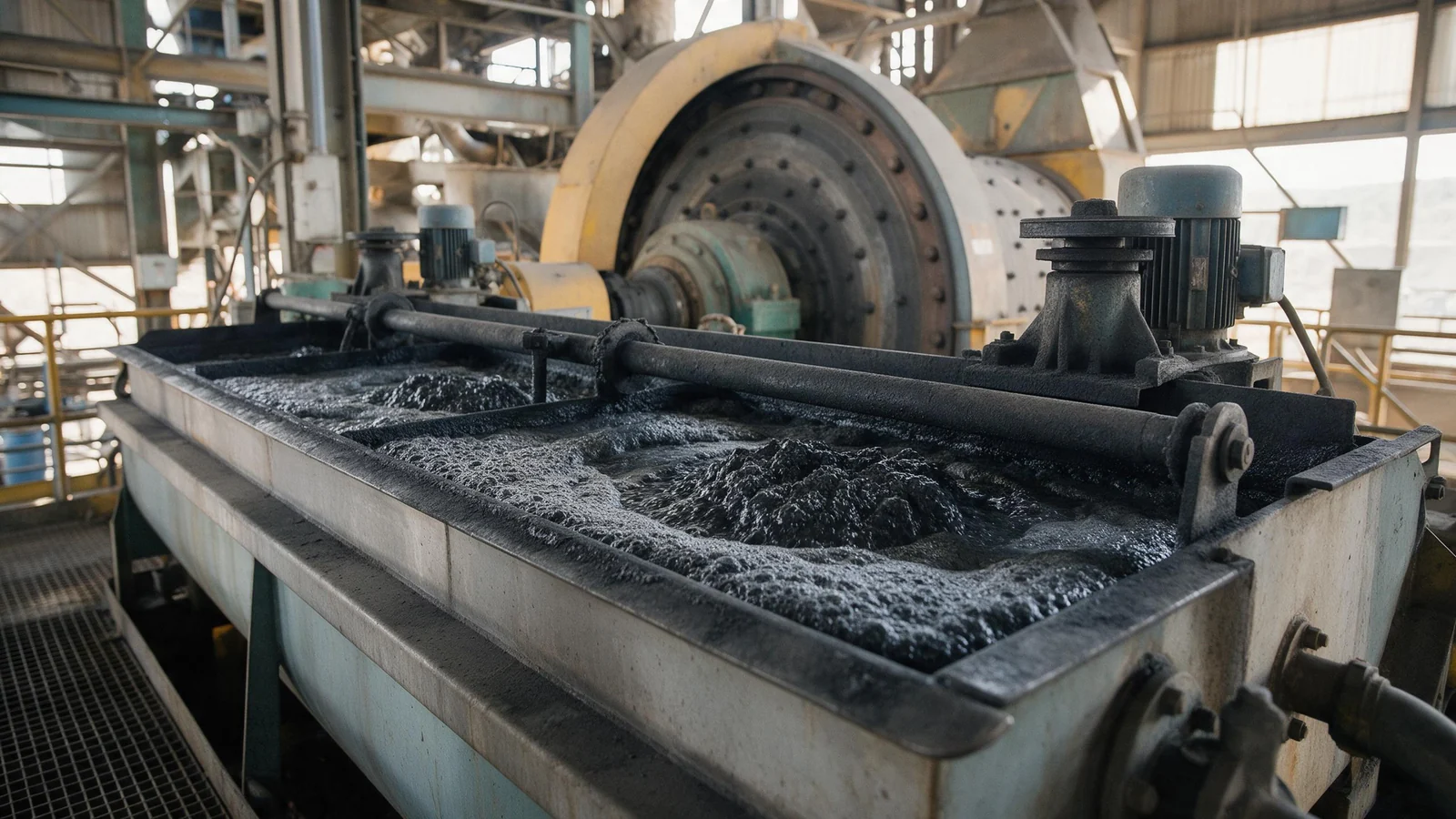
Header image: illustrative, not a photograph of a specific project.
Say a mine owner asks why two graphite plants with similar head grades produce concentrates of wildly different value. The short answer is flake size. Graphite beneficiation is usually misunderstood as a simple grade chase. Natural graphite is not one product. It's flake, amorphous, and vein graphite, and each behaves differently in a concentrator. Flake graphite crystallises as discrete plates. Amorphous graphite, sometimes called cryptocrystalline, is very fine and occurs as a soft black mass. Vein graphite, also called lump, forms in fracture zones and can be extremely coarse.
Your flowsheet should be built around the flake size distribution, because the market pays for size. If you shatter the flakes, you downgrade the ore. You can still hit a carbon grade, but you've destroyed the value. That is why the grinding circuit must liberate without pulverising. The US Geological Survey reports 100% net import reliance for natural graphite in 2024 and again in 2025. That strategic reliance pushes buyers to look hard at recovery and flake preservation, not just grade.
| Graphite type | Occurrence | Value driver | Processing implication |
|---|---|---|---|
| Flake | Disseminated in metamorphic rocks | Flake size distribution | Staged grinding to avoid flake fracture |
| Amorphous (cryptocrystalline) | Fine grained, often in coaly or carbonaceous layers | Carbon content | Can be milled finer without premium loss |
| Vein (lump) | Fracture filling, coarse masses | Purity and lump size | Selective mining may reduce processing |
A deeper look at full-life-cycle mining services shows why flake preservation isn't an afterthought.
Crushing and staged grinding to protect large flake
Primary crushing for flake graphite is about doing the least damage possible. Compression crushers do less harm than impact crushers. You're trying to reduce top size while keeping flakes intact. A jaw or cone crusher followed by screening can do that. The objective at this stage is a feed size fine enough for the first grinding stage, nothing more.
Staged grinding is the standard philosophy. You grind just enough to float any liberated flakes, then you regrind only the stream that still needs liberation. That stream is usually the rougher tailings or a scavenger concentrate. You don't send the whole mill product back for a second grind. You'd shatter the flakes you already freed. The regrind mill does not treat the rougher concentrate, or if it does, only a small portion of it. That is the difference between a plant that makes large flake and one that makes powder.
Fine flake and cryptocrystalline graphite need a different approach. Their value is not tied to flake size, so the grinding intensity can be higher. A cryptocrystalline ore can be milled much finer without destroying the product. That allows a simpler flowsheet with conventional rougher and cleaner flotation, often without the elaborate regrind loops used for large flake.
Flotation circuits for graphite: reagents, stages and middlings
Graphite is naturally hydrophobic. That makes flotation the workhorse. You can float graphite with a simple hydrocarbon collector and a frother. The difficulty is not floating the graphite. The difficulty is floating it cleanly enough and keeping the flake intact. Rougher flotation usually separates graphite from most gangue quickly. But the rougher concentrate is rarely saleable. It contains entrained gangue and composite particles.
Multi-stage cleaning is the answer. A rougher concentrate goes to first cleaner, second cleaner, sometimes a third or fourth cleaner. Each cleaner stage rejects a little more gangue. Middlings, the streams that are neither clean enough nor barren, need a return strategy. Send them back to the previous stage or to a regrind mill, depending on their composite content. Choose the return point carefully. A middling stream with a lot of locked particles should go to regrind, then return to cleaner feed. A middling stream with mostly liberated fine flakes should return to the cleaner bank without regrinding.
Reagent choice matters less than circuit design. A simple methyl isobutyl carbinol or pine oil frother works. A light hydrocarbon collector does the job. The real lever is where you add regrind energy. If you regrind the wrong stream, you'll see lower flake size and lower value, even though the assay looks fine.
Reaching high-purity graphite: polishing and purification routes
Flotation alone gets you to a carbon grade, but it can't reach battery-grade purity. The typical flotation concentrate grade for a saleable product depends on the ore, but flotation is a concentrating step, not a purification step. To go from, say, 90 per cent carbon to a very high purity, you need chemical, thermal or acid purification. These processes remove the impurities that flotation cannot.
Chemical purification usually uses acid leaching to dissolve silicate and carbonate gangue. Thermal purification heats the concentrate to vaporise impurities. Acid routes are common for flake graphite because they preserve flake size better than aggressive thermal cycles. Your choice depends on the impurity minerals, the target market, and the environmental permits you can secure. Do not assume a flotation plant will produce battery-grade graphite without a downstream purification circuit. It won't.
Tailings and water management in graphite beneficiation
Graphite flotation tailings are fine, wet, and often slow to settle. They can be a mix of clay minerals, fine quartz, and unrecovered graphite. These tailings have a high water retention and can be sensitive to remoulding. A tailings storage facility for graphite needs careful slope design and a solid water balance. You'll want a decant system to recover water for the plant. Seepage control matters because fine tailings can move easily if a liner fails.
Xinhai reports a 3,000 t/d graphite tailings storage facility (TSF) design in Tanzania. That is a tailings design, not a processing plant. It tells you that graphite tailings engineering is a distinct discipline. For any project, ask whoever designs your TSF about embankment stability, beach management, and emergency spillway capacity. If they can't explain the water balance, walk away.
From testwork to EPC: scoping a graphite beneficiation project
Before you commit to an EPC contract, you need metallurgical testwork and piloting. A single batch flotation test won't tell you how the plant behaves over a year. You need locked cycle tests, then a pilot run with continuous feeds, and then a flowsheet that fits the ore's variability. That work defines the regrind stages, the cleaner count, and the tailings characteristics. It also stops you from buying equipment you don't need.
Ask a contractor these questions:
- What locked cycle and pilot test data has your process design used for this specific ore type?
- Where exactly will regrind energy be applied in the circuit, and why there?
- How will you preserve large flake while hitting the commercial carbon grade?
- What TSF data will you require before issuing a construction design?
Then ask about delivery. EPC+M+O services should cover engineering, procurement, construction, and mine management and operation. That integration matters. You want one group accountable for the flowsheet, the equipment, and the start-up. If the design office and the construction team have never spoken, the plant will suffer. Look at real project case studies before you sign. They show how the flowsheet, TSF design, and delivery model fit together.
Graphite plant design data points and performance benchmarks
Grade-recovery trade-offs are the heart of graphite plant design. Pushing recovery higher often means regrinding more, which reduces flake size and market value. Chasing a high flake fraction by coarsening the grind can leave composite particles unliberated, which drops carbon grade. You can't maximise both independently. The right target is a compromise based on your deposit, your market, and your operating costs.
Xinhai's mine design institute holds a Class B metallurgical industry design qualification and states that it designs to JORC, NI 43-101, VALMIN, GB, Eurocodes, US and Australian standards. When you evaluate a graphite project, ask whether the design basis follows a recognised reporting code. That is not a luxury. It's how you compare apples with apples across jurisdictions.
The USGS data remind you why graphite matters. With 100% net import reliance, the pressure to develop domestic and diverse sources won't disappear. A well-designed beneficiation plant that preserves flake size is more than a technical exercise. It's the difference between a project that produces low value powder and one that ships high value flake concentrate into a tight market. If you want to discuss a deposit, contact us.
Frequently asked questions
What is graphite beneficiation and why is it needed?
Graphite beneficiation is the series of physical and chemical steps that separate graphite from its gangue minerals and upgrade its carbon content. Run-of-mine ore is usually too low grade to sell. It needs crushing, grinding, flotation, and sometimes purification. Beneficiation also protects the flake size distribution that determines market value. Without it, a mine would ship a low value bulk material.
Which beneficiation method is most common for graphite ore?
Froth flotation is the most common method. Graphite is naturally hydrophobic, so it attaches to air bubbles and floats away from water-wetted gangue. The circuit usually includes staged grinding, rougher flotation, and multiple cleaning stages. Heavy media separation or gravity separation can help in some deposits before flotation.
How do you protect large graphite flakes during grinding?
Use staged grinding and regrind only the unliberated streams. Avoid sending the whole mill product back through the mill. Compression crushing before grinding helps limit flake breakage. The regrind mill should treat scavenger concentrate or rougher tailings, not the rougher concentrate that already contains free flakes. Monitor flake size distribution after each stage.
What purity can graphite flotation achieve before chemical purification?
Flotation can upgrade graphite to a high carbon grade, but it rarely reaches battery-grade purity on its own. The exact grade depends on ore type, flake size, and the number of cleaning stages. Most producers use acid, thermal or chemical purification after flotation to remove residual silicate or carbonate impurities and meet battery specifications.
Request a proposal for your ore
What to send for a useful reply
- Head assays and, if you have them, a phase or mineralogy report
- Target throughput in t/d and the product you want to sell
- Project stage: exploration, feasibility, financing or expansion
- Site basics: country, power, water and access
Not ready to share data yet? Read the EPC turnkey delivery page first.