CIP vs CIL: Choosing the Right Project Circuit
CIP and CIL both put gold onto carbon, but they stage the chemistry differently.
Say a mine owner asks, 'Which circuit should I put in the bankable study, CIP or CIL?' That's the moment the CIP vs CIL discussion stops being theory. It becomes a question of tankage, carbon movement and who runs the plant day to day. You're not comparing two chemicals. You're comparing two operating philosophies.
Let's get the sequence straight first
In CIP, the cyanide leach and the carbon contact happen in separate vessel groups. Gold is dissolved first in a leach train. Only then does the slurry meet activated carbon in dedicated adsorption tanks. In CIL, the carbon goes straight into the leach tanks, so dissolution and adsorption happen at the same time. Both are agitated cyanidation circuits that recover gold onto activated carbon before elution and electrowinning. You'll see the same downstream steps in either circuit. The difference is where the carbon sits.
Say a bottle roll test shows a slow tail
Plot the leach curve. If the gold dissolves quickly, CIP might be fine because you can size the leach train for that fast front end. If the tail is long, CIL's continuous carbon sink becomes more attractive. That's a kinetics signal, not a grade problem. CIL often handles slow kinetics better because the activated carbon pulls dissolved gold out of solution continuously. That keeps the dissolved gold concentration low, which maintains the driving force for leaching. If the ore also contains preg-robbing carbonaceous matter, CIL's early carbon contact competes for the dissolved gold before that natural carbon can re-adsorb it. Well, at least it competes earlier. When copper or other easily cyanided metals are present, they consume cyanide. A shorter solution residence time in CIL can reduce that loss mechanism, though you'll still need reagent management. Ask for a carbonaceous matter assay and a preg-robbing test. The classical method is to contact a known gold solution with the ore and measure how much gold disappears. A high preg-robbing index favours CIL. For cyanide consumers, run a bottle roll with cyanide and lime, then plot residual NaCN over time. If the residual concentration falls steeply in the first hour, you'll have a reagent supply problem in either circuit, but CIL's shorter solution residence time can limit the exposure window. If you don't have internal testwork, Xinhai reports a CNAS-accredited laboratory covering 70+ ore types, which can run the kinetics and preg-robbing assays that feed this decision. Typical cyanide concentrations used in leaching range from 300 to 500 mg/l (0.03 to 0.05% as NaCN) depending on ore mineralogy, according to Cyanide Facts.
Tank sizing is where the flowsheet gets physical
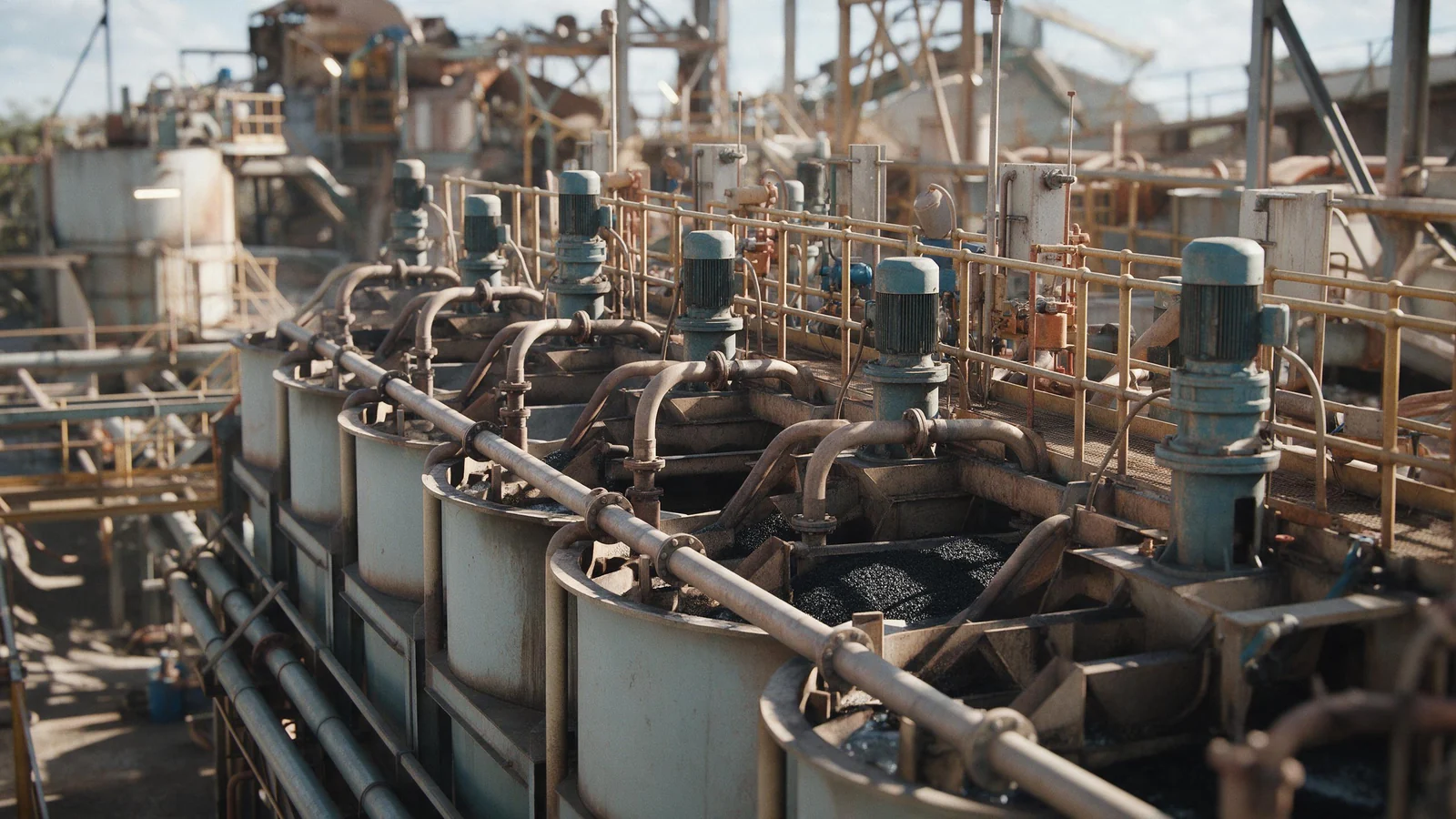
CIP typically uses dedicated leach tanks plus dedicated adsorption tanks. CIL integrates both duties in one tank series. That changes carbon inventory. CIL generally operates with lower carbon concentration in a larger slurry volume, so carbon transfer volume can be several times that of CIP. CIP can hold more metal inventory on carbon. The metal distribution between carbon and solution also shifts. Don't let anyone hand you a single tank count and call it a comparison. You need slurry flow, target residence time, carbon concentration and the number of adsorption stages. Imagine a plant that moves from four CIL tanks to four leach tanks plus four adsorption tanks. The carbon transfer pumps change from moving carbon in slurry to moving carbon countercurrent through a dedicated train. That's a real operating change, not a paper exercise.
| Parameter | CIP | CIL |
|---|---|---|
| Leaching and adsorption | Separate vessel groups, gold dissolved first, then carbon contact | Same tank series, carbon present during leaching |
| Carbon concentration | Higher in a smaller dedicated adsorption stage | Lower in a larger slurry volume |
| Carbon transfer volume | Smaller per unit of gold recovered | Can be several times that of CIP |
| Metal inventory on carbon | Can hold more metal per mass of carbon | Metal is distributed across a larger carbon inventory |
| Process control | Separate leach and adsorption sampling points | Tighter integrated control needed |
| Retrofit onto existing leach plant | Easier, add adsorption tanks | More difficult, requires integrated tankage |
Use it as a first cut, not a final design.
Capital cost is not the first question to answer
CIL can reduce total tank volume and plant footprint for new projects because leaching and adsorption share the same vessels. CIP may be easier to retrofit onto an existing leach plant by adding adsorption tanks. Neither process is universally cheaper. The decision depends on ore leachability, carbon loading and reagent consumption, not on a fixed equipment list. If you're comparing quotes, ask for tankage volume, carbon inventory and pumping duty for both options before you look at the bottom line. A low capital cost on paper can turn into a higher operating cost if carbon transfer volume and cyanide consumption aren't modelled together. You can see how this plays out in some project profiles.
Now think about who will run the plant
Under a contract-operation or EPC+M+O model, the choice isn't just technical. CIP separates leach and adsorption control points, so sectional troubleshooting is easier for an operations team. You can isolate a problem in the adsorption train without shutting down the leach. CIL integrates chemistry in one tank series, requiring tighter process control and automation from day one. Xinhai's EPC+M+O model covers engineering, procurement, construction, mine construction management and mine operation management, so the CIP or CIL choice can be carried through design into daily operation. An owner with a small technical team may find CIP more forgiving. A contract operator with good instrumentation may prefer CIL's smaller footprint. Neither choice is wrong per se. When we run a plant under a service contract, we want sampling points that line up with shift handover. CIP gives you a natural break between the leach area and the adsorption area. CIL needs one integrated control philosophy. If the operator is responsible for process performance, CIL's tighter coupling can make it harder to allocate variances. But if the operator is also the designer, that coupling is managed from the start. Learn more about our service model.
Recovery numbers travel badly
Gold CIL recovery can reach 99%, but that's a capability statement, not a guaranteed performance figure. Actual recovery depends on ore type, leach kinetics, cyanide management and carbon circuit design. Gold and silver are often found together in nature, and most processes used to recover one will also recover the other, as described by the US EPA. That matters when you read a recovery claim that only quotes gold. Tie any recovery figure back to the testwork and the flowsheet you actually designed. Don't accept a number that predates the bottle roll.
Copy this checklist before you sign anything
- Run bottle roll or pilot tests for leach kinetics and preg-robbing potential.
- Measure cyanide and lime consumption on representative ore samples.
- Compare total tank volume, carbon inventory and carbon transfer volume for CIP and CIL candidates.
- Model the metal distribution between carbon and solution across the design life.
- Confirm whether the plant will be owner-operated or run under a contract-operation model.
- Ask the supplier to justify the recovery figure with testwork, not a brochure.
That's the quick sort. It won't replace a feasibility study, but it'll stop a bad choice from hiding inside a nice flow diagram.
Frequently asked questions
What is CIL in gold processing?
CIL stands for carbon in leach. Activated carbon is added directly to the cyanide leach tanks, so gold dissolution and carbon adsorption happen at the same time. The loaded carbon then moves to elution and electrowinning.
What does CIP stand for in mining?
CIP stands for carbon in pulp. Gold is leached first in a dedicated train of tanks, then the gold bearing solution is contacted with activated carbon in a separate adsorption train. The carbon is usually kept in a coarser size fraction to allow screening from the pulp.
Which process gives higher gold recovery, CIP or CIL?
Neither process has a fixed recovery advantage. Gold CIL recovery can reach 99%, but that is a capability statement, not a guarantee. Actual recovery depends on ore leachability, preg-robbing, cyanide management and circuit design.
When should you choose CIL instead of CIP for a gold ore body?
Choose CIL when leach kinetics are slow or when the ore contains preg-robbing carbonaceous matter. The early carbon contact in CIL keeps dissolved gold concentration low, which maintains the leaching driving force and competes earlier for gold that might otherwise be re-adsorbed by natural carbon.